17 Hands-On Subtraction Activities for Kids (2026 Guide)
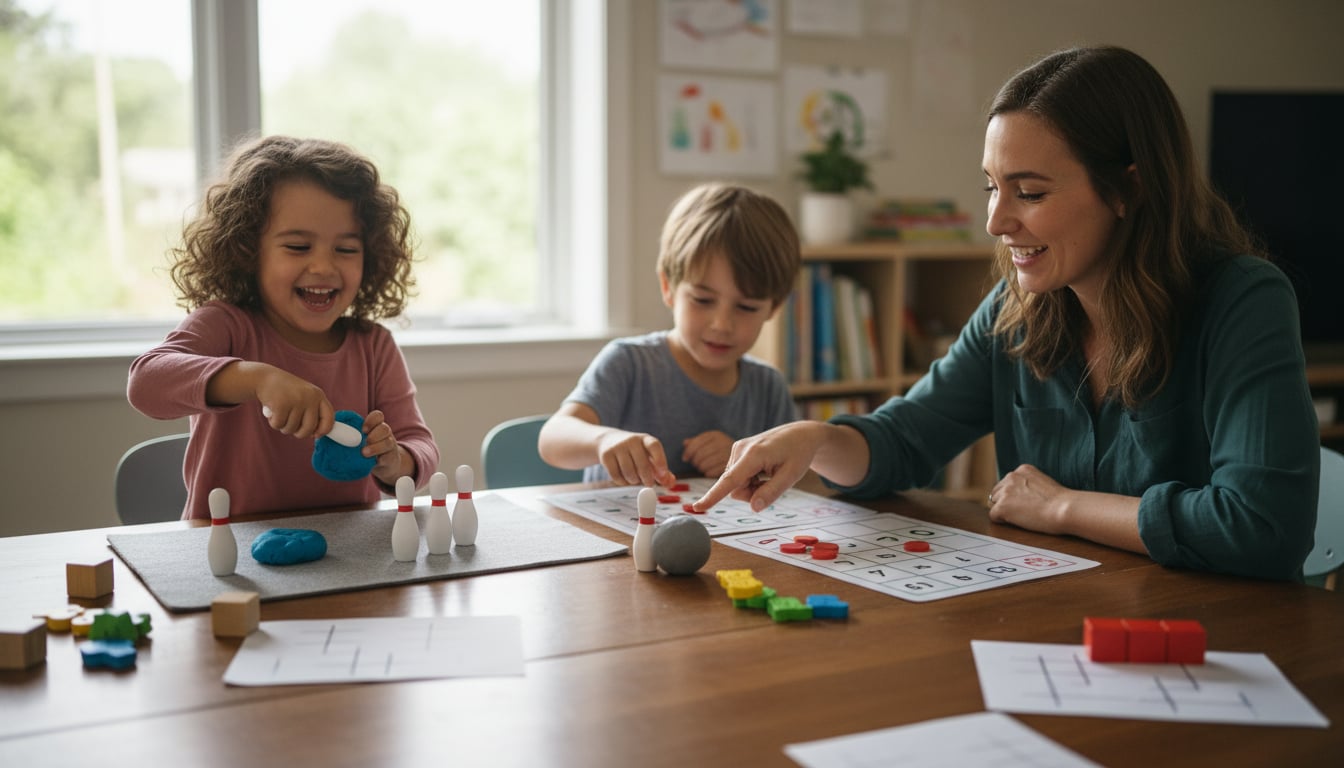
TL;DR
Subtraction clicks when kids move from touching real objects to drawing pictures to writing equations. This guide covers 17 subtraction activities for kids organized by skill level: concrete games like Play Dough Smash and bowling for beginners, visual tools like ten frames and number bonds for building understanding, number-line activities backed by research, and low-pressure card games and sprints for fluency. Each activity includes the grade range, materials, how to run it, common mistakes, and ways to make it easier or harder.
Subtraction is harder than addition for most children. Addition builds on the counting-up pattern kids learn first, but subtraction asks them to reverse that pattern, think about parts and wholes, compare groups, and find missing pieces. That is a lot of mental work for a five- or six-year-old.
Good subtraction activities for kids let them act, build, draw, and talk about the math before anyone hands them a worksheet. Kindergarten standards expect children to represent subtraction with objects, fingers, drawings, acting out, verbal explanations, expressions, or equations (Common Core K.OA). By first grade, students should connect subtraction to unknown-addend problems and build fluency within 10 (Common Core 1.OA). By second grade, the goal is fluency within 20 and solving word problems within 100 (Common Core 2.OA).
The activities below follow what researchers call a concrete-to-representational-to-abstract progression. The What Works Clearinghouse recommends using concrete and semi-concrete representations to support mathematical concepts, then systematically fading toward visual and abstract forms (IES Practice Guide). Think of it as a Subtraction Ladder:
- Act it (bowling, play dough, acting out stories)
- Build it (cubes, counters, base-ten blocks)
- Draw it (ten frames, part-part-whole mats, worksheets)
- Move on a line (number lines, counting up)
- Relate facts (fact families, number bonds)
- Retrieve fluently (card games, bingo, low-stress sprints)
Every activity in this list notes where it sits on that ladder so you can pick the right one for your students.
At-a-Glance Comparison Table
| Activity | Best For | Grades | Prep | Materials | Main Subtraction Idea | Differentiation |
|---|---|---|---|---|---|---|
| Play Dough Smash | Concrete “take away” | Pre-K to K | Low | Play dough, ten-frame mat | Removing part from whole | 5-frame, 10-frame, or 20-frame |
| Subtraction Bowling | Whole-body take-away | K to 1 | Low | Cups or pins, ball | Total minus knocked down | 5 pins or 10 pins |
| Hidden Counters | Missing part / unknown addend | Pre-K to 1 | Low | Counters, cup | “How many are hiding?” | Totals of 5, 10, or 20 |
| LEGO Tower Subtraction | Tactile removal | K to 2 | Low | Linking cubes or LEGO | Break apart a tower | Extend to tens/ones towers |
| Story Problem Theater | Word problems | K to 2 | Low | Students, toys, props | Situation modeling | Take-away, compare, missing-part |
| Part-Part-Whole Mats | Fact families | K to 2 | Low | Mat, counters | Whole and two parts | Add equation writing |
| Ten-Frame Cross-Out | Visual subtraction | K to 1 | Low | Printed ten-frame pages | Cross out to subtract | Within 5, 10, or 20 |
| Custom Worksheets (TeachTools) | Personalized practice | K to 5 | Low | Printed PDF or Google Doc | Any chosen skill | Within 5/10/20, word problems, regrouping |
| Color-by-Subtraction | Independent practice | K to 2 | Low | Printed pages, crayons | Solve and color | Adjust number range |
| Human Number Line | Whole-body movement | K to 2 | Medium | Tape, floor cards | Count back / distance | 0-10, 0-20, open line |
| Desk / Open Number Line | Mental subtraction | 1 to 3 | Low | Laminated line or paper | Flexible jumps | Count back or count up |
| Count-Up-to-Subtract | Finding differences | 1 to 3 | Low | Number line or mental | Distance between numbers | Small or large differences |
| Subtraction Card War | Fact fluency | 1 to 3 | Low | Deck of cards | Quick differences | Remove face cards for beginners |
| Memory Match | Visual retrieval | K to 2 | Medium | Printed cards | Match equation to answer | Use ten-frame picture cards |
| Subtraction Bingo | Review and practice | 1 to 3 | Medium | Boards, counters, cards | Solve and cover | Different boards by level |
| Roll and Race | Repeated practice | K to 2 | Low | Dice, game board | Subtract from 10 or find difference | One die or two dice |
| Classroom Store | Real-world subtraction | 1 to 3 | Medium | Play money, price tags | Change / difference | Whole dollars first, then coins |
How to Choose the Right Subtraction Activity
Not every struggling student needs the same activity. Here is a quick diagnostic:
| If students… | Start with… |
|---|---|
| Don’t understand what “take away” means | Play Dough Smash, Bowling, Story Theater |
| Can add but not subtract | Part-part-whole mats, Hidden Counters |
| Count every object from one each time | Ten frames, Hidden Counters |
| Rely only on fingers past first grade | Number lines, number bonds |
| Freeze on word problems | Story Problem Theater (act it out, draw it) |
| Know the concepts but lack speed | Card War, Bingo, low-stress fluency sprints |
| Struggle with borrowing or regrouping | Base-ten Build-and-Trade (see bonus activity) |
Practitioners on Reddit emphasize going back to basics when subtraction stalls. In one thread about a first grader struggling with subtraction, several teachers recommended using manipulatives, staying within 10, and connecting subtraction to addition through fact families before pushing anything abstract (Reddit r/AskTeachers).
Hands-On Subtraction Activities for Beginners
These activities sit at the bottom of the Subtraction Ladder: act it and build it. They are best for children who need to physically touch, move, and remove objects before pictures or equations make sense.
1. Play Dough Smash
Best for: Introducing “take away” with a concrete, sensory experience.
Grade range: Pre-K to kindergarten
Materials: Play dough and a printed five-frame or ten-frame mat. Cost is minimal.
How it works:
- Students roll play dough into small balls and place them on a ten-frame.
- Draw or read a subtraction card (for example, 10 minus 3).
- Students smash 3 balls flat.
- Count what is left.
- Say it: “10 take away 3 is 7.”
- Write it: 10 - 3 = 7.
Why it works: Children physically destroy part of a set, which makes “taking away” unmistakable. The ten-frame structure keeps counting organized instead of random.
Tradeoffs:
- Can turn into pure sensory play if there is no math talk.
- Messy without clear cleanup routines.
- Only teaches the “take away” meaning, not comparison or missing addend.
Teacher prompt to add: After every round, ask: “What was the whole? What part did you smash? What part is left? Can you show the same problem with an equation?”
A math educator on LinkedIn warned that students can move manipulatives around without the math changing in their heads; the explanation is what matters, not just the action (LinkedIn, Jon Cripwell).
Differentiation: Use a five-frame for numbers within 5, a ten-frame for within 10, or a double ten-frame for within 20.
2. Subtraction Bowling
Best for: Active, whole-body “take away” with a recording sheet.
Grade range: Kindergarten to 1st grade
Materials: 5 or 10 plastic cups (or empty bottles, paper towel tubes) and a soft ball. A recording sheet and pencil for each student.
How it works:
- Set up 10 pins.
- Student rolls the ball and knocks some down.
- Class counts how many fell.
- Write the equation: 10 - 4 = 6.
- Student says the subtraction sentence aloud.
Why it works: The starting amount is visible, the “taken away” amount is on the floor, and the remaining amount is still standing. It is hard to get subtraction wrong when you can see all three parts.
Tradeoffs:
- Noisy, so plan for it.
- Only models “take away,” not comparison or missing part.
- Needs clear turn-taking rules in groups.
Differentiation: Start with 5 pins for younger students. Use 10 for K and 1st grade. For a challenge, ask: “How many would you need to knock down to leave exactly 3 standing?” That flips it into a missing-subtrahend problem.
3. Hidden Counters
Best for: Building part-part-whole thinking and unknown-addend understanding.
Grade range: Pre-K to 1st grade
Materials: Any small counters (buttons, beans, cubes, small toys) and a cup or your hand. Free.
How it works:
- Show 5 counters. Count them together.
- Hide some under a cup.
- Show what is left.
- Ask: “We started with 5. You can see 2. How many am I hiding?”
- Record: 5 - 2 = 3, or 2 + ? = 5.
Why it works: This activity naturally frames subtraction as finding a missing part, which is exactly how Common Core grade 1 defines it: subtraction as an unknown-addend problem. It also builds number bond understanding, which pays off when students encounter fact families.
Tradeoffs:
- Some students guess randomly. Require them to explain: “I know because 2 and 3 make 5.”
- Keep totals small (within 5 or within 10) until students can subitize parts confidently.
4. LEGO or Cube Tower Subtraction
Best for: Tactile learners who need to physically break something apart.
Grade range: Kindergarten to 2nd grade
Materials: Linking cubes, LEGO bricks, or snap cubes. Most classrooms already have these.
How it works:
- Build a tower of 10 cubes.
- Break off 4.
- Count the remaining 6.
- Record 10 - 4 = 6.
Why it works: The whole is visible as a tower. The removed part is in the student’s hand. The remaining part is still standing. All three quantities are concrete at the same time.
Tradeoffs:
- Students sometimes focus on building elaborate structures instead of doing math. Keep towers simple.
- Always pair with math talk: “Which part did you remove? Which part stayed? How do you know?”
Extension: Build two towers of 10 to subtract within 20. Or use “tens towers” and loose ones to begin place-value work that prepares students for regrouping.
5. Story Problem Theater
Best for: Making word problems concrete, especially for ELL students and kids who freeze when they see story problems on paper.
Grade range: Kindergarten to 2nd grade
Materials: Students, stuffed animals, classroom objects, small toys. Free.
How it works:
- Create a real-world situation: “Seven frogs sat on a log. Three jumped into the pond.”
- Students physically act it out with toys or classmates.
- The class draws what happened.
- Students write the equation.
- Ask: “What changed? What stayed? What are we trying to find?”
Why it works: The What Works Clearinghouse recommends deliberate word-problem instruction to deepen mathematical understanding (IES Practice Guide). Acting out the problem builds comprehension before calculation. One parent on Reddit shared that subtraction finally clicked when problems were framed with people and dolls: friends on swings, some leaving, counting who remained (Reddit r/AskTeachers).
Tradeoffs:
- Students can get distracted by the acting. Keep scenarios short.
- Do not teach keyword tricks (“left means subtract,” “more means add”). Those shortcuts break down with comparison problems. Instead, have students describe the situation in their own words and decide what operation makes sense.
Differentiation: Use take-away stories first (“some went away”), then comparison stories (“how many more does A have than B?”), then missing-start stories (“some birds flew away, now there are 4, how many were there before?”).
Visual Subtraction Activities with Ten Frames, Mats, and Worksheets
Explore 26 free AI tools for teachers
Browse All Tools →These activities move up the Subtraction Ladder to “draw it.” Students work with pictures, structured representations, and printed pages rather than (or alongside) physical objects.
1. Part-Part-Whole Mats and Number Bonds
Best for: Connecting subtraction to addition through fact families.
Grade range: Kindergarten to 2nd grade
Materials: A printed part-part-whole mat (a circle at top for the whole, two circles at bottom for parts) plus counters. A number bonds worksheet works well for follow-up practice.
How it works:
- Put 8 counters in the “whole” section.
- Move some into Part A and the rest into Part B.
- Cover one part. Find the missing number.
- Write all related equations: 8 - 3 = 5, 8 - 5 = 3, 3 + 5 = 8, 5 + 3 = 8.
Why it works: Seeing all four related facts at once helps children understand that subtraction is not a separate operation from addition. They are two views of the same relationship. Practitioners on Reddit suggest triangle or number bond flashcards to help children see this connection (Reddit r/AskTeachers).
Tradeoffs:
- Some students memorize the visual layout without grasping the math. Ask them to tell a story for each equation: “If I have 8 cookies and eat 3…”
- Works best when paired with real objects at first, then faded toward just the mat and numbers.
2. Ten-Frame Cross-Out Pages
Best for: Bridging from concrete objects to pictorial subtraction.
Grade range: Kindergarten to 1st grade
Materials: Printed ten-frame pages with dots or pictures, plus a pencil or crayon to cross out.
How it works:
- A ten-frame shows 9 dots.
- The problem says 9 - 4.
- Students cross out 4 dots.
- Count the remaining 5.
- Write the equation.
Why it works: The ten-frame provides structure that random dot pictures lack. Students can see how many are in the top row, how many in the bottom row, and how the total relates to 10. This builds subtraction from 10 as a strategy (“I know 10 - 4 is 6, so 9 - 4 must be 5”). Grab a tens frames activity page to try this right away.
Tradeoffs:
- Can become rote if students always cross out from right to left without thinking.
- Best used after students have done the same problems with physical counters on ten frames.
3. Custom Subtraction Worksheets with TeachTools
Best for: Teachers who need differentiated printables for specific subtraction skills without spending prep time creating them from scratch.
Grade range: Kindergarten to 5th grade (depending on the topic selected)
Materials: A computer and printer. TeachTools is an AI-powered platform with a Worksheet Generator that creates customized, printable worksheets by topic, subject, and grade, with exports to PDF and Google Docs.
What you can generate:
- Subtraction within 5 picture worksheets for pre-K
- Ten-frame subtraction pages for kindergarten
- Subtraction word problems themed around your classroom
- Missing-number equations (14 - ___ = 9)
- Mixed addition and subtraction practice sheets
- Double-digit subtraction with or without regrouping
- Exit tickets and quick checks
Why it works: After a hands-on activity like bowling or play dough, students need a bridge to paper. Generating a custom worksheet that matches the exact skill and number range you just practiced keeps the connection tight. This aligns with the concrete-to-representational-to-abstract progression recommended in math intervention guidance (IES Practice Guide).
Tradeoffs:
- AI-generated content should always be reviewed by the teacher before printing.
- Worksheets should not replace hands-on practice, especially for students still building conceptual understanding.
- Printables work best as follow-up, not as the first introduction to a skill.
The free tier includes 5 generations per month across all tools, and paid plans offer unlimited generation. Try the free worksheet tools here to create a subtraction page for your next lesson.
4. Color-by-Subtraction Puzzle Pages
Best for: Independent seat work or a calm-down center activity.
Grade range: Kindergarten to 2nd grade
Materials: Printed color-by-number pages where each section has a subtraction problem, plus crayons or colored pencils.
How it works:
- Each section of the picture contains a subtraction equation.
- Students solve the equation to find the answer.
- A color key matches each answer to a color.
- Students color the section.
Why it works: The coloring adds motivation for students who resist plain worksheets. The self-checking nature (the picture looks “right” when equations are solved correctly) gives instant feedback.
Tradeoffs:
- Low in math talk. Pair with a partner discussion or have students explain one equation before starting.
- Some students rush through coloring without solving. Require them to write answers in each section first.
Number-Line Subtraction Activities
Number lines are not just a classroom gimmick. The What Works Clearinghouse gives number-line use a strong-evidence recommendation for building mathematical concepts and preparing students for advanced math (IES Practice Guide). In a Reddit discussion about teaching subtraction, educators advised a parent that number lines show what subtraction actually is, scale beyond fingers, and help later with larger numbers and even negative numbers (Reddit r/matheducation).
1. Human Number Line Hop
Best for: Kinesthetic, whole-body subtraction that connects movement to math.
Grade range: Kindergarten to 2nd grade
Materials: Painter’s tape on the floor, large number cards (0 through 10 or 0 through 20), or sidewalk chalk outdoors. Medium setup the first time, quick after that.
How it works:
- Create a number line on the floor.
- A student stands on the starting number.
- For 9 - 4, the student starts at 9 and hops backward 4 times.
- The student lands on 5 and records 9 - 4 = 5.
Why it works: Students feel subtraction as backward movement. This kinesthetic experience sticks.
Common mistake to watch for: Many children count the number they are standing on as the first hop. For 8 - 3, they say “8, 7, 6” and land on 6 instead of 5. Model clearly: “You start on 8. Your first hop takes you to 7. That is hop number 1.”
Tradeoffs:
- Requires floor space.
- Works best in small groups, not with 25 students at once.
- Should eventually fade toward paper number lines and mental strategies.
Differentiation: Beginners count back one hop at a time. Intermediate students use “jump 10, then ones.” Advanced students count up from the smaller number to find the difference.
2. Desk Number Line and Open Number Line
Best for: Students transitioning away from fingers toward flexible mental subtraction.
Grade range: 1st to 3rd grade
Materials: A laminated number line, a ruler, a whiteboard, or blank paper. Low cost and prep.
How it works:
- For basic subtraction, students jump backward along the number line.
- For difference problems, students count up from the smaller number to the larger.
- For double-digit subtraction, students decompose the subtrahend into friendly jumps.
Example: 43 - 18. Start at 43, jump back 10 to 33, jump back 8 to 25. Or count up from 18: add 2 to reach 20, add 20 to reach 40, add 3 to reach 43. The difference is 2 + 20 + 3 = 25.
Why it works: Open number lines support flexible strategy use. A LinkedIn practitioner noted that number lines help learners visualize magnitude and movement, supporting a shift from one-by-one counting to chunking and known facts (LinkedIn, Esme Schmitt).
Tradeoffs:
- Students may draw uneven number lines. That is fine as long as the order and spacing are roughly correct.
- Avoid turning the open number line into a rigid procedure. The whole point is flexible jumps.
3. Count-Up-to-Subtract Challenge
Best for: Teaching subtraction as finding the distance between two numbers.
Grade range: 1st to 3rd grade
Materials: Number line (physical or drawn), whiteboard.
How it works:
- Present a subtraction problem like 15 - 9.
- Instead of counting backward from 15, students start at 9 and count up to 15.
- They track their jumps: 9 + 1 = 10, 10 + 5 = 15. Total jumps: 6.
- So 15 - 9 = 6.
Why it works: Many subtraction problems are easier when thought of as “how far apart are these two numbers?” This is the comparison or distance meaning of subtraction, and it connects directly to addition. Students who struggle with counting backward often find counting up more natural.
Tradeoffs:
- Some students initially resist the idea that counting up can solve a subtraction problem. Use the number line to show visually that the gap between 9 and 15 is the same whether you count up or down.
- Requires explicit instruction; do not assume students will discover this on their own.
Subtraction Games for Fact Fluency
Games belong near the top of the Subtraction Ladder, after students already understand what subtraction means and have strategies for solving. The goal here is repetition without tedium.
A homeschool parent on Reddit asked for subtraction games because their child sighed every time the math curriculum came out. Suggestions included dice-based board games and card games that create repetitions in a playful format (Reddit r/homeschool). That is the right instinct: games add volume to practice without making every repetition feel like a worksheet.
1. Subtraction Card War
Best for: Quick-fire fact fluency with a partner.
Grade range: 1st to 3rd grade
Materials: A standard deck of playing cards (remove face cards for beginners). Free.
How it works:
- Each player flips two cards.
- Subtract the smaller from the larger.
- The player with the greater difference wins the round and keeps all four cards.
- Optional (and recommended): students record each equation on a recording sheet.
Why it works: Card War produces dozens of subtraction problems in 10 minutes without feeling like a drill. Reddit teachers and parents frequently recommend War-style card games for fact practice because they create repetition in a low-pressure format (Reddit r/AskTeachers).
Tradeoffs:
- Can reward speed over accuracy if not managed. Require students to say the full equation before claiming cards.
- Students may subtract in the wrong order (smaller minus larger). For this game, teach “larger minus smaller.” Later, explain that order matters in subtraction generally.
Differentiation: Remove face cards and use Ace as 1 for facts within 10. For a challenge, flip three cards and create a two-digit minus one-digit problem.
2. Memory Match
Best for: Connecting equations to answers or visual representations.
Grade range: Kindergarten to 2nd grade
Materials: Printed cards (equation on one card, answer or ten-frame picture on the matching card). Medium prep, but reusable.
How it works:
- Lay all cards face down.
- Students flip two cards.
- If 9 - 4 matches a card showing 5 (or a ten-frame with 5 dots), the student keeps the pair.
- The student must say the complete equation before keeping the match.
Why it works: The game encourages repeated retrieval in a context that feels like play. Using ten-frame picture cards instead of bare numbers keeps the activity conceptual rather than purely memorization-based.
Tradeoffs:
- Students can memorize card locations without actually solving the math. The “say the fact” rule prevents this.
- Requires prep to print and cut cards, but a set lasts all year.
3. Subtraction Bingo
Best for: Whole-class or small-group review of subtraction facts.
Grade range: 1st to 3rd grade
Materials: Bingo boards with answers, counters or chips, and a set of subtraction equation cards for the caller. Medium prep.
How it works:
- The teacher (or a student caller) reads a subtraction equation: “12 minus 5.”
- Students solve mentally and cover the answer (7) on their board.
- First student to complete a row reads back all the equations for their covered answers.
Why it works: Bingo produces many repetitions in a short time and works for groups of any size. The “read back” rule at the end adds accountability.
Tradeoffs:
- Some students copy their neighbors. Using individual whiteboards for a “solve first, then cover” step prevents this.
- The game element can overshadow the math. Add a recording sheet to keep it productive.
4. Roll and Race Dice Difference
Best for: Fast, random practice with minimal materials.
Grade range: Kindergarten to 2nd grade
Materials: Dice (standard six-sided or ten-sided), a simple game board or recording sheet. Low cost and prep.
How it works:
- Option A: Roll one die and subtract the result from 10.
- Option B: Roll two dice and subtract the smaller number from the larger.
- Option C (for older students): Roll two dice, form a two-digit number, and subtract a one-digit number from it.
Students record each equation and race to fill a recording sheet or reach the end of a game board.
Why it works: Dice add an element of surprise that keeps practice from feeling repetitive. Students get many quick problems in a short session.
Tradeoffs:
- Students may rely on counting the pips on the die forever. After a few weeks, switch to numeral dice to encourage fact retrieval.
- Needs clear rules so students do not race through without actually solving.
Real-World and Advanced Subtraction Activities
1. Classroom Store
Best for: Showing subtraction as a real-world skill (making change, comparing prices, budgeting).
Grade range: 1st to 3rd grade
Materials: Play money, price tags, and small classroom items or pictures of items. Pairs well with a coins and money worksheet for reinforcement.
How it works:
- Give each student a budget (20 cents, 50 cents, or $10).
- Students “buy” an item.
- They calculate how much money they have left.
- They record the equation.
Example: “You have 20 cents. A sticker costs 7 cents. How much is left?” 20 - 7 = 13.
Why it works: Students see subtraction as something real people do every day. The activity also builds money skills and supports word-problem comprehension in context.
Tradeoffs:
- Money adds cognitive load. Start with whole-dollar amounts or same-coin amounts before mixing denominations.
- Not ideal as a first introduction to subtraction. Use this after students already understand taking away.
Differentiation: Whole-dollar amounts for beginners. Mixed coins for on-level. Give a budget and ask students to buy two items and calculate total change for advanced practice.
Bonus: Base-Ten Regrouping Build-and-Trade
Best for: Making “borrowing” visible as regrouping.
Grade range: 2nd to 3rd grade
Materials: Base-ten blocks, bundles of craft sticks, or LEGO tens rods. A place value practice page makes a strong follow-up.
How it works:
Using 32 - 17 as an example:
- Build 32 with 3 tens rods and 2 ones cubes.
- Try to subtract 7 ones. There are only 2 ones available.
- Trade 1 tens rod for 10 ones cubes. Now you have 2 tens and 12 ones.
- Subtract 7 ones (12 - 7 = 5 ones remain) and 1 ten (2 - 1 = 1 ten remains).
- Count what is left: 15.
Why it works: Students see that “borrowing” is actually exchanging one group of ten for ten individual ones. Nothing appears out of thin air. This connects place value to the subtraction algorithm instead of teaching regrouping as a magic trick.
Tradeoffs:
- If introduced too early, students mimic the trades without understanding. Wait until students are comfortable subtracting within 20 without regrouping.
- Always pair with drawings and written equations. The blocks alone do not transfer to paper.
Should Kids Memorize Subtraction Facts?
This question divides teachers, parents, and Reddit threads alike. The answer is not either/or.
Yes, students eventually need automatic recall of subtraction facts. The National Mathematics Advisory Panel states that computational facility rests on automatic recall of addition and related subtraction facts. Without it, students spend mental energy on basic calculations instead of the harder math that comes next.
But memorization should not come first. NCTM defines procedural fluency as applying procedures efficiently, flexibly, and accurately, not just quickly. Facts should be taught through number relationships and reasoning strategies, not simple memorization alone (NCTM Position Statement).
The practical sequence:
- Teach meaning and strategies first (act it out, use objects, draw it).
- Build relationships (fact families, making 10, doubles).
- Then practice for speed and accuracy with low-stress retrieval activities.
For that final stage, a low-stress fluency sprint works well. Choose facts students have already learned. Give 1 to 3 minutes. Students solve as many as they can accurately. They graph their own progress over time instead of competing against classmates. The What Works Clearinghouse supports brief timed activities lasting about 1 to 5 minutes as one component of fluency intervention, but only after students have worked with the concept over many lessons, and never for introducing new material (WWC/ERIC).
A teacher on Reddit described “reverse timed tests” where students time themselves and graph their own completion time, finding it less anxiety-producing while still building automaticity (Reddit r/Teachers). That kind of self-competition avoids the public ranking that causes math anxiety.
If you want to create customized fluency practice sheets or quick exit tickets, compare AI worksheet generators to find a tool that fits your workflow.
Common Subtraction Mistakes and How to Fix Them
Counting the starting number on a number line. For 8 - 3, a student says “8, 7, 6” and lands on 6 instead of 5. Fix: Model that the student starts on 8 and the first hop takes them to 7. Practice with a floor number line where landing spots are clear.
Mixing up the whole and the part. Students write 3 - 8 instead of 8 - 3, or they put the smaller number first in a vertical problem. Fix: Use part-part-whole mats to make the whole visible at the top, always.
Using keyword tricks for word problems. Teaching “left means subtract” and “more means add” fails on comparison problems like “Sara has 5 more stickers than Tom. Tom has 8. How many does Sara have?” Fix: Have students act out or draw the situation and describe what is happening before choosing an operation.
Subtracting smaller digit from larger digit in each column. In 32 - 17, a student writes 25 because they compute 7 - 2 in the ones column and 3 - 1 in the tens column. Fix: Use base-ten blocks to show that you cannot take 7 ones from 2 ones without regrouping. Let students physically trade a ten for ten ones.
Moving manipulatives without explaining. A student pushes counters around and arrives at a correct answer but cannot say how or why. Fix: Require verbal explanations. Use sentence frames: “The whole is ___. I took away ___. The part left is ___.”
The What Works Clearinghouse gives mathematical language a strong-evidence recommendation: teach clear, concise math language and support students’ use of it (IES Practice Guide).
When to Fade Manipulatives
Most articles on subtraction activities for kids stop at “use manipulatives.” But knowing when and how to move past them matters.
Follow this progression:
- Use objects: “Show me 10 cubes. Take away 4.”
- Use drawings: “Draw 10 circles. Cross out 4.”
- Use structured representations: Ten frames, number bonds, number lines.
- Use equations: 10 - 4 = 6.
- Use mental strategies: “10 - 4 is 6 because 4 and 6 make 10.”
The key: do not skip steps. And do not rush. If a student can solve 10 - 4 with cubes but not with a drawing, they are not ready for equations. Go back, connect the cube action to the drawing, then try again.
Don’t shame finger counting, either. Fingers are a starting tool. Educators on Reddit commonly frame fingers as useful but not sufficient for numbers past 10 (Reddit r/matheducation). The goal is to connect fingers to ten frames, number lines, and known facts so students are not limited.
FAQ
What is the easiest way to teach subtraction to kids?
Start with small groups of real objects. Show the whole, physically remove a part, count what is left, then connect the action to a drawing and an equation. Kindergarten standards call for representing subtraction with objects, fingers, drawings, acting out, verbal explanations, expressions, or equations (Common Core K.OA). Activities like Play Dough Smash, Hidden Counters, and Subtraction Bowling make this concrete.
What age do kids learn subtraction?
In Common Core-aligned expectations, kindergarten students (ages 5 to 6) work with addition and subtraction within 10 and build fluency within 5. First graders solve subtraction problems within 20 and develop fluency within 10. Second graders work toward fluency within 20 and solve word problems within 100. Most children begin meaningful subtraction work between ages 4 and 7, depending on readiness.
Why is subtraction harder than addition?
Children learn to count up before they learn to take apart, compare, or find missing pieces. Subtraction requires multiple types of thinking: removing a part, finding what is missing, comparing two groups, and counting backward. Each of these is a different skill, and students need practice with all of them, not just “take away.”
Are fingers okay for subtraction?
Yes, as an early tool. But fingers max out at 10, and students who rely on them exclusively will struggle with larger numbers. Gradually connect finger counting to ten frames, counters, and number lines. The goal is not to ban fingers but to give students additional tools that scale.
Are timed subtraction tests bad?
High-pressure timed tests can cause anxiety and do not measure full fluency. NCTM cautions against timed tests as the sole measure of fluency (NCTM Position Statement). However, brief, low-stakes timed practice (1 to 3 minutes, self-comparison only, facts the student already understands) can build automaticity as one part of a broader approach. The problem is not timing itself, but public ranking and using speed drills before understanding is in place.
How do I help a child who can add but not subtract?
Go back to concrete objects and small numbers. Use Hidden Counters to show that subtraction is really finding the missing part of a group. Connect every subtraction fact to its related addition fact using part-part-whole mats or fact-family triangles. Several teachers on Reddit recommend staying within 10 and using number lines until the concept clicks before moving to larger numbers (Reddit r/AskTeachers).
What subtraction strategies should kids learn?
The main strategies for K through 2 include: counting back, counting up, using related addition facts, making 10 (decomposing), using doubles, and using a number line. First-grade standards specifically mention decomposing to make ten, using the relationship between addition and subtraction, and creating equivalent easier problems (Common Core 1.OA). Teach multiple strategies and let students choose the one that fits the problem.
Where can I find printable subtraction worksheets?
You can generate custom subtraction worksheets matched to the exact skill and number range you need. Choose the topic (subtraction within 10, missing numbers, word problems, regrouping), select a grade level, and export to PDF or Google Docs. For a broader look at worksheet creation options, see this guide to free AI worksheet generators.