Weather Forecast Resources & Guide for Classrooms (2026)
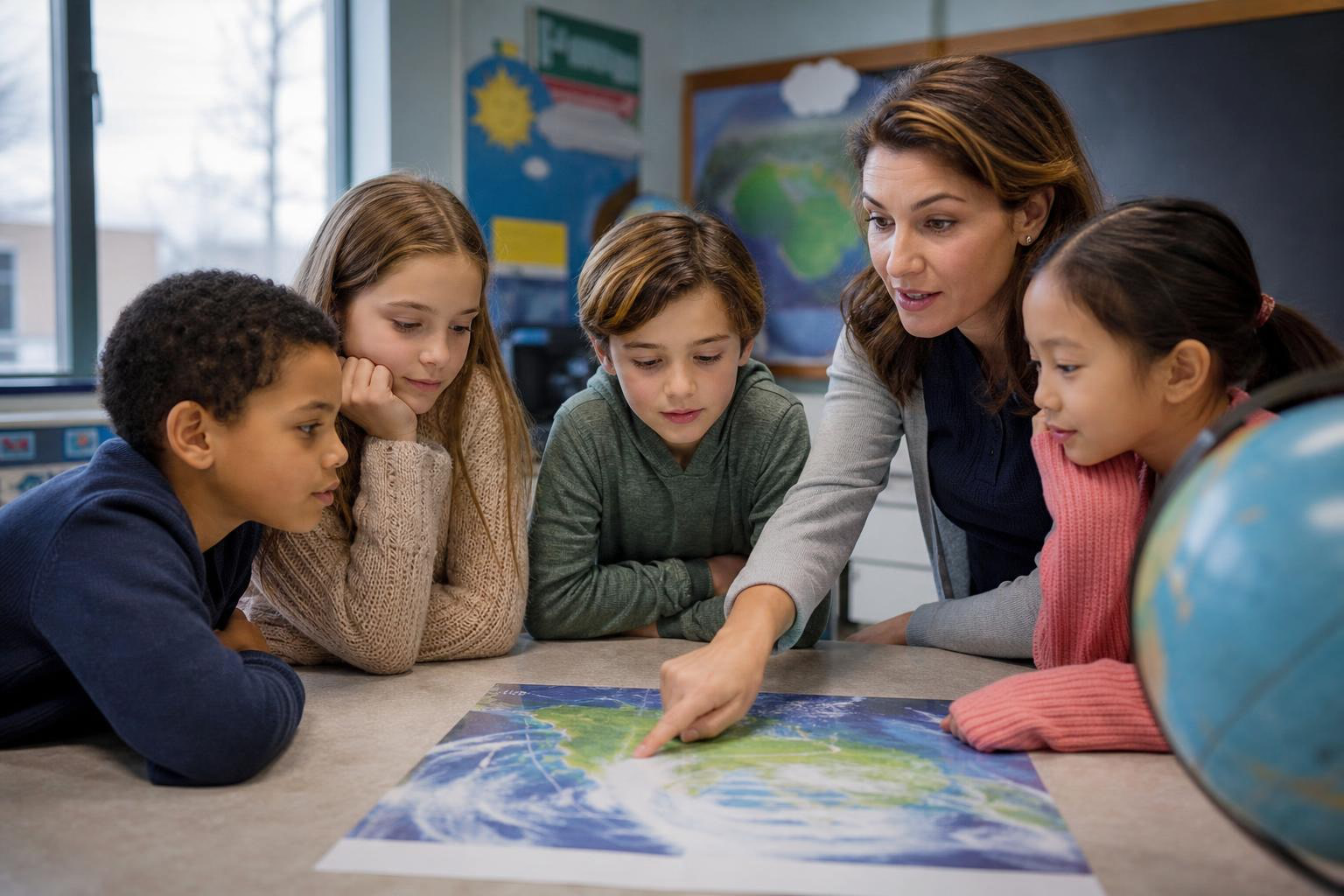
TL;DR: A weather forecast is a scientific prediction of future atmospheric conditions for a specific place and time. Teachers use this concept across multiple NGSS-aligned grade bands, from kindergarten pattern observation through high school climate modeling. This guide covers definitions, forecasting tools, key vocabulary, standards alignment, and classroom activities to help you build a complete weather unit.
Understanding weather is one of the first real science experiences students have. They walk outside, feel the wind, notice clouds, and ask, “Is it going to rain?” That question, at its core, is about weather forecasting, and it opens the door to observation, data collection, and scientific thinking. This guide gives you everything you need to teach the concept clearly, from copy-paste definitions to hands-on activity ideas.
Explore all TeachTools resources to save time building your weather unit materials.
What Is a Weather Forecast?
A weather forecast is a scientific prediction of future weather conditions for a given location and time, based on current measurements, satellite imagery, and computer models. Meteorologists collect observational data and run it through mathematical simulations to estimate what the atmosphere will do next, whether that’s in the next hour or the next two weeks.
Weather forecasting applies science and technology to predict atmospheric conditions, and it has been practiced informally for thousands of years.
Kid-friendly version you can put on the board: A weather forecast is a prediction, or a good guess, about what the weather will be like soon. Scientists called meteorologists use special tools to figure out if it will be sunny, rainy, windy, or snowy.
Every forecast describes the atmosphere using six main components: temperature, atmospheric pressure, wind, humidity, precipitation, and cloudiness. Together, these variables capture the full picture of weather at any moment.
Why Weather Forecasts Matter
Weather forecasts aren’t just about deciding whether to bring an umbrella. They protect lives. A Washington Post analysis found that doubling forecast accuracy could save approximately 2,200 lives every year. Forecasts help farmers plan planting schedules, pilots navigate safely, and communities prepare for severe storms. For students, learning about forecasting connects abstract science to something they experience daily.
Weather Forecast vs. Climate: What’s the Difference?
This is the single most common point of confusion in any weather unit. Practitioners on teacher blogs consistently report that students mix up weather and climate, and multiple educators dedicate entire lessons just to drilling this distinction.
Weather refers to the short-term conditions of the atmosphere: what’s happening outside right now or in the next few days.
Climate refers to the average weather patterns of a place over an extended period, typically 30 years or more, according to National Geographic Education.
| Weather | Climate | |
|---|---|---|
| Timeframe | Hours to days | 30+ years |
| Example | “It’s raining today in Dallas.” | “Dallas has hot, humid summers.” |
| Changes | Rapidly | Slowly |
| Measured by | Daily observations | Long-term data averages |
Teacher tip: One popular classroom mnemonic is CLAWS, which stands for “Climate Long And Weather Short.” Teachers on practitioner blogs like The Science Penguin report that this sticks well, especially for elementary students. Sorting activities where students categorize statements as “weather” or “climate” are also effective reinforcement tools.
For more approaches to making vocabulary stick, see this guide to vocabulary games and activities.
Types of Weather Forecasts
Not all forecasts cover the same time window. Meteorologists categorize them into four types, each with different methods and accuracy levels.
| Type | Time Range | Method | Accuracy |
|---|---|---|---|
| Nowcasting | 0 to 6 hours | Real-time radar and satellite data | Highest |
| Short-range | 1 to 3 days | Numerical weather prediction models | High |
| Medium-range | 3 to 7 days | Computer models with ensemble runs | Moderate |
| Long-range | 7+ days to seasonal | Statistical methods, large-scale patterns (El Niño, La Niña) | Lower |
The accuracy of a weather forecast drops as the time horizon increases. This is a great concept for older students: prediction gets harder the further out you go, because small atmospheric changes compound over time.
Geography matters too. Research from ForecastWatch found that Miami’s weather forecast is reasonably accurate at least 7 days out, while the Great Plains had some of the most unpredictable weather in the U.S., with high temperature accuracy extending no more than 2 days out. To produce its official forecast, the National Weather Service blends data from 44 separate computer models built by the U.S., Australia, Europe, and Canada.
Weather Forecasting Tools & Instruments
Teaching weather instruments is a staple of elementary and middle school science units. These are the tools students are most likely to encounter.
| Tool | What It Measures | Simple Explanation |
|---|---|---|
| Thermometer | Temperature | Tells you how warm or cold conditions are |
| Barometer | Air pressure | A drop in air pressure often signals incoming rain or storms; rising pressure usually means improving weather |
| Anemometer | Wind speed | Spinning cups catch the wind; faster spin means higher speed |
| Rain gauge | Precipitation amount | Collects rain and measures how much has fallen |
| Wind vane / Wind sock | Wind direction | Points toward or inflates in the direction the wind is blowing from |
| Hygrometer | Humidity | Measures the amount of moisture in the air |
| Doppler radar | Storm movement and intensity | Uses the Doppler effect to measure the velocity of approaching weather |
| Weather satellite | Cloud and storm patterns | Tracks weather from high in the atmosphere, providing wide-area images |
| Weather balloon | Upper-atmosphere conditions | Carries instruments up into the atmosphere to measure temperature, pressure, and humidity at altitude |
Practitioners consistently recommend hands-on instrument building as one of the most engaging weather activities. DIY anemometers using paper cups and pencils, homemade rain gauges from plastic bottles, and simple barometers with balloons and jars all give students direct experience with the tools behind a weather forecast.
Need a printable worksheet covering these instruments? Generate a custom worksheet in minutes with TeachTools.
Key Weather Vocabulary for the Classroom
Explore 26 free AI tools for teachers
Browse All Tools →Teacher blogs emphasize introducing vocabulary at the start of a weather unit so students have maximum time to learn and use words in context. Word walls and vocabulary lapbooks are popular formats. Here are the essential terms, each with a one-sentence definition.
| Term | Definition |
|---|---|
| Air mass | A large body of air with similar temperature and humidity throughout |
| Atmosphere | The layer of gases surrounding Earth |
| Blizzard | A severe snowstorm with strong winds and low visibility |
| Cirrus | Thin, wispy clouds found at high altitudes, often indicating fair weather |
| Condensation | The process of water vapor turning into liquid water |
| Cumulus | Puffy, white clouds with flat bases, often seen on sunny days |
| Dew point | The temperature at which air becomes saturated and water vapor condenses |
| Drought | An extended period of below-normal precipitation |
| Evaporation | The process of liquid water turning into water vapor |
| Fog | A cloud at ground level that reduces visibility |
| Front (cold/warm) | The boundary between two different air masses |
| Hail | Balls of ice that form inside strong thunderstorms |
| Humidity | The amount of water vapor present in the air |
| Hurricane | A large, rotating tropical storm with sustained winds of 74+ mph |
| Meteorologist | A scientist who studies the atmosphere and predicts weather |
| Precipitation | Water that falls from clouds as rain, snow, sleet, or hail |
| Stratus | Flat, gray clouds that often cover the entire sky |
| Temperature | A measure of how hot or cold the air is |
| Tornado | A violently rotating column of air extending from a thunderstorm to the ground |
| Water cycle | The continuous movement of water between Earth’s surface and atmosphere |
| Weather map | A chart showing current or predicted weather conditions across an area |
| Weather station | A facility with instruments that observe and record atmospheric conditions |
| Wind speed | How fast air is moving horizontally |
For even more strategies on building vocabulary retention, check out these fun vocabulary activities for grade 3, which adapt well for weather units across elementary grades.
You can also create a weather vocabulary quiz to test comprehension after introducing these terms.
NGSS Standards That Cover Weather Forecasting
Weather is woven through the Next Generation Science Standards from kindergarten through high school. Listing specific performance expectations helps demonstrate that your unit is curriculum-aligned.
Kindergarten
- K-ESS2-1: Use and share observations of local weather conditions to describe patterns over time.
- K-ESS3-2: Ask questions to obtain information about the purpose of weather forecasting to prepare for, and respond to, severe weather.
Students at this level are expected to develop an understanding of patterns in local weather and why weather forecasts exist, particularly for safety during severe events.
Grade 3
- 3-ESS2-1: Represent data in tables and graphical displays to describe typical weather conditions expected during a particular season.
This is where weather data collection becomes more structured. Students graph temperatures, track precipitation, and compare seasonal patterns.
Middle School (MS Weather and Climate)
Focus shifts to air masses, weather fronts, and the water cycle as the driver behind weather systems. Students begin connecting individual weather events to larger atmospheric patterns.
High School (HS Weather and Climate)
Includes climate modeling and analysis of geoscience data. Students work with real datasets and explore how atmospheric science informs both short-term weather forecasting and long-term climate projections.
If you need a standards-aligned lesson plan for any of these grade bands, TeachTools’ lesson plan generator can produce one matched to specific NGSS performance expectations.
Classroom Activities for Teaching Weather Forecasts
Daily Weather Logs
The most universally recommended activity. Students record the type of weather, temperature, precipitation, and wind conditions each day. Over weeks, they begin spotting patterns, which directly connects to K-ESS2-1. Simple log templates work for kindergarten; older students can create graphs and calculate averages.
Student Weather Reports
A popular culminating project for grades 4 through 6. Students follow real weather forecasts over several days, gauge their accuracy, and then produce their own weather report for the class. This builds observation, data recording, and public speaking skills simultaneously.
DIY Weather Stations
Building simple instruments from household materials is one of the highest-engagement activities teachers report. Paper-cup anemometers, plastic-bottle rain gauges, and balloon barometers are all cheap to build and directly teach how weather data gets collected.
Vocabulary Crosswords and Word Searches
These remain workhorses for weather vocabulary instruction. Multiple teacher resource sites feature them prominently, and students enjoy the puzzle format more than straight memorization. You can create printable weather crosswords and word searches in seconds using AI tools.
Weather Bingo
A fast-paced review game where students match definitions to terms or identify weather symbols. Generate bingo cards customized with your unit’s vocabulary list.
Climate vs. Weather Sorting
Give students a set of statements (“It snowed in Chicago yesterday,” “The Amazon rainforest is hot and wet year-round”) and have them sort each as weather or climate. This reinforces the distinction through active categorization rather than passive reading.
A Brief History of Weather Forecasting
People have tried to predict the weather for thousands of years, starting with observation of cloud patterns, wind direction, and animal behavior. Formal scientific forecasting began in the 19th century with the invention of the telegraph, which allowed weather observations to be shared rapidly across regions.
The first computer-generated weather forecast was produced in 1955, a milestone that transformed meteorology from an art into a computational science. Today, national weather services run dozens of mathematical models on supercomputers, processing millions of data points from satellites, weather balloons, ocean buoys, and ground stations. Modern forecasting is remarkably accurate for short-range predictions, though long-range forecasts remain inherently uncertain because of the chaotic nature of the atmosphere.
For students, this history arc, from looking at clouds to running supercomputer simulations, illustrates how science and technology evolve together.
Frequently Asked Questions
What is a weather forecast in simple terms?
A weather forecast is a prediction about what the weather will be like at a certain place and time. Meteorologists use tools like thermometers, radar, satellites, and computer models to make these predictions.
What is the difference between weather and climate?
Weather describes short-term atmospheric conditions (today’s temperature, tonight’s rain). Climate describes the average weather patterns of a place over 30 or more years. A helpful mnemonic: CLAWS, meaning Climate Long And Weather Short.
What NGSS standards cover weather forecasting?
The main standards are K-ESS2-1 and K-ESS3-2 at the kindergarten level, 3-ESS2-1 in third grade, and MS-ESS2-5/6 in middle school. High school standards under HS Weather and Climate address climate modeling and geoscience data analysis.
What are the six components of weather?
Temperature, atmospheric pressure, wind, humidity, precipitation, and cloudiness. Together, these six variables describe the complete weather conditions at any given time and place.
How accurate are weather forecasts?
Accuracy depends on time range and location. Short-range forecasts (1 to 3 days) are quite reliable. Beyond 7 days, accuracy drops significantly. Geographic variation matters too: some regions like Miami see accurate forecasts a week out, while areas like the Great Plains may only be reliable 2 days ahead.
What tools do meteorologists use to make weather forecasts?
Key instruments include thermometers, barometers, anemometers, rain gauges, wind vanes, hygrometers, Doppler radar, weather satellites, and weather balloons. Each measures a different atmospheric variable.
How can I teach weather forecasting in my classroom?
Start with vocabulary introduction using word walls or lapbooks. Add daily weather logs for ongoing data collection. Build DIY instruments for hands-on learning. Use sorting activities for the weather vs. climate distinction. End with a student weather report as a culminating project.
What grade levels cover weather in the curriculum?
Weather appears across all K-12 grade bands in NGSS. Kindergarteners observe local weather patterns. Third graders graph seasonal data. Middle schoolers study air masses and fronts. High schoolers analyze climate data and forecasting models.
Ready to build your weather unit materials without spending hours on prep? See TeachTools pricing and start with 5 free generations per month, no credit card required.