Transportation Prepositions: In, On, By Rules (2026 Guide)
TL;DR
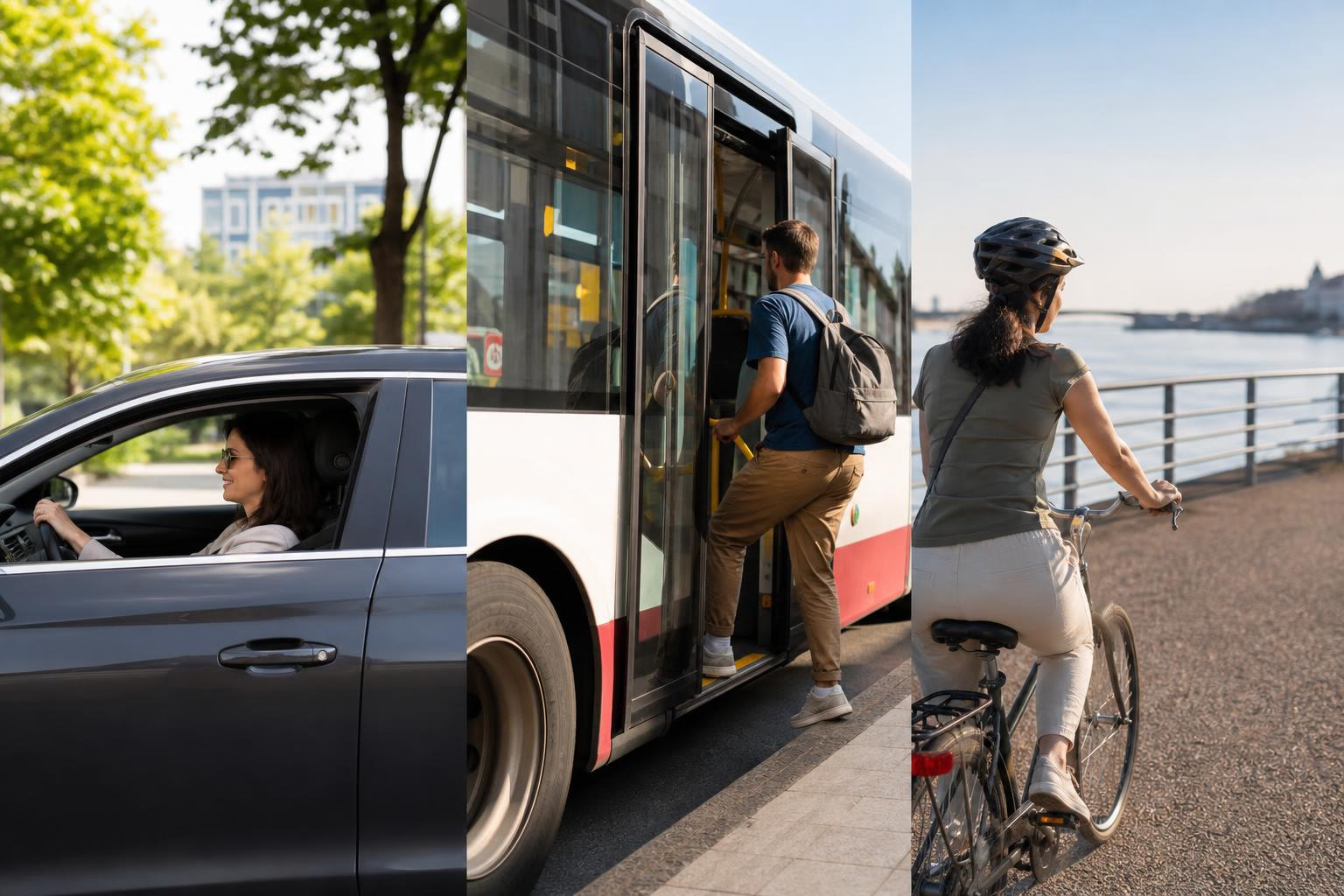
Transportation prepositions are the words “by,” “on,” and “in” used with modes of transport to describe how someone travels. “By” describes the general mode (by car, by train), “on” goes with large vehicles and ride-on vehicles (on a bus, on a bike), and “in” goes with small, enclosed vehicles (in a car, in a taxi). The same logic extends to phrasal verbs: you get on a bus but get in a car.
Teaching prepositions is already tricky. Teaching prepositions with transportation? That’s where students start saying things like “I travel with car” or “I’m on the car,” and even confident speakers second-guess themselves. Worksheet creators on ESL teacher communities note that prepositions with vehicles are “one of the main mistakes” students make in both speaking and writing.
The good news is that transportation prepositions follow surprisingly consistent rules. Unlike most English preposition usage, which feels arbitrary, the rules for by, on, and in with vehicles are logical enough that students can learn a handful of principles and apply them to nearly every mode of transport.
This guide covers every rule, every edge case, and a complete vehicle-to-preposition reference table you can use in class tomorrow.
Create custom preposition worksheets to practice these rules with your students.
What Are Transportation Prepositions?
Transportation prepositions are the prepositions (primarily “by,” “on,” and “in”) that English speakers use with modes of transport to express how someone travels or where they are in relation to a vehicle. They also determine which phrasal verbs we use when boarding or exiting, like “get on” versus “get in.”
Why are they worth a dedicated lesson? Because the rules don’t transfer from most students’ first languages. Spanish speakers, Mandarin speakers, Arabic speakers, and many others use completely different systems for linking prepositions to vehicles. Even native English speakers occasionally stumble, particularly on edge cases like helicopters, canoes, or the “on foot” versus “by foot” question.
The three core prepositions break down like this:
- By describes the general mode of travel
- On is for large vehicles or ride-on vehicles
- In is for small, enclosed vehicles
If you’re working with English language learners, this topic pairs well with broader strategies for teaching ELLs across content areas.
“By”: Describing the General Mode of Transport
When someone talks about how they travel without referring to a specific vehicle, the preposition is always “by.”
- I go to work by car.
- She travels by train.
- They crossed the ocean by ship.
“By” also works with transportation environments and surfaces:
- by sea, by air, by land
- by rail, by road, by water
The No-Article Rule
This is the grammar point students miss most often. After “by,” there is no article. It’s “by car,” not “by a car” or “by the car.” The moment you add an article, you’re talking about a specific vehicle, and the preposition changes:
- General: I travel by bus.
- Specific: I was sitting on the bus when it started raining.
A helpful way to explain this to students: “by” answers the question “How did you get there?” while “on” or “in” answers “Where were you during the trip?”
“On”: Large Vehicles and Ride-On Vehicles
“On” covers two categories, and both follow the same underlying logic.
Category 1: Large Vehicles You Can Walk Around In
If a vehicle is big enough that passengers can stand up and move around inside it, use “on”:
- on a bus
- on a train
- on a plane
- on a ship or cruise ship
- on a ferry
- on the subway or metro
- on a tram
Category 2: Vehicles You Sit or Stand On Top Of
If you straddle, balance on, or sit on top of the vehicle, use “on”:
- on a bicycle
- on a motorcycle
- on a skateboard
- on a scooter
- on a horse
The Freedom-of-Movement Heuristic
The simplest memory device, and the one that appears across virtually every teaching resource on this topic: “on” equals more freedom of movement. You can walk around on a train. You can shift your weight on a skateboard. In both cases, the preposition is “on.”
This heuristic is the single most useful rule to teach students, because it covers both categories with one principle.
“In”: Small, Enclosed Vehicles
When a vehicle is small enough that you sit down inside it and can’t walk around, use “in”:
- in a car
- in a taxi
- in a truck or van
- in a helicopter
- in a canoe or kayak
- in a rowboat
- in a rickshaw
The complementary heuristic: “in” equals less freedom of movement. You’re seated, buckled, or physically contained.
Edge Case: Bowl and Box Shapes
Some vehicles aren’t fully enclosed but still use “in.” Canoes, kayaks, wagons, and rafts are open on top, yet we say “in a canoe,” not “on a canoe.” The reason is that these vehicles have a bowl or box shape that contains the passenger. Most competing grammar pages skip this nuance entirely, but it matters for students who encounter these words in reading passages or on standardized tests.
Quick-Reference Table: Every Vehicle with Its Prepositions
No grammar page currently provides a comprehensive lookup table for transportation prepositions, so here it is. Print this out, project it, or hand it to students as a reference sheet.
| Vehicle | By ___ (mode) | On ___ (specific) | In ___ (specific) | Enter / Exit Verbs |
|---|---|---|---|---|
| Car | by car | — | in a car | get in / get out of |
| Taxi | by taxi | — | in a taxi | get in / get out of |
| Bus | by bus | on a bus | — | get on / get off |
| Train | by train | on a train | — | get on / get off |
| Plane | by plane | on a plane | — | get on / get off |
| Subway / Metro | by subway | on the subway | — | get on / get off |
| Tram | by tram | on a tram | — | get on / get off |
| Ship | by ship | on a ship | — | get on / get off |
| Ferry | by ferry | on a ferry | — | get on / get off |
| Small boat | by boat | — | in a boat | get in / get out of |
| Bicycle | by bike | on a bike | — | get on / get off |
| Motorcycle | by motorcycle | on a motorcycle | — | get on / get off |
| Skateboard | — | on a skateboard | — | get on / get off |
| Scooter | by scooter | on a scooter | — | get on / get off |
| Horse | on horseback | on a horse | — | get on / get off |
| Camel | — | on a camel | — | get on / get off |
| Elephant | — | on an elephant | — | get on / get off |
| Truck / Van | by truck | — | in a truck | get in / get out of |
| Helicopter | by helicopter | — | in a helicopter | get in / get out of |
| Canoe / Kayak | by canoe | — | in a canoe | get in / get out of |
| Walking | on foot | — | — | — |
Note that some vehicles (skateboard, camel, elephant) don’t have a conventional “by ___” form because they aren’t considered standard modes of transportation. Practitioners on the UsingEnglish.com forums confirm this: one respondent noted, “I would use ‘on’ rather than ‘by’ [for rollerblades and skateboards] as they’re not really a form of transportation to me.” This reveals that even native speakers treat edge cases differently, which is worth flagging for students.
Want to turn this table into a practice quiz? Generate a preposition quiz tailored to your students’ grade level.
Phrasal Verbs: Get On, Get Off, Get In, Get Out Of
Explore 26 free AI tools for teachers
Browse All Tools →Most grammar resources stop at by, on, and in. But students also need to know how to talk about boarding and exiting vehicles, and the rules map directly onto the same logic.
The Pattern
- Vehicles that use “on” → get on / get off
- Vehicles that use “in” → get in / get out of
Examples
Get on / get off:
- We got on the train at 8:00 a.m.
- Please get off the bus at the next stop.
- She got on her bicycle and rode away.
- He got off the horse carefully.
Get in / get out of:
- I got in the taxi and gave the driver the address.
- We got out of the car when we arrived.
- They got in the canoe and paddled across the lake.
Notice the asymmetry: “get out of” adds an extra word that “get in” doesn’t need. Students often forget the “of,” so it’s worth drilling separately.
Related Verbs
Beyond “get,” students will encounter other verbs that follow the same on/in split:
- Board (formal): board the plane, board the ship
- Ride: ride a horse, ride a bike, ride the bus (all “on” vehicles)
- Drive: drive a car, drive a truck (all “in” vehicles)
- Take: take the bus, take a taxi, take the train (works with everything)
For related grammar topics like imperatives and commands, which often show up in transportation contexts (“Get on the bus!” “Please exit the vehicle”), you can build a connected lesson sequence.
Common Mistakes to Avoid
These are the errors that come up again and again in student writing and speaking. Each one makes a useful mini-lesson or bell ringer exercise.
Mistake 1: “I’m on the car”
Wrong: I’m on the car.
Right: I’m in the car.
Cars are small, enclosed vehicles. “On the car” literally means you’re sitting on the roof. Students who overgeneralize the “on” rule for buses and trains often make this error.
Mistake 2: “I travel with car”
Wrong: I am traveling with car.
Right: I am traveling by car.
“With” should not be used to describe a means of transport. This mistake is especially common among speakers whose first language uses an equivalent of “with” for this purpose (German “mit,” for example).
Mistake 3: “In the bus” as a default
Wrong (as a standard choice): I’m in the bus.
Right: I’m on the bus.
People will sometimes say “I’m in the bus” or “I’m in the plane” to emphasize that they are physically inside. However, “on” is still considered the standard and correct form for large vehicles. This connects to an important distinction covered below.
Mistake 4: Confusing “In” with “Inside”
The preposition “in” is not the same as the word “inside.” You can be inside an airplane (as opposed to outside on the tarmac), but we still use “on” as the standard preposition: “I was on the plane.” The preposition describes your relationship to the mode of transport, not your physical enclosure. This trips up students who reason, “I’m inside it, so it must be ‘in.’”
If you want students to practice catching these errors, a text proofreading activity where they identify incorrect prepositions in a paragraph works well.
Mistake 5: “By foot” instead of “On foot”
This is one of the most debated edge cases in English grammar forums. Both “on foot” and “by foot” are understood by native speakers. But “on foot” is the standard form. On language forums, experienced teachers are direct about this: “On foot is never wrong and by foot could be wrong and could cost your student marks.” There isn’t a notable difference between American and British varieties here. Both prefer “on foot.”
For test prep purposes, always teach “on foot.”
Animals as Transport
Forum users frequently ask about animals, and the rule is consistent: when talking about sitting on animals used for transportation, always use “on” or “onto.”
- on a horse
- on a camel
- on an elephant
- on a donkey
The entry and exit verbs follow accordingly: get on a horse, get off a horse. The formal equivalent is “on horseback” (one word, no article), which functions the same way “on foot” does for walking.
Classroom Activities for Teaching Transportation Prepositions
Once students know the rules, they need practice. Here are activities that work across grade levels and proficiency tiers.
1. Fill-in-the-Blank Sentences
The classic format. Give students sentences with blanks where the preposition should go:
- We traveled ___ train from Chicago to Denver.
- She got ___ the taxi and waved goodbye.
- He rides ___ his bicycle every morning.
This works well as a warm-up or bell ringer activity at the start of class.
2. Picture-Match Quiz
Have students cut out pictures of various modes of transportation from magazines or printed images. One student holds up a picture, and their partner supplies the correct preposition. This is particularly effective for younger learners and visual learners. A variation: print vehicle images on cards and have students sort them into “on” and “in” piles before checking against the reference table.
3. Error-Correction Paragraphs
Write a short paragraph with deliberate preposition mistakes (“Last summer, I traveled with plane to visit my grandmother. I was in the plane for three hours.”) and have students find and correct each error. This builds editing skills alongside grammar knowledge.
4. Sentence-Writing Relay
Split the class into teams. Each team gets a vehicle word. They have 60 seconds to write three correct sentences: one with “by,” one with “on” or “in,” and one with the correct phrasal verb. First team with all three correct wins the round.
5. Transportation Prepositions Bingo
Create bingo cards where each square contains a vehicle name. Call out sentences with blanks (“I got ___ the ferry”), and students mark the vehicle if they can supply the correct preposition. You can create a bingo game with your own vocabulary list to make this prep-free.
For teachers who want to differentiate these activities for mixed-ability classes, the reference table works as a scaffold for struggling students while advanced students work without it.
Related Grammar Terms
Understanding transportation prepositions connects to several broader grammar concepts:
Prepositions of place describe where something is located (in, on, at, under, between). Transportation prepositions overlap with this category when describing a person’s location on or in a vehicle.
Prepositions of movement describe direction or motion (to, from, through, across, into, onto). These pair with transportation prepositions in sentences like “She got onto the bus” or “He climbed into the car.”
Phrasal verbs are verb-plus-preposition combinations (get on, get off, get in, get out of) where the preposition changes the verb’s meaning. The transportation phrasal verbs are among the most commonly tested.
Collocations are word pairs that naturally go together. “By car,” “on foot,” and “get on the bus” are all collocations. Students who learn transportation prepositions as collocations rather than isolated grammar rules tend to produce more natural-sounding speech and writing.
If you’re building a full prepositions unit, generating a structured lesson plan can save significant planning time while ensuring you cover all of these connected concepts.
FAQ
Do I say “on the plane” or “in the plane”?
Use “on the plane” as the standard preposition. Even though you’re physically inside the aircraft, English treats planes as large vehicles where passengers can stand and move around, which puts them in the “on” category. “In the plane” isn’t grammatically wrong in every context, but “on” is the accepted default and the form that will be marked correct on tests.
Why is it “in a car” but “on a bus”?
The distinction comes down to freedom of movement. In a car, you’re seated and can’t walk around, so you’re “in” it. On a bus, you can stand, walk to different seats, and move up and down the aisle, so you’re “on” it. The same principle applies to trains, planes, and ships versus taxis, trucks, and small boats.
Is it “on foot” or “by foot”?
“On foot” is the standard and universally accepted form. “By foot” is understood by native speakers, but language teachers and test makers generally consider it nonstandard. For classroom purposes and exam preparation, always teach “on foot.”
What preposition do I use with a helicopter?
Use “in a helicopter.” Helicopters are small, enclosed vehicles where passengers sit in a confined space and can’t walk around. This puts them in the same category as cars and taxis. You would say “get in a helicopter” and “get out of a helicopter.”
Why is it “in a canoe” if a canoe is open on top?
Canoes and kayaks have a bowl or box shape that contains the passenger, even though they aren’t fully enclosed. English treats this containment the same way it treats sitting inside a car. The shape of the vehicle matters more than whether it has a roof.
Can I use “by” with any vehicle?
Almost. “By” works with all standard modes of transport (by car, by bus, by train, by plane, by ship, by bicycle). However, it sounds unnatural with vehicles that aren’t typically considered transportation modes. Native speakers on English learner forums point out that saying “by skateboard” or “by rollerblades” sounds odd because these aren’t seen as ways to get from point A to point B in daily life.
What’s the difference between “by bus” and “on the bus”?
“By bus” describes the general mode of travel and uses no article: “I go to work by bus.” “On the bus” refers to a specific vehicle at a specific time: “I was on the bus when my phone rang.” The shift from general to specific changes both the preposition and the article.
Do the same rules apply when teaching young ELL students?
Yes, but simplify. For younger or beginning-level students, start with just the “on = big, in = small” distinction and three or four familiar vehicles (car, bus, bike, train). Add the “by” rule and edge cases once the basics are solid. The reference table in this guide works as a scaffold you can reveal in stages.