The First Thanksgiving Lesson: 2026 Glossary for K–8
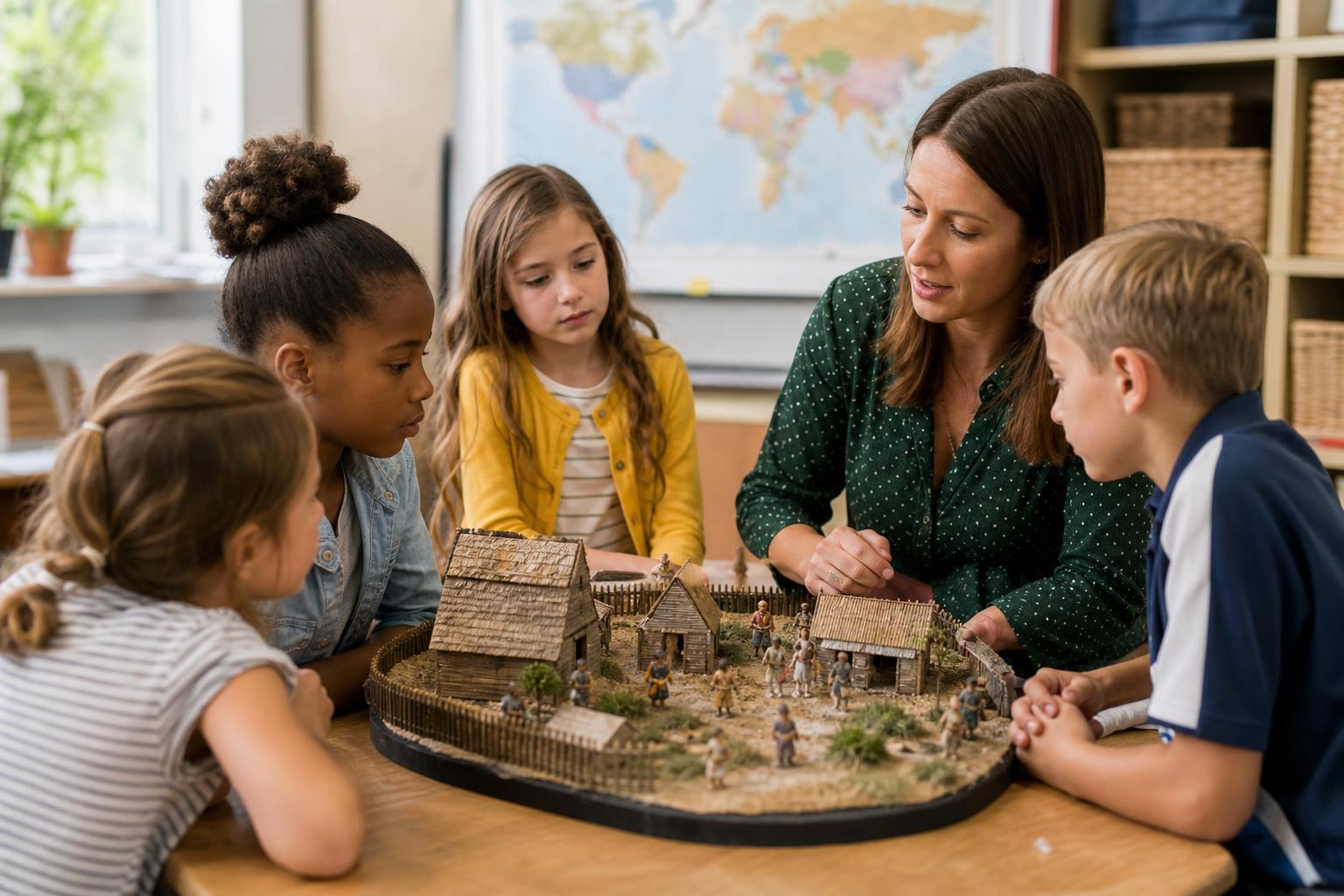
TLDR: The first Thanksgiving lesson needs both historical accuracy and age-appropriate delivery. This glossary defines the key historical terms (Wampanoag, English Separatists, the 1621 harvest celebration), explains common classroom activities (KWL charts, cloze readings, sequencing), and provides grade-level vocabulary lists from K through 8. It also addresses common myths and offers guidance on culturally responsive teaching.
Most teachers start planning their Thanksgiving unit sometime in October, and the search usually goes the same way: scroll through Pinterest, download a few PDFs, hope the content is accurate. The problem is that the first Thanksgiving lesson carries more historical weight than a turkey craft suggests. Getting the terminology right matters, both for honesty and for the students who deserve a complete story.
This glossary is built for the five minutes before you start assembling your unit. Every term includes a plain definition and a note on why it belongs in your classroom.
See how TeachTools helps K-12 teachers create classroom-ready materials in minutes.
Historical Terms Every Thanksgiving Lesson Needs
These are the foundational concepts students should encounter in any first Thanksgiving lesson, regardless of grade level.
The First Thanksgiving (1621 Harvest Celebration)
The event most people call “the first Thanksgiving” was a three-day harvest celebration in the autumn of 1621 at Plymouth Colony. English settlers who had survived their first year shared a meal with Wampanoag people who had helped them learn to hunt and grow crops in unfamiliar land. It was not called “Thanksgiving” at the time. It was a harvest feast, and it looked nothing like the November holiday Americans celebrate today.
Why it matters in the classroom: Students need to understand that the 1621 event and the modern holiday are connected but very different. The Gilder Lehrman Institute offers a multi-day lesson plan built around this distinction.
Plymouth Colony / Plymouth Plantation
The settlement established by English Separatists (often called “Pilgrims”) in 1620 in present-day Massachusetts, on the traditional lands of the Wampanoag and Massachusett people. Plymouth Colony was the site of the 1621 harvest feast and the broader story of early English colonization in New England.
Why it matters: Students should know this was an existing homeland before it was a colony. Map-labeling activities work well here, especially for grades 3 through 5.
Wampanoag
The Wampanoag are an Indigenous people of the northeastern United States who were instrumental in helping the English survive their first years at Plymouth. Several Wampanoag individuals taught the settlers where to hunt and how to cultivate crops. A critical point for any first Thanksgiving lesson plan: the Wampanoag are not a historical footnote. They exist today as a living nation with ongoing culture and governance.
Why it matters: Replacing “Indians” with “Wampanoag” is one of the simplest and most impactful corrections a teacher can make. Dr. Star Yellowfish, cited by the National Education Association, encourages educators to use tribally specific names rather than generic terms.
English Separatists (Not Just “Pilgrims”)
The people who sailed on the Mayflower were English Separatists, a religious group that broke from the Church of England. The word “Pilgrim” became common later, but it flattens the political and religious complexity of who these people were and why they left.
Why it matters: Using “English Separatists” or simply “the English” teaches students that historical groups have specific identities, not storybook labels.
Tisquantum (Squanto) and Massasoit (Ousamequin)
Tisquantum was a Patuxet man (the Patuxet were part of the Wampanoag confederation) who served as interpreter and guide for the English settlers. Massasoit, also known as Ousamequin, was the sachem (leader) of the Wampanoag who entered into a diplomatic alliance with the Plymouth colonists. Their involvement was political and strategic, not simply charitable.
Why it matters: Teaching these figures by their actual names, with context about their motivations, moves a Thanksgiving lesson away from the “friendly Indian” stereotype.
National Day of Mourning
Since 1970, many Native Americans have observed the fourth Thursday of November as a National Day of Mourning rather than a day of gratitude. David Silverman argues in This Land Is Their Land that the Wampanoag were deeply harmed by the arrival of English settlers, and today they consider the day one of mourning rather than celebration.
Why it matters: Including this concept, especially for grades 5 and up, shows students that historical events carry different meanings for different communities. It is honest teaching, not politics.
Mayflower
The ship that carried approximately 102 passengers from England to the coast of present-day Massachusetts in 1620. The voyage took about 66 days. Many passengers were Separatists seeking religious freedom; others were merchants and servants.
Harvest Feast vs. Modern Thanksgiving
The 1621 event was a multi-day outdoor gathering that likely included venison, fowl, corn, and shellfish. There were no pies, no cranberry sauce, and no football. The modern Thanksgiving holiday was not established as a national observance until Abraham Lincoln proclaimed it in 1863, more than 240 years later.
Common Myths vs. Documented History
A responsible first Thanksgiving lesson addresses what students think they know. As Chuck Larsen wrote, “when you build a lesson on only half of the information, then you are not teaching the whole truth.” Here are myths worth correcting.
Myth 1: The Pilgrims invited the Wampanoag to a feast out of gratitude.
What we actually know is limited. Primary sources suggest the Wampanoag may have arrived after hearing gunfire from the English celebration, not that they received a formal invitation. Did you know there were more Wampanoag than English at the event? Approximately 90 Wampanoag attended alongside roughly 50 surviving colonists.
Myth 2: The two groups became lasting friends.
The diplomatic relationship was brief and rooted in mutual survival needs and alliances against rival groups. Within a generation, English expansion led to King Philip’s War (1675-1676), one of the deadliest conflicts in colonial history relative to population.
Myth 3: Thanksgiving has always been a national holiday.
Various colonies held occasional days of thanksgiving for specific events (military victories, good harvests), but there was no annual tradition until the 19th century. Conflating a 1621 meal with a national holiday distorts the timeline.
Myth 4: “Pilgrims and Indians” is an acceptable framing.
It is vague to the point of inaccuracy. Annmarie Decoteau, Indigenous curriculum specialist for Bismarck Public Schools, reports that educators frequently reach out asking how to teach Thanksgiving more accurately. The answer starts with specific names: Wampanoag and English Separatists.
For creating myth-vs-fact worksheets at any grade level, a worksheet generator tool can save significant prep time.
Pedagogical Terms for Thanksgiving Lessons
Explore 26 free AI tools for teachers
Browse All Tools →These are the activity types and teaching strategies you will encounter most often when building or adapting a first Thanksgiving lesson.
KWL Chart
A three-column graphic organizer: K (what students already know), W (what they want to know), and L (what they learned). For Thanksgiving, start by recording what students think they know about the story, then return to correct and expand after the unit. This is one of the most commonly cited structures for opening a Thanksgiving unit, and it doubles as a formative assessment.
Cloze Reading
A passage with key words removed, requiring students to fill in the blanks from context or a word bank. Cloze readings are popular for Thanksgiving passages in K through 2 because they combine reading comprehension with vocabulary practice. The top Pinterest results for “the first Thanksgiving lesson” frequently reference free cloze passages for ELA blocks.
Sequencing Activity
Students arrange events in chronological order: Separatists leave England, Mayflower voyage, arrival at Plymouth, first winter, Wampanoag assistance, harvest feast. Sequencing is a core K-2 skill, and applying it to the Thanksgiving narrative gives students both historical knowledge and literacy practice. If you use formative assessment strategies, sequencing activities are a natural fit for checking understanding mid-unit.
Read-Aloud
A teacher reads a book to the class, pausing for discussion. Choosing accurate Thanksgiving read-alouds matters. Look for books that feature tribally specific portrayals of Native people, both past and present, rather than generic or stereotypical depictions.
Interactive Craft Book
A multi-page student-created book where each page covers a different part of the Thanksgiving story. One first-grade teacher on Firstieland describes spending five days building an interactive craft book that contains “a kid-friendly, accurate portrayal of the history of Thanksgiving.” Each day covers a different topic: why the English left, the voyage, the first winter, the feast, and modern Thanksgiving.
Primary Source Investigation
Students examine original documents, images, or artifacts to draw conclusions. The Plimoth Patuxet Museums offers an interactive game called “You Are the Historian” where students visit historical locations and complete tasks to investigate the first Thanksgiving. This type of activity works well for grades 3 through 8.
Culturally Responsive Teaching
An approach that recognizes students’ cultural backgrounds and incorporates multiple perspectives into instruction. For Thanksgiving, this means presenting the Wampanoag perspective alongside the English perspective, selecting accurate materials, and acknowledging that not all students or families view the holiday the same way. Teachers looking for deeper guidance on inclusive approaches can explore strategies for creating inclusive classrooms.
Cross-Curricular Integration
Connecting a single topic across multiple subjects. A first Thanksgiving lesson unit might include cloze reading in ELA, menu budgeting in math, map labeling in social studies, turkey crafts in art, and letter-writing prompts (“pretend you are a Separatist writing home to England”). This approach is especially common in elementary classrooms where one teacher covers all subjects.
Grade-Level Vocabulary Scaffolding
Not every student needs the same words. Here are vocabulary lists organized by developmental level, drawn from the terms and concepts covered above.
K-2 Vocabulary
Wampanoag, harvest, feast, colony, voyage, grateful, Mayflower, Plymouth, Separatist, crop
At this level, focus on concrete meanings. A harvest is when crops are gathered. A voyage is a long trip by ship. A colony is a place where people from another country come to live. Pair each word with an image or simple definition card. For ideas on making vocabulary stick at this age, see these vocabulary activities for younger students.
3-5 Vocabulary
Alliance, indigenous, treaty, colonization, primary source, Tisquantum, Massasoit, diplomacy, religious freedom, harvest celebration
Students at this level can handle more abstract ideas. An alliance is an agreement between groups to help each other. A treaty is a formal agreement, often written down. Colonization is when one group takes control of another group’s land. Use these terms in context through reading passages and discussion prompts.
6-8 Vocabulary
Exceptionalism, colonialism, cultural narrative, National Day of Mourning, Patuxet, sachem, confederation, revisionist history, dispossession, sovereignty
Middle school students are ready to examine how stories get told and by whom. Exceptionalism is the belief that one’s country or group is uniquely special, often used to justify actions that harmed others. A cultural narrative is the version of a story that a society tells itself. These terms open the door to critical thinking about whose perspective dominates the first Thanksgiving lesson most students received in earlier grades.
Build a Thanksgiving vocabulary quiz tailored to any of these grade bands.
Planning Your First Thanksgiving Lesson Faster
The typical Thanksgiving unit runs about five days and includes reading activities, vocabulary work, writing prompts, art projects, and some form of assessment. That is a lot of material to create or curate from scratch, especially when accuracy matters as much as engagement.
AI tools designed for teachers can speed up the process considerably. Instead of searching Pinterest for an hour, you can enter a topic (like “the first Thanksgiving”), select a grade level, and generate worksheets, quizzes, or full lesson plans in minutes. TeachTools offers 23 purpose-built classroom tools that handle everything from vocabulary worksheets to lesson plan outlines, all exportable to PDF or Google Docs.
For teachers concerned about data privacy, TeachTools is designed with FERPA compliance in mind, with no student PII required and no training on user data.
A five-day Thanksgiving unit becomes much more manageable when the material generation is handled and you can focus your energy on the teaching itself.
Start free with 5 generations per month and see how much time it saves.
Frequently Asked Questions
What grade level is the first Thanksgiving lesson typically taught?
Most first Thanksgiving lessons are designed for K through 2, but the topic appears across elementary and into middle school. The difference is depth. Kindergarteners learn vocabulary like “harvest” and “feast,” while middle schoolers can examine colonialism, the National Day of Mourning, and competing historical narratives.
Should I stop teaching about Thanksgiving altogether?
No, but you should teach it accurately. Native educators like Dr. Star Yellowfish and Annmarie Decoteau encourage teachers to keep the topic while correcting the narrative. Use specific names (Wampanoag, not “Indians”), include Indigenous perspectives, and acknowledge that the story is more complicated than a shared meal.
What is the difference between the 1621 harvest feast and modern Thanksgiving?
The 1621 event was a multi-day outdoor gathering with venison, fowl, and corn, shared by about 50 English colonists and 90 Wampanoag. Modern Thanksgiving was established as a national holiday by Abraham Lincoln in 1863 and looks almost nothing like the original event in food, setting, or meaning.
What is a KWL chart and how do I use it for Thanksgiving?
A KWL chart has three columns: Know, Want to Know, and Learned. Start your unit by asking students what they already know about Thanksgiving (which often reveals myths), then record what they want to learn. After the unit, fill in the “Learned” column. It works as both a lesson opener and a formative assessment.
How do I handle the “Pilgrims and Indians” language in older materials?
Replace it. Use “Wampanoag” and “English Separatists” or “the English.” Explain to students why specific names matter: we do not call all Europeans “Pilgrims,” and calling all Native peoples “Indians” erases the distinct nations, languages, and cultures that existed and still exist.
What primary sources can students examine for the first Thanksgiving?
The Plimoth Patuxet Museums offers a free interactive game called “You Are the Historian” where students investigate primary sources about the 1621 event. Edward Winslow’s letter from 1621, which contains one of the only firsthand accounts of the harvest feast, is another accessible source for upper elementary and middle school.
How long should a first Thanksgiving lesson unit take?
Most elementary teachers plan a five-day unit: Day 1 covers why the English left, Day 2 the Mayflower voyage, Day 3 the first winter and Wampanoag assistance, Day 4 the harvest feast, and Day 5 modern Thanksgiving and gratitude activities. This structure allows time for accuracy without rushing.
Can AI tools help me build Thanksgiving lesson materials?
Yes. AI tools built for teachers can generate vocabulary worksheets, reading passages, quizzes, and full lesson plans based on topic and grade level. The key is choosing tools designed specifically for education that do not require student data. TeachTools, for example, lets you input “first Thanksgiving” and a grade band, then exports classroom-ready materials as PDFs or Google Docs.