Teaching English Language Learners: 2026 Strategies Guide
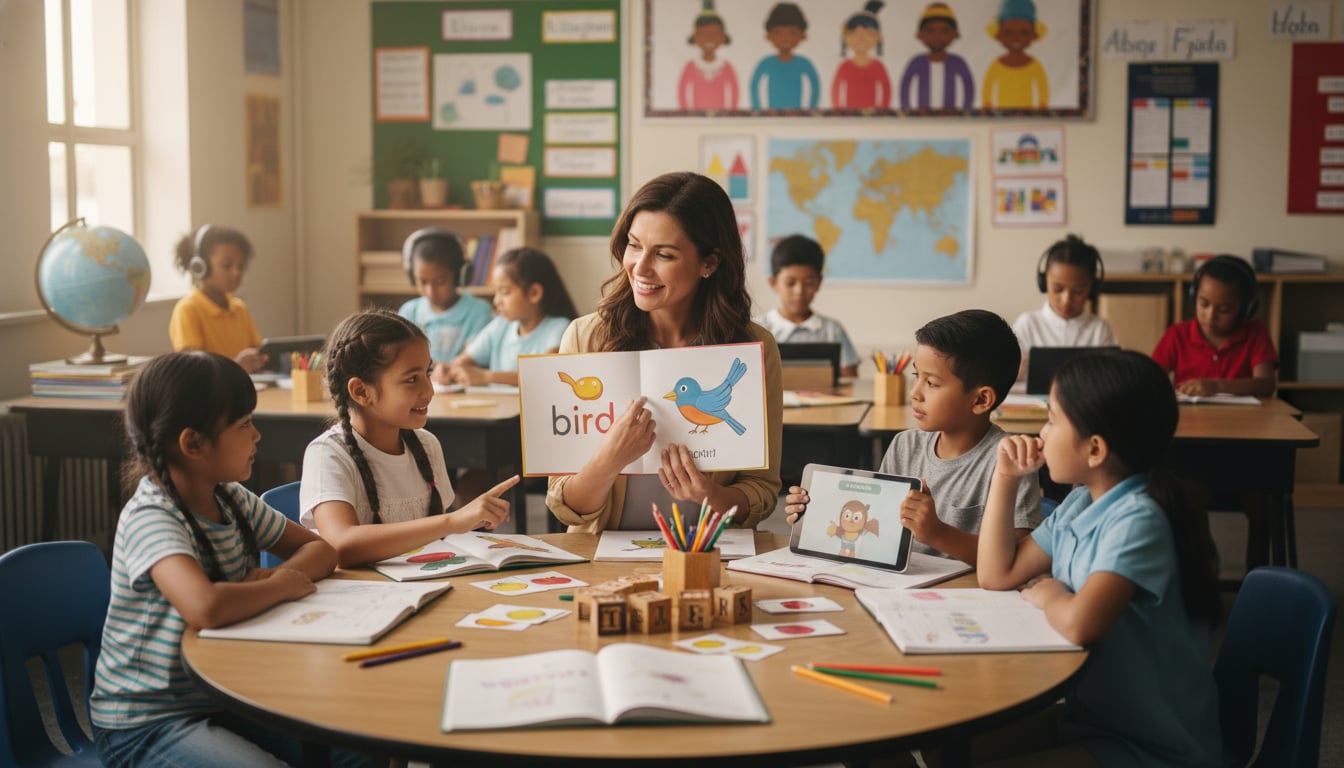
Teaching English language learners effectively comes down to making content understandable, giving students frequent opportunities to use the language, and scaffolding instruction to match each student's proficiency level. That's the short answer. The longer answer requires understanding the research behind language acquisition, choosing the right program model, and building a daily practice around strategies like sheltered instruction, academic vocabulary development, and structured peer interaction. This guide covers all of it: core theories, program models, and practical classroom techniques that help students build both language skills and content knowledge, along with newer topics like video based instruction, game based learning, phonics foundations, and technology considerations that round out a modern ELL program.
Looking for tools that speed up ELL lesson prep? The Lesson Plan Generator from TeachTools creates full plans with both content and language objectives in minutes.
Understanding How Language Is Learned: Second Language Acquisition Theory
Before jumping into classroom strategies, it helps to understand the theories that explain how people learn a new language. Second Language Acquisition (SLA) theory isn't just academic. It's the "why" behind the most effective practices for teaching English language learners.
- Comprehensible Input (Krashen): Linguist Stephen Krashen proposed that students acquire language when they receive "comprehensible input," language just slightly beyond their current level (he called this "i+1"). The key is that learners can understand the message using context, visuals, and prior knowledge. Simply talking at students in complex English doesn't work. The input must be understandable.
- Interaction (Long): Michael Long built on this idea, arguing that language is acquired through interaction. When students have conversations, they negotiate for meaning, ask for clarification, and receive feedback. This back and forth makes input much more comprehensible and powerful.
- Comprehensible Output (Swain): Merrill Swain observed that students also need to produce language (speak or write). Trying to express an idea forces learners to notice gaps in their knowledge ("Wait, how do I say that?") and pay closer attention to grammar and vocabulary.
- Sociocultural Theory (Vygotsky): Learning is social. Students learn language through meaningful collaboration with teachers and peers. Scaffolding, or providing temporary support, allows learners to achieve more than they could on their own.
These theories collectively tell us that effective language learning happens in an environment rich with understandable messages, frequent interaction, opportunities for students to talk and write, and strong social support.
School Wide Approaches: ELL Program Models
How a school organizes its support for teaching English language learners is defined by its instructional program model. There are several common approaches.
- ESL Pull Out: Students leave their main classroom for short periods to receive targeted English instruction from a specialist.
- ESL Push In: An ESL specialist co teaches or provides support within the regular content classroom.
- Structured English Immersion (SEI): Students learn all subjects in English, but the teacher uses sheltering strategies to make content comprehensible. The goal is a quick transition to mainstream classes.
- Transitional Bilingual Education: Students initially learn core subjects in their native language while also learning English. Instruction gradually shifts to all English.
- Dual Language Immersion: Both native English speakers and ELLs learn together in two languages. The goal is for all students to become bilingual and biliterate. Research shows strong long term outcomes for ELLs in these programs, often closing the academic achievement gap by middle school.
A comprehensive five year study found no evidence that English immersion was superior to bilingual approaches. This supports the idea that valuing and using a student's native language can be a powerful asset.
Making Grade Level Content Accessible: Sheltered Instruction (SIOP)
Regardless of the school model, a key strategy for teaching English language learners in content classes is Sheltered Instruction. This approach makes grade level content (like science or history) accessible while students develop English.
The Sheltered Instruction Observation Protocol (SIOP) is a research based framework for doing this effectively. It organizes best practices into eight components, including lesson preparation, building background knowledge, making input comprehensible, and promoting student interaction.
A hallmark of the SIOP model is planning both content objectives and language objectives for every lesson. For example:
- Content Objective: Students will be able to explain the life cycle of a butterfly.
- Language Objective: Students will be able to use sequence words (first, next, then, finally) to describe the life cycle.
Research has validated the SIOP model's effectiveness. In one study, a school that consistently used SIOP saw 86% of its third grade ELLs score at or above grade level on state reading tests, a massive improvement. Teachers looking for a structured planning model might also explore the 5E lesson plan framework, which pairs well with SIOP's emphasis on building background and structured exploration.
Core Classroom Strategies for Teaching English Language Learners
Beyond broad models, day to day instruction relies on a set of core strategies. These practices create a supportive environment where language and content learning can flourish together.
Academic Language Development
There's a huge difference between social English (playground talk) and academic English (the language of textbooks and essays). While a student might become conversationally fluent in one to three years, research shows it can take five to nine years to catch up to native speakers in academic language.
Because of this long timeline, explicitly teaching academic language is non negotiable. This means teaching subject specific vocabulary, complex sentence structures, and language functions like "compare and contrast" or "argue and persuade." For upper elementary practice, assign grammar exercises for Grade 4 to build sentence fluency and academic language.
Building on Background Knowledge and Culture
New information is easier to learn when it hooks onto something a student already knows. Activating students' prior knowledge and connecting lessons to their cultural backgrounds makes learning more meaningful and improves comprehension.
A classic study demonstrated this perfectly. When American and Indian students each read about a wedding in their own culture and a foreign one, they read faster and recalled more details when the text matched their cultural background. Similarly, the famous "baseball study" found that students with strong prior knowledge of baseball, even if they were weaker readers, outperformed strong readers who knew little about the sport. Background knowledge can sometimes be even more important than general reading ability.
Comprehensible Input and Language Output
As SLA theory tells us, these two concepts are the engine of language acquisition.
- Comprehensible Input is language that students can understand. Teachers make input comprehensible by speaking clearly, using visuals, demonstrating concepts, and providing context.
- Comprehensible Output is giving students structured opportunities to use the language they are learning. When students are "pushed" to speak or write, they solidify their knowledge and notice areas where they need to improve.
A balanced lesson provides plenty of understandable input first, then creates low pressure opportunities for students to produce output.
The Power of Talk: Classroom Interaction and Peer Discussion
Learning is social. The more students talk, the more they learn.
- Classroom Interaction refers to all the dialogue in a classroom, between the teacher and students and among students themselves. Michael Long's Interaction Hypothesis highlights that the negotiation of meaning in conversation drives language acquisition forward.
- Peer Discussion involves structured activities like "Think Pair Share" where students process ideas with a partner. Low stakes conversation starters like Would You Rather Questions for Kids also work well. For ELLs, discussing concepts with peers is often less intimidating than speaking to the whole class. It provides a safe space to practice language, ask questions, and learn from classmates who might explain things in simpler terms.
The SIOP model emphasizes that student to student interaction should be a cornerstone of every lesson. Creating a classroom culture where structured talk is expected and supported is one of the most powerful things a teacher can do. Ice breaker activities can help build that culture early in the year; see these getting to know each other activities for ideas.
Explicit Instruction with Modeling and Feedback
When teaching new concepts or skills, clarity is key. Explicit instruction follows a simple "I do, We do, You do" sequence.
- I do (Modeling): The teacher clearly explains and demonstrates the skill. For example, the teacher might write a paragraph on the board while thinking aloud about each step.
- We do (Guided Practice): The class practices the skill together with teacher support.
- You do (Independent Practice): Students apply the skill on their own while the teacher provides feedback.
Feedback is the other critical piece. Research shows that timely, specific feedback is one of the most powerful influences on student achievement. For ELLs, this can be as simple as gently recasting an incorrect sentence to model the correct form. For a deeper dive into effective feedback techniques, this guide on proven feedback strategies is worth reading.
Integrated Language Modality Instruction
Language isn't used in a vacuum. We naturally combine listening, speaking, reading, and writing. Integrated instruction mirrors this by weaving all four modalities into lessons.
For example, a science lesson might involve:
- Listening to a teacher's explanation.
- Speaking with a partner to discuss a hypothesis.
- Reading a short article or diagram.
- Writing down observations.
This layered approach reinforces learning through multiple pathways and keeps students engaged. What an ELL might miss in reading, they might pick up while listening or discussing. For writing output, prompt students with Creative Writing Prompts (Grade 5) to encourage extended language production.
Video Based Instruction for ELL
Video has become one of the most effective mediums for teaching English language learners, and not just as a "movie day" reward. When used intentionally, video based instruction provides comprehensible input through multiple channels at once: spoken language, visual context, facial expressions, and on screen text.
Why Video Works for Language Learners
ELLs process language more effectively when they can see context alongside what they hear. A student who struggles to follow a purely verbal explanation of photosynthesis may understand it immediately when watching an animated diagram with narration. Practitioners on Reddit report that short, captioned videos (two to four minutes) are far more effective than longer ones, because ELLs can rewatch them without losing focus.
Practical Approaches
- Pre teach vocabulary before showing a video. Give students three to five key words they'll hear, with visuals or L1 translations.
- Use captions and subtitles. Research from the National Literacy Trust shows that same language subtitles significantly improve word recognition and reading fluency.
- Pause and discuss. Stop the video at key moments and have students turn to a partner to summarize what they just saw.
- Assign video responses. Have students record short spoken summaries of what they watched. This pushes comprehensible output while keeping the stakes low.
Teachers can also use the YouTube Summarizer from TeachTools to quickly generate written summaries of educational videos, which double as reading comprehension passages for ELLs.
Listening Comprehension Practice
Listening is often the first skill ELLs develop, yet it receives the least explicit instruction. Most classroom "listening" is passive: students hear the teacher talk. That's not the same as structured listening comprehension practice.
Building Active Listening Skills
- Dictation exercises. The teacher reads a short passage at a controlled pace while students write what they hear. This bridges listening and writing, and it highlights gaps in vocabulary or grammar knowledge.
- Listen and draw. The teacher describes a scene or sequence, and students sketch it. This works especially well at the pre production and early production stages because it requires comprehension without speech.
- Audio journals. Students listen to a short podcast clip or recorded story, then write or dictate a response. Podcasts designed for English learners (like "Voice of America Learning English" or "6 Minute English" from the BBC) are freely available and graded by difficulty level.
- Song lyrics and chants. Music is memorable. Songs with repetitive choruses help students internalize sentence patterns and vocabulary without the pressure of academic performance.
One YouTube educator who coaches ELL teachers noted that pairing listening exercises with a simple graphic organizer (main idea, three details) transforms passive listening into active comprehension. The key is giving students a purpose before they listen.
Phonics and Foundational Reading Skills
For younger ELLs or newcomers with limited formal schooling, phonics instruction is essential. English has a notoriously irregular spelling system, and students whose first language uses a different script (Arabic, Mandarin, Korean) face an additional challenge: learning a new alphabet altogether.
What the Research Says
The National Reading Panel's findings on phonics instruction apply to ELLs as well as native speakers. Systematic, explicit phonics instruction improves word reading and spelling for English learners, particularly when combined with oral language development. A meta analysis published in Reading Research Quarterly found that phonological awareness interventions had a moderate to large effect on ELL reading outcomes.
Practical Phonics Strategies for ELLs
- Contrastive analysis. Identify sounds that exist in English but not in the student's L1. Spanish speakers, for example, often struggle with the short vowel sounds /ɪ/ and /ɛ/ because Spanish has only five vowel sounds. Knowing this lets teachers target instruction.
- Sound walls over word walls. A sound wall organizes vocabulary by phoneme rather than by first letter, which helps ELLs connect sounds to spelling patterns more logically.
- Decodable texts. Use texts where the majority of words follow phonics patterns the student has already learned. This builds confidence and fluency.
- Multisensory techniques. Tracing letters in sand, clapping syllables, or using magnetic letters engages multiple learning pathways. For a bank of activities focused on letter sounds, see this letter names and sounds activity guide.
Phonics instruction should not replace meaning based reading instruction. The two work best together: phonics gives students the tools to decode, while comprehension strategies give them the tools to understand.
Leveled Texts and Differentiation
Not all ELLs are at the same level, and a single classroom can easily contain students at three or four different proficiency stages. Leveled texts are one of the most practical tools for managing this range.
What Leveled Texts Look Like in Practice
A leveled text presents the same core content at different reading levels. A fifth grade science unit on ecosystems might include:
| Proficiency Level | Text Features |
|---|---|
| Beginning | Simple sentences, heavy picture support, labeled diagrams, key vocabulary bolded with L1 glossary |
| Intermediate | Short paragraphs, some academic vocabulary with context clues, graphic organizers embedded |
| Advanced | Grade level text with margin notes defining tier 2/3 vocabulary |
The goal is not to water down content. Every student should engage with the same big ideas. The difference is in the linguistic complexity of the text and the scaffolds provided alongside it.
Differentiation Beyond Text Level
Leveled texts are just one piece. True differentiation for ELLs also involves varying the output expectations (a drawing vs. a paragraph vs. an essay), adjusting grouping structures, and providing different levels of sentence frames. For a broader look at differentiation strategies across subject areas, this differentiation guide for teachers covers the topic in depth.
Creating differentiated materials by hand is time consuming. The Worksheet Generator from TeachTools can produce practice materials at different difficulty levels for the same topic, cutting prep time significantly.
Scaffolding and Supports
Explore 26 free AI tools for teachers
Browse All Tools →Scaffolding means providing temporary supports to help students access content that would otherwise be out of reach. For teaching English language learners, scaffolding is essential.
Vocabulary Instruction
Students cannot understand content without knowing the words used to discuss it. Effective vocabulary instruction for ELLs is:
- Explicit: Directly teach a small number of high impact words.
- Rich and Varied: Provide multiple exposures to new words in different contexts (speaking, reading, writing).
- Visual: Connect words to images, gestures, or real objects.
- Interactive: Get students using the new words in games, discussions, and writing.
Creating engaging vocabulary practice can be time consuming, but tools like the crossword and word search generators from TeachTools can help you build fun, printable activities in minutes.
Visual Aid Scaffolds
Visuals are a universal language. For ELLs, they are a critical scaffold that makes abstract concepts concrete. Effective visual aids include:
- Photos, illustrations, and diagrams
- Videos and animations
- Graphic organizers (like Venn diagrams or timelines)
- Gestures, props, and real objects (realia)
- Anchor charts with key concepts or vocabulary
Using a rich mix of visuals helps bridge language gaps and ensures all students can access the core ideas of a lesson.
Native Language Support
A student's first language is an asset, not a deficit. Using a student's native language (L1) strategically can be a powerful support. This doesn't mean translating everything, but it can include:
- Allowing students to briefly discuss a complex idea in their L1 with a peer.
- Providing bilingual glossaries for key vocabulary.
- Letting students brainstorm or pre write in their L1.
Cognitive skills transfer across languages. If a student understands a concept in their first language, they only need to learn the English label for it, not relearn the entire concept. The Text Translator tool can help teachers quickly create bilingual reference materials for key passages or directions.
Game Based Learning and Assessment for ELLs
Games lower the affective filter, a concept from Krashen's theory that describes the emotional barrier anxiety creates against language acquisition. When students are playing, they're more willing to take risks with language.
Why Games Work
ELLs often hesitate to speak because they fear making mistakes in front of peers. Games reframe errors as part of play rather than failure. Practitioners on Reddit's r/ESL community frequently recommend games as the single best way to get reluctant speakers talking, noting that competitive or collaborative game formats generate more spontaneous language than almost any other activity.
Effective Game Formats for ELLs
- Vocabulary bingo. Students match definitions or images to words on their bingo cards. The Bingo Generator creates custom cards in seconds.
- Scavenger hunts. Give students clues written at their proficiency level. They must read, discuss with a partner, and find the answer somewhere in the room or in a text.
- Quiz games. Kahoot style quizzes with images and simplified language let teachers assess comprehension in real time. For a standards aligned version, the Quiz Generator can produce assessments that double as competitive review games.
- Board games with sentence frames. Students draw cards and must answer using a specific sentence structure ("I think ___ because ___"). This turns grammar practice into a social activity.
- Digital escape rooms. Students solve language puzzles (unscramble vocabulary, fill in cloze passages, answer comprehension questions) to "unlock" the next clue.
Game based assessment is particularly valuable because it captures what students know without the anxiety of a formal test. Teachers can observe language use, note errors, and adjust instruction, all while students think they're just playing.
Learning Apps and Websites for ELL Students
Technology has opened up a wide range of tools specifically designed for English language learners. The best apps and websites supplement (not replace) teacher instruction by giving students additional input and practice time.
Recommended Free and Low Cost Tools
- Duolingo for Schools. A free classroom dashboard that lets teachers assign lessons and track student progress. Useful for basic vocabulary and grammar, though it doesn't teach academic English well.
- Newsela. Provides current event articles at multiple Lexile levels. Teachers can assign the same article to the whole class, with each student reading at their appropriate level.
- Epic! (for younger learners). A digital library with read aloud features and books available in Spanish. The audio support makes it useful for listening and reading practice simultaneously.
- ReadWorks. Free reading passages with comprehension questions, sortable by grade and Lexile level. Many passages come with audio.
- Flipgrid (now Flip). Students record short video responses to prompts. This is a low pressure way to practice speaking, since students can re record until they're satisfied.
Choosing the Right Tool
Not every app works for every student. The best approach is to evaluate tools based on three questions: Does it provide comprehensible input at the student's level? Does it require the student to produce language? Is it engaging enough that the student will actually use it?
One ELL specialist shared on a teaching forum that the biggest mistake she sees is teachers assigning apps as busy work without connecting them to classroom learning goals. A vocabulary app is only effective if the words students practice there also show up in class discussion and written work.
Internet Access and Device Considerations
Before assigning any technology based work, teachers need to account for the digital divide, which disproportionately affects ELL families. According to Pew Research Center data, roughly 1 in 4 households earning under $30,000 per year lack home broadband access. Many ELL families fall into this category.
Practical Steps
- Survey families early. At the start of the year, find out which students have reliable internet access and devices at home. Do this privately and without judgment.
- Provide offline alternatives. Any digital assignment should have a paper based equivalent. Printable worksheets, physical books, and handwritten journals ensure no student is penalized for lack of connectivity.
- Use school devices strategically. If the school provides Chromebooks or tablets, build in dedicated class time for app based practice rather than assuming it will happen at home.
- Choose low bandwidth tools. Some apps work well on mobile phones with limited data plans. Text based tools and audio recordings use far less data than video streaming.
When selecting any edtech tool for ELL students, data privacy matters. FERPA compliance and clear data handling policies should be non negotiable, especially for tools that might process student language samples. For guidance on evaluating tools, see this privacy checklist for AI tools.
Bilingual Educator Resources
Teachers who speak their students' home languages have a significant advantage, but even monolingual educators can access bilingual resources that support ELL instruction.
Where to Find Quality Bilingual Materials
- Colorín Colorado (colorincolorado.org). A bilingual site (English/Spanish) funded by the American Federation of Teachers. It offers research based articles, strategy guides, and webcasts specifically about ELL instruction. It also provides parent resources in Spanish that teachers can send home.
- ¡Cuéntame! from PBS. Video resources in Spanish and English designed for family engagement with schooling.
- Bilingual book publishers. Companies like Lectura Books and Lee & Low Books publish children's literature in multiple languages. Having books in a student's home language in the classroom library sends a powerful message of inclusion.
Supporting Bilingual Paraprofessionals
Many schools rely on bilingual paraprofessionals to bridge communication gaps with ELL families. These staff members are invaluable, but they're often undertrained. Providing them with professional development on SLA basics and sheltered instruction techniques multiplies their effectiveness.
When writing report cards for ELL students, specific language about language acquisition progress matters. This guide to ESL report card comments organizes sample comments by skill level, saving time and ensuring clarity.
Planning for Success
Effective instruction doesn't happen by accident. It requires thoughtful planning that anticipates the needs of English language learners.
Lesson Language Demand Analysis
Before teaching a lesson, analyze its language demands. This means identifying the specific vocabulary, sentence structures, and language functions (explaining, arguing, comparing) students will need to succeed. Once you know the demands, you can plan scaffolds to support them. A great lesson plan includes both content and language objectives.
Instructional Strategy by Language Acquisition Stage
Not all ELLs are at the same level. Their needs change as they progress through the stages of language acquisition.
- Pre production (Silent Period): Students are absorbing language but speaking very little. Focus on comprehension and allow nonverbal responses (pointing, drawing).
- Early Production: Students use one or two word phrases. Ask yes or no questions and provide sentence stems.
- Speech Emergence: Students speak in simple sentences. Use group work and provide sentence frames to encourage more complex speech.
- Intermediate Fluency: Students can engage in more complex conversations. Focus on academic vocabulary and higher order thinking skills.
- Advanced Fluency: Students are nearly proficient. Continue to provide support with nuances of English like idioms and figurative language.
Differentiating instruction to match a student's stage ensures they are always supported and appropriately challenged.
Higher Order Thinking and Learning Strategy Instruction
A student's language level does not reflect their cognitive ability. ELLs are fully capable of higher order thinking like analyzing, evaluating, and creating. The teacher's job is to provide the language scaffolds (like sentence frames or word banks) that allow them to express their complex thoughts.
It's also important to explicitly teach learning strategies, such as how to take notes, summarize text, or use graphic organizers. This "learning how to learn" empowers students to become more independent and confident. For strategies that improve outcomes across all learners, this article on improving student achievement provides a useful companion read.
Formative Assessment
How do you know if students are learning? Formative assessment involves frequent, low stakes checks for understanding that happen during the learning process. This can include exit tickets, quick quizzes, or simply observing students as they work in pairs.
The goal is to gather real time data to adjust your teaching. Research shows that effective formative assessment can lead to huge learning gains, in some cases moving a student from the 50th to the 65th percentile on standardized tests. For more on exit ticket design, see these exit ticket activity ideas.
Professional Development Resources for ELL Teachers
Even experienced teachers benefit from ongoing training in ELL instruction. The field evolves, new research emerges, and the demographics of ELL populations shift. Professional development is not optional; it's a career long commitment.
High Quality PD Options
- WIDA (wida.wisc.edu). WIDA develops the English language proficiency standards used by over 35 states. Their professional learning courses cover topics like using the WIDA framework, integrating language and content, and assessing ELLs. Many are available online and self paced.
- TESOL International Association (tesol.org). Offers webinars, conferences, and certificate programs. The TESOL certificate is widely recognized and covers SLA theory, lesson planning for ELLs, and assessment.
- State specific ELL endorsements. Most states offer an ESL or bilingual endorsement that teachers can add to their certification. Requirements vary but typically include coursework in linguistics, SLA, and cross cultural communication.
- Colorín Colorado webcasts. Free, archived webcasts featuring leading researchers in ELL education. Topics range from vocabulary instruction to family engagement.
Building PD Into the School Day
One barrier to professional development is time. Teachers on Reddit's r/Teachers subreddit frequently note that PD sessions often feel disconnected from their actual classroom challenges. The most effective PD for ELL instruction tends to be job embedded: peer observations, co planning with an ESL specialist, or analyzing student work samples together. Schools can formalize this through professional learning communities (PLCs) focused specifically on ELL outcomes.
Frequently Asked Questions About Teaching English Language Learners
What are the biggest challenges in teaching English language learners?
The main challenges include bridging the academic language gap, building background knowledge that may differ from the curriculum's assumptions, providing differentiated instruction for multiple proficiency levels in one classroom, and assessing content knowledge separately from language proficiency.
How long does it take for an ELL to become proficient in English?
While students often develop conversational fluency within 1 to 3 years, achieving proficiency in academic English, which is necessary for school success, can take anywhere from 5 to 9 years.
What is the "silent period" for a new English language learner?
The silent period is the pre production stage where a newcomer is actively listening and absorbing the new language but produces very little speech. This is a normal and important phase. Forcing students to speak before they are ready can create anxiety.
How can I support an ELL if I don't speak their native language?
Use visuals, gestures, and modeling. Pair the student with a supportive peer. Use translation technology for key concepts. Label the classroom in multiple languages. Most importantly, create a warm, welcoming environment where the student feels safe to take risks with English.
What is the difference between an ESL and a bilingual program?
An ESL (English as a Second Language) program focuses on teaching students English, often in an English only environment with specialized supports. A bilingual program uses the student's native language for some portion of instruction to teach content while they also learn English, with the goal of developing proficiency in both languages.
Are game based assessments reliable for measuring ELL progress?
Yes, when designed thoughtfully. Game based assessments capture authentic language use in low anxiety contexts. They're especially useful for formative purposes: observing which vocabulary a student can use spontaneously, how they negotiate meaning with peers, and where their grammar breaks down. They should complement (not replace) more formal assessment tools.
How can technology help with teaching English language learners?
Technology offers powerful tools when used wisely. Translation apps and bilingual dictionaries provide on demand support. Digital storytelling tools let students practice language creatively. Video platforms with captions build listening and reading simultaneously. And AI platforms like TeachTools save educators significant prep time by generating differentiated materials, lesson plans, and assessments, freeing them up to focus on direct student interaction.
Ready to cut your ELL lesson prep time? Explore all 23 tools and start with 5 free generations per month, no credit card required.