On the Move Activities: 22 Classroom Ideas That Work (2026)
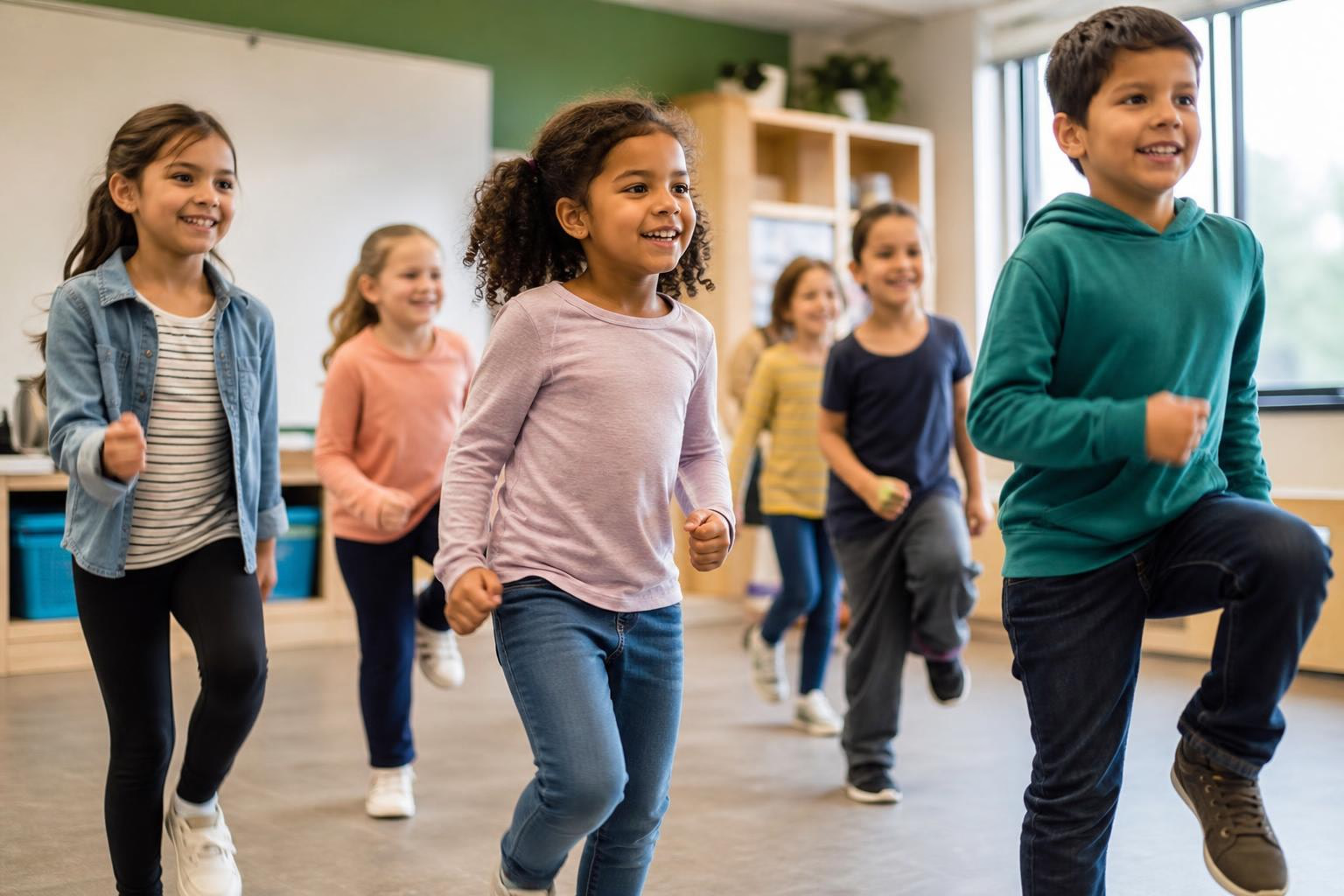
TL;DR
Students sit roughly 4.5 hours a day in classrooms, but research shows that movement breaks and movement-integrated learning improve working memory, concentration, and test scores. This guide organizes 22 on the move activities into five categories (brain breaks, academic integration, transitions, calming, and middle/high school) so you can pick exactly what your classroom needs. Every activity includes grade bands, prep level, and timing.
At-a-Glance: All 22 On the Move Activities
| # | Activity | Category | Time | Prep | Best Grade Band |
|---|---|---|---|---|---|
| 1 | Freeze Dance Party | Brain Break | 1–2 min | None | K–5 |
| 2 | 5-4-3-2-1 Countdown | Brain Break | 2 min | None | K–5 |
| 3 | Shake-Off & Reset | Brain Break | 30–60 sec | None | K–12 |
| 4 | Animal Walks | Brain Break | 2–3 min | None | K–3 |
| 5 | Follow the Leader | Brain Break | 2–3 min | None | K–5 |
| 1 | Gallery Walk | Academic | 10–20 min | Medium | K–12 |
| 2 | Scoot | Academic | 10–15 min | Medium | K–8 |
| 3 | Egg Hunt Review | Academic | 15–20 min | Medium | K–5 |
| 4 | Math Dance Party Mats | Academic | 10–15 min | Medium | K–3 |
| 5 | Vocabulary Charades | Academic | 10–15 min | Low | K–12 |
| 6 | Spelling Hopscotch | Academic | 10–15 min | Low | K–3 |
| 7 | Escape Room / Breakout | Academic | 20–45 min | High | 3–12 |
| 8 | Bingo Review Walk | Academic | 10–15 min | Medium | K–8 |
| 1 | Silent Hallway Challenges | Transition | 1–3 min | None | K–8 |
| 2 | Movement Cards | Transition | 1–2 min | Low | K–5 |
| 3 | “Andy’s Coming” Freeze | Transition | 1 min | None | K–5 |
| 1 | Chair Stretch Break | Calming | 2–3 min | None | K–12 |
| 2 | Kid-Friendly Yoga Poses | Calming | 3–5 min | None | K–8 |
| 1 | Jigsaw with Movement | Middle/HS | 15–25 min | Medium | 6–12 |
| 2 | Speed Dating Review | Middle/HS | 10–15 min | Low | 6–12 |
| 3 | Inner-Outer Circle | Middle/HS | 10–15 min | Low | 6–12 |
| 4 | Trading Places | Middle/HS | 3–5 min | None | 6–12 |
Why On the Move Activities Matter: What the Science Says
The CDC recommends that children and adolescents aged 6 to 17 get 60 minutes or more of moderate-to-vigorous physical activity every day. Most students don’t come close. They sit for roughly 4.5 hours during a typical school day, and the consequences show up not just in their bodies but in their ability to learn.
The part of the brain that processes movement is the same part that processes learning. That’s not a metaphor. Researchers Middleton and Strick established this connection back in 1994, and decades of follow-up work have confirmed it. A study published on NCBI found that working memory performance increased significantly more in students who received active breaks than in a control group (p < 0.05). Another 2021 study cited by Edutopia showed that mixing math into movement sessions led to a 16 percent increase in children’s motivation to learn math and a 6 percent increase in mastery of specific math skills.
Perhaps the most striking finding: in 2015, researchers compared a full school year of standardized math test scores and found that students who participated in brain breaks scored 50 percent higher than those who didn’t.
Movement breaks also improve concentration, engagement, and productivity, according to a 2021 systematic review by Peiris et al. published in NCBI. And research from Boston University confirms that when schoolchildren are allowed to stand and move, memory, attention, mood, and academic achievement all improve.
So if the evidence is this clear, why aren’t more teachers doing it?
The answer is fear. A study by researcher Sarah Benes found that most classroom teachers know the benefits of movement but aren’t using it. She suspects the fear of disruption is the biggest barrier, not budgets, not administrators, not curriculum mandates. This article addresses that fear head-on, with specific activities and a classroom management section near the end.
Before jumping into the activities, one important distinction. There’s a real difference between a brain break (a short pause from learning to reset energy) and movement-integrated learning (where the movement IS the learning). Most articles about on the move activities lump these together. This guide separates them so you can match the right tool to the right moment.
If you’re building full lesson plans around these activities, TeachTools’ lesson plan generator can save you significant prep time.
Quick Brain Break Activities (1–3 Minutes, Zero Prep)
These are your go-to on the move activities for energy dips, transitions between subjects, or the moment you notice glazed-over eyes. Experts recommend inserting a brain break every 25 to 30 minutes. Good micro-breaks are quick, lasting 1 to 3 minutes, and need no prep or equipment.
1. Freeze Dance Party
Best for: K–5, transitions between subjects or as a reward after focused work
Turn on an upbeat song and let students dance for 60 seconds. When the music stops, everyone freezes. Musical movement reduces anxiety while flooding the brain with feel-good chemicals. This works especially well as a subject transition because it creates a clean mental break between, say, math and reading.
Accessibility note: Students with mobility differences can wave their arms, snap, or move just their upper body from a seated position.
2. 5-4-3-2-1 Countdown
Best for: K–5, mid-lesson energy resets
Students stand up and the teacher calls out five different movements in descending order. For example: “Do five jumping jacks, spin around four times, hop on one foot three times, walk all the way around your desk two times, give your neighbor one high-five.” The countdown structure gives it a natural ending, which makes re-focusing easier.
Subject pairing: Swap in math facts. “Do 3+2 jumping jacks, clap 6-4 times, spin 1+1 times.”
3. Shake-Off & Reset
Best for: K–12 (yes, even high schoolers will do this one)
Have students stand, stretch arms overhead, and shake their hands, arms, and legs for 30 seconds. That’s it. It releases physical tension and helps regulate energy. This works after tests, before writing assignments, or any time the room feels stiff.
Accessibility tip: Students can shake just their hands, fingers, or head while seated. This is one of the most inclusive on the move activities you can use.
4. Animal Walks
Best for: K–3, post-recess wind-down or indoor recess alternatives
Students imitate animal movements across the classroom: bear crawl, crab walk, frog jump, penguin waddle. One practitioner on Reddit described having 6th graders walk in funny manners (like walking on hot coals) while the teacher played guitar. When the music stopped, kids froze. The silliness is the point. It resets the emotional temperature of the room.
5. Follow the Leader
Best for: K–5, building community and executive function
Choose a student leader to guide 4 to 5 quick moves: jumps, stretches, spins, arm circles. Rotate leaders so everyone gets a turn. This builds sequencing skills and social connection while getting blood flowing. It also gives you a moment to breathe while a student runs the show.
Movement-Integrated Learning Activities (5–20 Minutes)
Explore 26 free AI tools for teachers
Browse All Tools →These on the move activities are where the real academic payoff lives. Movement integration is an interdisciplinary method that provides effective instruction in two areas at once. Students aren’t taking a break from learning. They’re learning through movement. As Education Week noted, movement can produce significant benefits in content mastery when used as an instructional tool rather than a break from instruction itself.
The catch: these activities usually require printed materials like task cards, review questions, or worksheets. That’s where prep time can balloon. Tools like TeachTools’ worksheet generator can cut that prep from 30 minutes to about 5.
1. Gallery Walk
Best for: K–12, any subject, reviewing content or sparking discussion
Post questions, problems, images, or student work around the room (or in the hallway). Students walk from station to station in small groups, responding on sticky notes or recording sheets. Hallway learning walks are effective because they require minimal preparation yet immediately reset student attention.
Subject pairings: Math word problems, primary source analysis in social studies, vocabulary in context for ELA, lab results in science.
2. Scoot
Best for: K–8, math review, vocabulary, and test prep
Place one task card at each desk. Students sit, solve the problem, then rotate to the next desk every 1 to 2 minutes when you call “Scoot!” It’s essentially a moving quiz where students cycle through every question in the room. Teachers love it because it combines movement with informal assessment.
What you need: A set of numbered task cards and a recording sheet. You can generate the questions quickly with a quiz generator and print them as individual cards.
3. Egg Hunt Review
Best for: K–5, end-of-unit review in any subject
Print task cards, place one inside each plastic egg, and hide them around the room. Students work in small groups assigned to a specific egg color. Their job is to find only their colored eggs and solve the tasks inside. They aren’t allowed to continue searching until their answer is correct, which keeps both the movement and the accountability intact.
This is one of those on the move activities that students will ask to do again. The novelty of the hunt keeps engagement high even when the content is straightforward review.
4. Math Dance Party Mats
Best for: K–3, math fact practice
Print dance party sheets (with math problems), slide them into plastic sleeves, and arrange them in a circle on the floor. Start music. Students dance around the circle until the music stops, then solve the problem on the mat in front of them. A 2021 study found that mixing math into movement-based sessions produced a 16 percent increase in motivation and a 6 percent increase in skill mastery compared to typical seated instruction.
5. Vocabulary Charades
Best for: K–12, vocabulary in any subject, science body systems, historical events
Students draw a card and act out the word or concept. The rest of the class identifies it. For a science twist, students act out a movement and classmates must identify the bones and joints involved. For ELA, use vocabulary words. For social studies, act out historical events or key figures.
This adapts up easily for older students. Ninth graders will act out SAT vocabulary words with surprising enthusiasm if you frame it as a competition.
6. Spelling Hopscotch
Best for: K–3, letter recognition, sight words, number identification
Tape a hopscotch grid on the floor with letters, numbers, or sight words in each square. Students hop through while calling out each one. The impact of combining movement with learning is well documented, and hopscotch provides enough structure that even the most active learners stay on task.
7. Escape Room / Breakout
Best for: Grades 3–12, end-of-unit review, critical thinking
Use BreakoutEDU kits or create your own. The active twist is to place clues in various locations around the room or building, just like actual escape rooms. Students move between stations, solving academic problems to unlock the next clue. This requires more prep than other activities, but the engagement payoff is enormous.
For teachers who want to build custom review questions for their escape room clues, related reading on creating review packets can help streamline the process.
8. Bingo Review Walk
Best for: K–8, review for any subject
Instead of calling out answers from the front of the room, post clue cards around the space. Students walk to each clue, figure out the answer, and mark it on their bingo board. It turns a passive review game into an active one. You can create custom bingo boards for any topic using TeachTools’ bingo generator.
Transition Movement Activities
Teachers spend up to 15 percent of classroom time managing transitions. That’s nearly an hour each day. Over a full school year, just 15 minutes of daily transition time adds up to 45 hours of lost instruction, roughly a week of school. These on the move activities turn dead transition time into productive movement.
1. Silent Hallway Fitness Challenges
Best for: K–8, moving between rooms or to specials
Practitioners on teacher blogs report that students love hallway fitness challenges. The key rule: all movements must be silent. Walking lunges from one room to the next, toe touches at the water fountain, tiptoeing past the office. The silence constraint teaches self-regulation while the movement resets attention for the next activity.
2. Movement Cards for Transitions
Best for: K–5, any classroom transition
Keep a stack of movement cards near the door. Before lining up, flip one card to show how students must move. Maybe they walk silently like a ninja, move like a muted robot, or tiptoe like a mouse. The novelty prevents the “lining up” battles that eat instructional time.
3. “Andy’s Coming” Freeze Games
Best for: K–5, hallway transitions, getting attention quickly
Three variations work well together. In “Freeze,” students must stand perfectly still. When “the floor is lava,” students fit onto one floor tile. If “Andy’s coming” (a Toy Story reference), they lie down like a toy on the floor. These are quick, fun ways to get around the building and recapture attention. Rotate between them so they don’t lose their novelty.
If you’re looking for a broader framework for managing these kinds of routines, a classroom management plan template can help you formalize movement expectations.
Calming and Mindfulness Movement Activities
Not all on the move activities need to spike heart rates. After recess, lunch, or high-stress moments (picture day, fire drills, standardized testing), calming movement helps students regulate. These are especially valuable for students with sensory processing needs.
1. Chair Stretch Break
Best for: K–12, tight spaces, classrooms without room to stand, students with mobility differences
While seated, guide students through simple stretches: reach to the ceiling, touch toes, twist side to side, roll shoulders forward and back. Hold each for 10 seconds. This takes under two minutes and works even in the most cramped rooms. It offers meaningful options for students who can’t stand, making it one of the most accessible on the move activities in this list.
2. Kid-Friendly Yoga Poses
Best for: K–8, post-lunch, post-recess, test anxiety moments
Tree pose, warrior, downward dog, butterfly. Free printable yoga cards are available from multiple education sites. A three-minute yoga sequence after lunch can transform the energy of your afternoon. For younger students, give the poses animal or nature names to make them stickier.
On the Move Activities for Middle and High School
This is the biggest gap in existing resources. Almost every article about classroom movement targets elementary students, leaving middle and high school teachers with nothing. Older students need movement just as much, but the approach has to respect their developmental stage. The “too cool” factor is real, but it’s manageable.
The trick with teens: frame activities as academic strategies, not as “fun breaks.” Competition helps. Choice helps more.
1. Jigsaw with Movement
Best for: Grades 6–12, covering large amounts of reading or content
Jigsaw remains a powerful way to promote movement and cover a large amount of material quickly. Assign each group a different section of text or topic. Groups become “experts,” then members physically move to new mixed groups to teach their section. It reinforces summarizing, paraphrasing, and speaking skills while keeping every student on their feet.
Subject pairings: History chapters, science articles, novel analysis, current events.
2. Speed Dating Review
Best for: Grades 6–12, test review, discussion-based subjects
Arrange desks in two facing rows. Each pair gets 90 seconds to quiz each other on review material, then one row shifts. Practitioners report that games are by far one of the best ways to add movement in middle and high school classrooms. Students appreciate the opportunity to move and be creative, and teachers get a meaningful review activity they don’t have to grade.
This pairs well with formative assessment strategies that capture student understanding in the moment.
3. Inner-Outer Circle Discussion
Best for: Grades 6–12, Socratic discussion, ELA, social studies
Students form two concentric circles facing each other. Pose a discussion prompt. Partners discuss for 60 to 90 seconds, then the outer circle rotates one position. New partner, new prompt (or a deeper follow-up to the same one). Movement plus academic discussion plus exposure to multiple perspectives.
4. Trading Places
Best for: Grades 6–12, community building, transitions, warm-ups
Students stand behind their pushed-in chairs. Call out a trait: “Everyone who ate cereal for breakfast, trade places.” Everyone who fits the description must find a new spot. It builds community, gets blood flowing, and works as a warm-up before heavier content. For an academic twist, use content-based prompts: “Everyone who can name a cause of the Civil War, trade places.”
How to Implement On the Move Activities Without Losing Control
Fear of chaos is the number one reason teachers avoid movement. Here’s how to make it work.
Set expectations before the first movement break. Explain what the activity looks like, sounds like, and feels like. Practice the routine once before doing it “for real.” This front-loaded investment pays off for the rest of the year.
Use a consistent re-focus signal. A bell, a countdown, a music stop, a hand raise. Pick one and use it every single time. Students should know that when the signal comes, they freeze, return to seats, or lower their voices within 5 seconds. Practice this until it’s automatic.
Start small. Begin with 30-second to 2-minute activities. A Shake-Off & Reset or a single round of Follow the Leader. Once students prove they can handle short movement and transition back smoothly, gradually extend to longer activities like Gallery Walks and Scoot.
Let students choose. Offer two or three movement options and let students vote. Buy-in increases dramatically when students feel ownership over the activity. This is especially important for middle and high school.
Designate movement leaders. Rotate a student leader each day who chooses or leads the brain break. This reduces your energy load and builds student responsibility.
Plan for accessibility. Every standing activity should have a seated alternative. Every high-energy activity should have a low-energy version. This isn’t optional. Inclusive on the move activities serve all learners, including those with physical disabilities, anxiety, or sensory sensitivities.
For a more comprehensive approach to classroom routines, you can build a full classroom management plan that includes movement break protocols alongside your other expectations.
Free and Printable Resources for On the Move Activities
Many of these activities need supporting materials: task cards for Gallery Walks, question sets for Scoot, bingo boards for review games. Here’s where to find or create them.
GoNoodle is used in four out of five U.S. public elementary schools, with more than 14 million kids playing each month. It offers video-based movement breaks that require zero teacher prep. Just project and go.
Printable movement cards are available from sites like Childhood101 and various teacher resource platforms. These are useful for transition activities and brain break rotations.
For academic movement activities, the bottleneck is usually creating the content: the questions, the vocabulary lists, the review problems. AI tools can generate these materials in minutes rather than hours. TeachTools offers 23 specialized tools for creating worksheets, quizzes, bingo boards, and other classroom materials, all exportable as print-ready PDFs.
Putting It All Together
Movement isn’t a reward for good behavior. It isn’t a distraction from “real” learning. It is a research-backed instructional strategy that improves working memory, attention, mood, and academic achievement. The data is overwhelming on this point.
Start with one two-minute brain break per day. When that feels smooth, add a movement-integrated review activity once a week. Build from there. Your students will be more focused, more engaged, and, honestly, happier.
The biggest obstacle isn’t time or space or budget. It’s the fear that movement will create chaos. But with clear signals, consistent expectations, and a willingness to start small, on the move activities become the most productive minutes of your day.
Ready to create the task cards, review questions, and bingo boards that power these activities? Explore TeachTools’ pricing and start generating classroom-ready materials in minutes.
FAQ
How often should I use on the move activities during the school day?
Research suggests a movement break every 25 to 30 minutes of seated work. Brain breaks can be as short as 30 seconds. Even one or two breaks per class period makes a measurable difference in attention and working memory.
Do on the move activities actually improve test scores?
Yes. A 2015 study found that students participating in brain breaks scored 50 percent higher on standardized math tests over the course of a school year. Separately, movement-integrated math sessions produced a 16 percent increase in motivation and a 6 percent increase in skill mastery.
What’s the difference between a brain break and movement-integrated learning?
A brain break is a short pause from instruction where students move to reset their energy and focus. Movement-integrated learning uses physical activity as the instructional method itself, so students are learning academic content through movement. Both are valuable, but movement integration produces stronger academic outcomes because students are actively engaging with material.
How do I keep my classroom under control during movement activities?
Use a consistent re-focus signal (bell, countdown, music stop) every time. Set expectations before the first activity. Start with very short breaks (under 2 minutes) and build gradually. Designate student movement leaders to share responsibility. Teachers who practice these routines in the first week of school report far fewer issues throughout the year.
Are on the move activities appropriate for middle and high school students?
Absolutely. The SERP is dominated by elementary-focused content, but older students benefit just as much. Frame activities as academic strategies rather than “games.” Jigsaw, Speed Dating Review, and Inner-Outer Circle discussions all work well with teens because they combine movement with intellectual engagement.
What about students with disabilities or mobility limitations?
Every on the move activity should include a seated or low-energy alternative. Chair stretches, hand-shaking exercises, and upper-body movements provide options for students who can’t stand. Inclusive design isn’t an add-on; it’s a requirement. Special education teachers in particular should look for activities tagged as accessible in this guide.
How much prep time do movement-integrated activities require?
Brain breaks require zero prep. Movement-integrated activities like Gallery Walks and Scoot need task cards or question sets, which can take 20 to 30 minutes to create by hand. AI-powered worksheet generators can reduce that to under 5 minutes.
Can I use on the move activities in a very small classroom?
Yes. Chair Stretch Breaks, Shake-Off & Reset, 5-4-3-2-1 Countdown, and Follow the Leader all work in tight spaces. For activities that need more room (like Gallery Walks), use the hallway. Several teachers report that hallway-based activities actually improve focus because the change of scenery adds novelty.