31 Fractions Math Activities That Actually Work (2026)
TL;DR
Fractions are the single strongest predictor of algebra success, yet most students struggle with them and most teachers find them hard to teach. This guide covers 31 fractions math activities organized by type: hands-on manipulatives, card and board games, real-world projects, math center stations, printable worksheets, and digital tools. Each activity includes a grade range, materials list, and the specific fraction skill it targets, so you can pick what fits your classroom and go.
Why Fractions Deserve Your Best Activities
Only 15 percent of math teachers say it’s “not at all challenging” to teach fractions, decimals, or percentages, according to a nationally representative EdWeek Research Center survey. The students aren’t faring much better: sixth and eighth graders answer standard fraction problems correctly only about 50 percent of the time.
That matters because fraction understanding isn’t just one math topic among many. Research from Carnegie Mellon published in Psychological Science found that fifth graders’ fraction knowledge predicts high school algebra learning and overall math achievement, even after controlling for whole number knowledge, IQ, and family education levels. In a nationally representative sample of 1,000 Algebra 1 teachers, most rated their students’ fraction knowledge as “poor.”
The research consensus is clear on what works: fractions instruction should follow a concrete to pictorial to abstract progression. Kevin Dykema, past president of NCTM, recommends visuals like fraction circles, bars, and number lines paired with student-to-student discourse. David Dai, an NCTM board member, warns against jumping straight to rules and algorithms: “Their foundation early on gets weaker.”
This article gives you 31 specific fractions math activities, organized by type, tagged by grade level, and grounded in that research.
Quick Reference: Fraction Skills by Grade (Common Core)
Under the Common Core State Standards, fractions instruction spans grades 3 through 6:
| Grade | Key Fraction Skills |
|---|---|
| Grade 3 | Understanding unit fractions, placing fractions on a number line, basic comparison |
| Grade 4 | Fraction equivalence, adding/subtracting with like denominators, multiplying fractions by whole numbers |
| Grade 5 | Adding/subtracting with unlike denominators, multiplying and dividing fractions |
| Grade 6 | All operations with fractions and mixed numbers, ratio connections |
If you need a complete lesson built around any of these standards, you can generate a fractions lesson plan in minutes rather than building one from scratch.
At-a-Glance Comparison: Activity Types
| Activity Type | Grade Range | Prep Time | Materials Needed | Skills Practiced | Best For |
|---|---|---|---|---|---|
| LEGO Fraction Towers | K–5 | Low | LEGOs/Duplos, dice | Identifying, comparing | Visual/kinesthetic learners |
| Fraction War (cards) | 3–6 | None | Playing cards | Comparing, ordering | Fast-paced practice |
| Recipe Conversion | 4–6 | Medium | Printed recipes, measuring cups | Equivalent fractions | Real-world connections |
| Fraction Bingo | 2–5 | Low | Bingo cards | Identifying, equivalence | Whole-class engagement |
| Paper Plate Pizza | K–3 | Low | Paper plates, markers, scissors | Parts of a whole | Introduction to fractions |
| AI-Generated Worksheets | K–8 | None | Computer/printer | Any fraction skill | Differentiation at scale |
| Fraction Charades | 3–5 | None | Fraction cards | Identifying, representing | Active learners |
| Domino Fractions | 4–6 | None | Dominoes | Improper fractions, mixed numbers | Small group practice |
Now let’s get into the full list.
Hands-On Fraction Activities
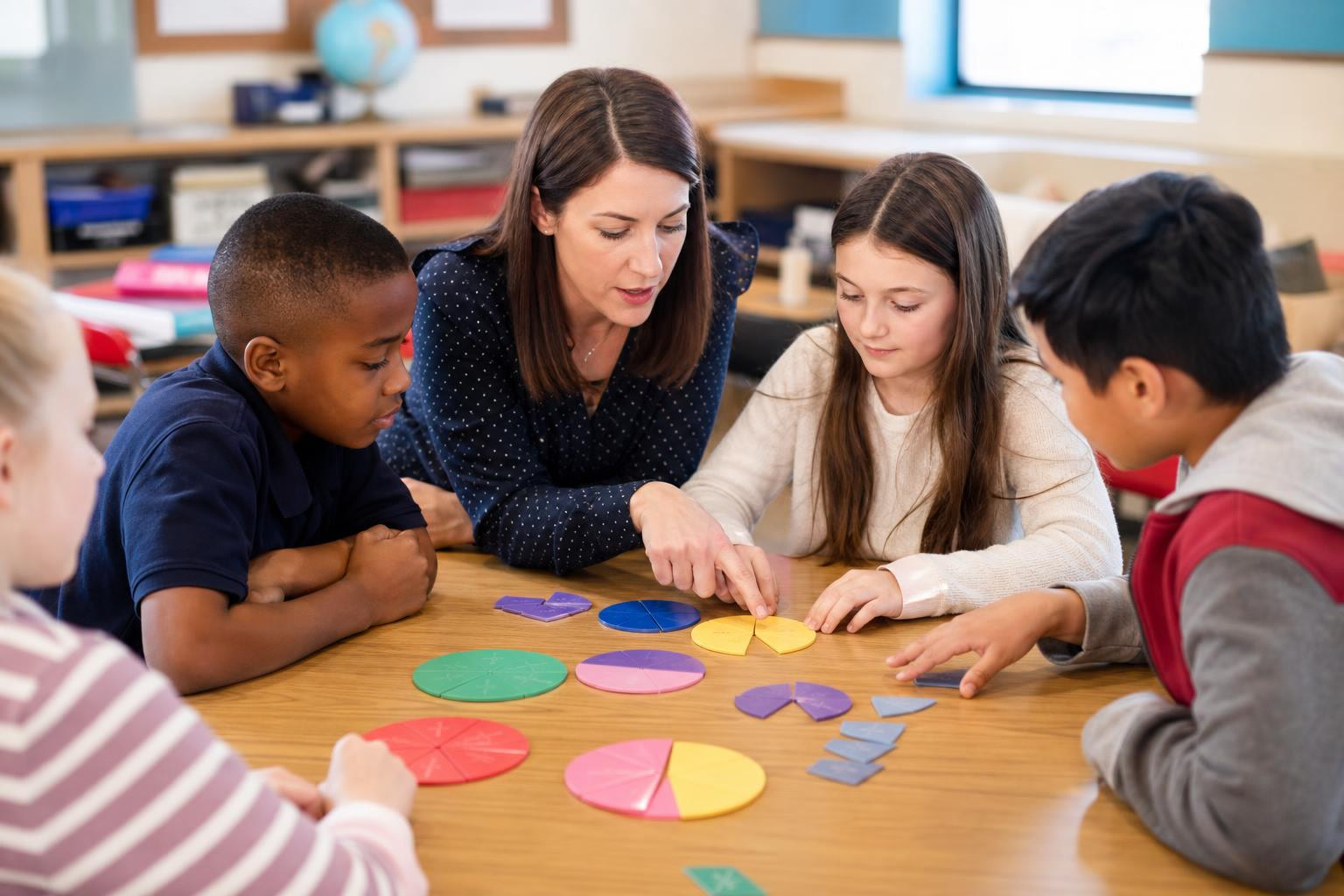
These are the concrete foundation. The IES What Works Clearinghouse specifically recommends using visual representations because they help students “see” the math. Every hands-on fraction activity below builds that conceptual base before you move to symbols and procedures.
1. LEGO Fraction Towers
Best for: Visual and kinesthetic learners in K–5
Materials: LEGO or Duplo bricks in two colors, dice
How it works: Students roll two dice. One number determines the total bricks in the tower (denominator), the other determines how many are a specific color (numerator). They build the tower and write the fraction it represents. For older students, have them build two towers and compare the fractions.
Skill targeted: Identifying fractions, comparing fractions
Teacher bloggers consistently mention LEGOs as one of the most engaging fraction manipulatives because students already know how to work with them. No learning curve on the tool itself means all the cognitive effort goes toward the math.
2. Paper Plate Pizza Fractions
Best for: Introducing parts of a whole in grades K–3
Materials: Paper plates, markers, scissors
How it works: Give each student a blank paper “pizza crust” and have them divide it into a specific number of equal pieces. They decorate the slices with different toppings, then write fractions to describe what portion has pepperoni versus mushrooms versus plain cheese.
Skill targeted: Partitioning into equal parts, writing fractions
3. Play-Doh Fraction Cutting
Best for: Tactile exploration in grades K–3
Materials: Play-Doh or modeling dough, plastic knives
How it works: Each student flattens a ball of dough into a circle. You call out fractions, and students use a plastic knife to cut their dough into that many equal parts. The physical act of cutting reinforces what “equal parts” actually means, which is where many misconceptions start.
Skill targeted: Equal partitioning, unit fractions
4. Candy Fraction Sorting
Best for: Engaging reluctant learners in grades 2–5
Materials: Small bags of M&Ms or Skittles, paper, pencils
How it works: Students sort candy by color, then write each color as a fraction of the total. Extensions include ordering the fractions from least to greatest, finding equivalent fractions, or comparing their fractions with a partner’s bag.
Skill targeted: Writing fractions, comparing, ordering
5. Paper Folding Fractions
Best for: Building equivalence understanding in grades 2–4
Materials: Blank paper (multiple sheets per student)
How it works: Students fold paper into halves, then fourths, then eighths. After folding, they unfold and label each section. The visual proof that 1/2 and 2/4 cover the same area is more convincing than any rule you could state. Mel, a third grade teacher who blogs at More Time 2 Teach, emphasizes that “when teaching fractions, it is important to stay away from simply presenting students with a set of rules to follow.” Paper folding is one of the simplest ways to follow that advice.
Skill targeted: Equivalent fractions, unit fractions
6. Pattern Block Equivalent Fractions
Best for: Hands-on equivalence exploration in grades 3–5
Materials: Pattern blocks (hexagons, trapezoids, rhombuses, triangles)
How it works: The hexagon represents one whole. Students discover that the trapezoid is 1/2, the rhombus is 1/3, and the triangle is 1/6. From there, they build equivalent fraction statements: two triangles equal one rhombus, so 2/6 = 1/3. Practitioners on teaching blogs like Teaching with a Mountain View consistently rank pattern blocks among the most engaging fraction manipulatives.
Skill targeted: Equivalent fractions, fraction relationships
7. Fraction Strips With Dominoes
Best for: Comparing and converting in grades 3–6
Materials: Fraction strip sets, dominoes
How it works: Students pick two dominoes and treat each as a fraction (larger number on top). They use fraction strips to compare the two fractions and determine which is greater. For advanced students, convert improper fractions to mixed numbers using the strips as proof.
Skill targeted: Comparing fractions, improper fractions, mixed numbers
8. Straw Number Line
Best for: Number line placement in grades 3–5
Materials: Straws, scissors, tape, paper
How it works: Students cut straws into segments representing different fractions of a whole straw. They tape a full straw to paper as a number line from 0 to 1, then place cut segments at the correct positions. This directly supports the IES recommendation to use number lines as a “central representational tool.”
Skill targeted: Placing fractions on a number line
If you want a printable companion worksheet to pair with any of these hands-on activities, you can generate a custom fractions worksheet in about 30 seconds by entering the topic, grade level, and difficulty.
Fraction Games Students Love
Games turn repetitive fraction practice into something students actually want to do. The key is choosing games where the fraction thinking is the gameplay itself, not just a skin layered over drill.
1. Fraction War
Best for: Fast-paced comparison practice in grades 3–6
Materials: Standard playing cards (remove face cards, or assign J=11, Q=12, K=0)
How it works: Each player flips two cards. The first card is the numerator, the second is the denominator. Players compare their fractions. The player with the larger fraction takes all four cards. If fractions are equal, it’s “war,” and players flip again. This is probably the single most recommended fraction game across teacher blogs, and for good reason: zero prep, high engagement, constant practice.
Skill targeted: Comparing fractions, benchmarking to 1/2 and 1
2. Domino Fractions
Best for: Improper fractions and mixed numbers in grades 4–6
Materials: A set of dominoes
How it works: Place all dominoes face down. Each student draws one and positions it with the larger number on top as the numerator. Students then convert the improper fraction to a mixed number. Partners compare mixed numbers to see who has the larger value.
Skill targeted: Improper fractions, mixed numbers, comparing
3. Fraction Bingo
Best for: Whole-class review in grades 2–5
Materials: Bingo cards with fraction representations, calling cards
How it works: You call out a fraction (or hold up a visual model), and students find the matching representation on their boards. Boards can include area models, number lines, written fractions, or equivalent expressions depending on the skill you’re targeting. You can create custom fraction bingo cards that match exactly what your class is working on.
Skill targeted: Fraction identification, equivalence, multiple representations
4. Fraction Spinner Games
Best for: Partner practice in grades 3–5
Materials: Paper clip, pencil, spinner board with fraction sections
How it works: Make a spinner using a paper clip and pencil on a circle divided into fraction sections. Students spin and must name the fraction, find an equivalent fraction, or add the fraction to their running total (first to reach exactly 3 whole wins). The spinner is easy to make and customize for whatever skill you’re practicing that week.
Skill targeted: Identifying, equivalence, addition
5. Fraction Charades
Best for: Active classrooms and kinesthetic learners in grades 3–5
Materials: Fraction cards
How it works: Each group receives a fraction card and must figure out how to physically act out that fraction without talking. For 3/4, three of four group members might stand while one sits. Kayla Bernardez, a teacher blogger, notes that Fraction Charades seems confusing at first but is “actually pretty awesome and great for practice identifying fractions.”
Skill targeted: Fraction identification, part-whole understanding
6. Fraction Golf
Best for: Adding fractions practice in grades 4–6
Materials: Fraction cards, scorecard
How it works: Create a 9-hole “course” where each hole has a target sum (like 1 whole or 1 1/2). Students draw fraction cards and try to reach the target sum in as few draws as possible. Fewer draws equals a lower score, just like real golf. This naturally practices addition of fractions with unlike denominators.
Skill targeted: Adding fractions, strategic thinking
Real-World and Project-Based Fraction Activities
Explore 26 free AI tools for teachers
Browse All Tools →These activities answer the eternal student question: “When will I ever use this?” They also develop the critical thinking skills that standardized tests try to measure but worksheets alone can’t build.
1. Recipe Conversion Challenge
Best for: Equivalent fractions and multiplication in grades 4–6
Materials: Printed recipes, measuring cups (optional for verification)
How it works: Give students a recipe that serves 4 and ask them to rewrite it to serve 6, 8, or 2. The constraint: they can only use a 1/4 cup and 1/3 cup measure. Students must convert every measurement using equivalent fractions. Calling this “A Recipe for Disaster” and framing it as a cooking show challenge adds engagement.
Skill targeted: Equivalent fractions, multiplying fractions
After a project like this, a quick formative check helps you see who got it and who’s still shaky. You can build a fraction quiz aligned to the specific skill in a couple of minutes.
2. Classroom Survey Fractions
Best for: Connecting fractions to data in grades 2–5
Materials: Whiteboards, markers
How it works: Ask the class questions (“Who likes popcorn? Who has a pet?”) and have students write fractions on whiteboards based on the responses. If 27 out of 28 students like popcorn, that’s 27/28. Then discuss: is that close to 1 whole? Could we simplify it? This grounds fractions in real, visible data.
Skill targeted: Writing fractions, benchmarking, simplifying
3. Name Fractions
Best for: Introduction to fractions in grades 2–4
Materials: Paper, pencils
How it works: Students write their full name and create fractions based on prompts: “What fraction of letters in your name are vowels? What fraction are capital letters? What fraction appear more than once?” Simple, personal, and requires zero materials beyond what’s already on every desk.
Skill targeted: Part-whole relationships, writing fractions
4. Fraction Museum
Best for: Synthesis and presentation in grades 3–6
Materials: Student-created fraction displays, index cards with questions
How it works: Each student creates an exhibit showing a fraction concept (equivalent fractions using area models, a number line display, a real-world fraction scenario). The class walks through the “museum,” visiting each exhibit and answering the creator’s question card. This forces students to teach, which deepens their own understanding.
Skill targeted: Multiple fraction concepts, mathematical communication
5. Bakery Shop Project
Best for: Operations with fractions in grades 4–6
Materials: Printed menus, play money (optional)
How it works: Students run a bakery where inventory, orders, and recipes all involve fractions. They need to figure out how many pies they can make if they have 7 1/2 cups of flour and each pie requires 1 3/4 cups. This naturally generates division and multiplication of fractions in a context that makes sense.
Skill targeted: Multiplying and dividing fractions, mixed numbers
Math Center and Station Ideas
Station rotations let you differentiate fractions math activities across skill levels while running small groups. Krejci Creations, an upper elementary teacher blogger, attributes fraction success to “three words: small group instruction,” reporting that students “excelled and performed at the top of my district on fraction concepts” using this approach.
1. Fraction Flapbook
Best for: Reference building in grades 3–5
Materials: Construction paper, scissors, markers
How it works: Students build a folded flapbook where each flap represents a different fraction, from 1 whole down to twelfths. Under each flap, they draw an area model, place the fraction on a number line, and list equivalent fractions. This becomes a personal reference tool they use all unit long.
Skill targeted: Multiple representations, equivalent fractions
2. Comparing Fractions Station
Best for: Targeted comparison practice in grades 3–5
Materials: Fraction cards, comparing mat with >, <, = symbols
How it works: Set up a mat with space for two fraction cards and a spot for greater than, less than, or equal symbols. Students draw two cards, place them on the mat, and determine the relationship. They must justify their answer using a strategy (benchmarking to 1/2, finding common denominators, or using a visual model).
Skill targeted: Comparing fractions with reasoning
3. Equivalent Fractions Accordion Book
Best for: Visual equivalence in grades 3–4
Materials: Sentence strips, fraction circles, glue, scissors
How it works: Students color and cut fraction circles, then glue them onto a folded sentence strip in order from smallest to largest denominator, showing equivalence chains (1/2 = 2/4 = 3/6 = 4/8). The accordion format makes a satisfying visual display.
Skill targeted: Equivalent fractions, ordering
4. Task Card Rotation
Best for: Flexible skill practice in grades 3–6
Materials: Printed task cards (sets of 12–20), recording sheets
How it works: Place task card sets at different stations, each targeting a different fraction skill. Students rotate through stations, solving cards and recording answers. The game format keeps energy up. For a fresh set of fraction task cards on any specific skill, a worksheet generator can produce new problems every time you need them.
Skill targeted: Varies by station (any fraction skill)
5. Writing About Fractions Station
Best for: Deepening conceptual understanding in grades 3–6
Materials: Writing prompts, paper or journals
How it works: Students respond to prompts like “Why is 2/4 the same as 1/2? Explain using a picture and words” or “A friend says 1/3 is bigger than 1/2 because 3 is bigger than 2. Write them a letter explaining why they’re wrong.” As one teacher, Buzzing with Ms. B, puts it: “It’s amazing how writing deepens understanding, and gives those quiet thinkers a chance to shine!”
Skill targeted: Mathematical reasoning, misconception correction
Printable and AI-Generated Fraction Worksheets
Worksheets still have their place, particularly for independent practice, homework, and assessment. The evolution is in how you create them.
1. Color-by-Fractions
Best for: Engaging independent practice in grades 2–4
Materials: Printed worksheets, colored pencils
How it works: Students solve fraction problems. Each answer corresponds to a color, and they color sections of a picture accordingly. A wrong answer means the picture looks off, creating built-in self-checking.
Skill targeted: Varies (identification, equivalence, basic operations)
2. Fraction Number Line Worksheets
Best for: Number line fluency in grades 3–5
Materials: Printed worksheets
How it works: Students place fractions on pre-drawn number lines, identify fractions at marked points, or compare fractions using the number line as a tool. The IES specifically recommends number line work as foundational.
Skill targeted: Placing fractions on number lines, comparing
3. Differentiated Fraction Worksheet Packs
Best for: Classrooms with mixed skill levels in grades 3–6
Materials: Printed worksheets at multiple difficulty levels
How it works: Create three tiers of the same skill: approaching, on level, and advanced. Students work at their level, which keeps struggling students from shutting down and advanced students from zoning out.
Skill targeted: Any fraction skill at differentiated levels
4. AI-Generated Custom Fraction Worksheets
Best for: Differentiation at scale in grades K–8
Materials: Computer, printer
How it works: Instead of spending 20 minutes hunting for the right worksheet or modifying one that’s close but not quite right, you type “equivalent fractions grade 4” into an AI worksheet generator and get a print-ready worksheet with an answer key. You can adjust the difficulty, change the number of problems, and generate a completely different version for your advanced group in another 30 seconds.
TeachTools’ worksheet generator uses simple form inputs (topic, grade, difficulty) so you don’t need to write elaborate prompts. It exports to PDF and Google Docs. For teachers concerned about privacy, TeachTools is designed with FERPA compliance in mind, with AES-256 encryption and a policy of not training on user data.
Skill targeted: Any fraction skill, customized to your exact needs
If you want to compare options before choosing a tool, here’s a roundup of the best free AI worksheet generators.
Digital Fraction Games and Apps
1. SplashLearn
Best for: Adaptive fraction practice in grades K–5
An online platform with fraction games covering everything from identifying parts of a whole to operations. The adaptive engine adjusts difficulty based on student performance. Free for teachers with a classroom account.
2. Math Playground
Best for: Game-based fraction exploration in grades 3–6
Offers dozens of fraction games organized by skill. The visual fraction models are particularly strong. Free to use with ads, or ad-free with a subscription.
3. Prodigy
Best for: Gamified fraction practice that feels like an RPG, grades 1–8
Students answer fraction questions to progress in an adventure game. The math is real but the context keeps students playing voluntarily. Free tier available; premium adds parent and teacher reporting features.
Cross-Curricular Fraction Connections
These aren’t numbered activities, but they’re worth weaving into your fraction unit for students who connect to fractions through other subjects.
Fraction picture books: Books like “Fraction Fun” by David Adler or “Give Me Half” by Stuart Murphy introduce fraction concepts through story. Reading one aloud before a hands-on activity primes understanding. Jillian Starr, who teaches and blogs at Teaching with Jillian Starr, describes hands-on fraction activities as “the keystone to understanding abstract concepts such as unit fractions,” and picture books create the bridge between story and hands-on work.
Music and fractions: Whole notes, half notes, quarter notes, and eighth notes are fractions made audible. Students who struggle with written fractions sometimes grasp them instantly when they hear that two half notes fill the same time as one whole note. Research shows math and music are deeply intertwined, and learning to read music has helped students learn more complex mathematical concepts.
Tips for Making Fractions Math Activities Stick
After working through dozens of fractions math activities, here’s what the research and practitioner experience point to:
Start with estimation. Before students calculate anything, ask them to estimate. “Is 3/8 + 4/8 going to be more or less than 1?” This builds number sense that procedural work alone never develops.
Use number lines alongside area models. Many classrooms rely only on pie charts and shaded rectangles. The number line helps students see fractions as numbers with positions, not just pieces of a shape.
Let students explain. The NCTM past president has warned that “so many misconceptions have happened because we’ve just told the students what to do.” Pair activities with partner discussions or the writing station described above.
Don’t rush to tricks. The butterfly method and “Keep, Change, Flip” have their place, but only after conceptual understanding is solid. Jumping to algorithms too early is exactly what creates the fragile fraction knowledge that crumbles in algebra.
Use AI tools for differentiated practice. Generating three versions of a worksheet (one for each skill level in your classroom) used to take half an hour of searching and editing. AI worksheet generators reduce that to minutes. You can explore all 23 teacher tools to see what fits your workflow beyond just worksheets.
Frequently Asked Questions
What is the best way to introduce fractions to students?
Start with concrete, hands-on activities before moving to pictures and then abstract symbols. This concrete to pictorial to abstract progression is backed by both the IES What Works Clearinghouse and the NCTM. Paper folding, Play-Doh cutting, and paper plate pizza fractions are all strong starting points because they let students physically create equal parts.
What grade do students start learning fractions?
Under Common Core standards, formal fractions instruction begins in grade 3 with unit fractions and number line placement. However, many teachers introduce foundational concepts (halves, fourths) in grades 1 and 2 through sharing activities and simple partitioning.
Why do students struggle with fractions?
The most common issue is applying whole number thinking to fractions. NAEP data from 2013 showed that 39 percent of U.S. fourth graders added both numerators and denominators when asked to add fractions (for example, computing 1/2 + 1/3 as 2/5). This happens when students haven’t built conceptual understanding of what fractions represent before being taught procedures.
How can I differentiate fraction activities for mixed-ability classrooms?
Use the same activity format but adjust the numbers. In Fraction War, younger or struggling students can use only cards 1 through 5 (keeping fractions simple), while advanced students use the full deck and must convert improper fractions to mixed numbers. AI worksheet generators are also effective here because you can produce three difficulty levels of the same skill in minutes.
Are fraction games effective for learning, or just fun?
Both, when designed well. Games like Fraction War require students to compare fractions dozens of times in a single session, producing far more practice repetitions than a worksheet would. The competitive element also triggers engagement that sustains attention. The key is choosing games where the fraction thinking is required for gameplay, not optional.
What are the most important fraction skills before middle school?
By the end of grade 5, students should be fluent with adding and subtracting fractions with unlike denominators and should understand multiplication and division of fractions. Research shows that this fraction knowledge is the strongest predictor of algebra success, more than whole number arithmetic, IQ, or family background.
Can AI tools help with teaching fractions?
Yes, particularly for generating differentiated practice materials and assessments. Instead of searching for the right worksheet, you can describe what you need (topic, grade, difficulty) and get a print-ready resource with an answer key. TeachTools’ worksheet generator is built specifically for teachers, with simple form inputs that don’t require prompt engineering. It’s free to start with 5 generations per month.
How do I assess fraction understanding beyond tests?
The Fraction Museum activity, writing station, and project-based activities all serve as formative assessments. You can also use quick exit tickets generated through an AI quiz generator that produces 3 to 5 targeted questions on the day’s skill. These give you a snapshot of understanding without the weight of a formal test.