Famous National Parks: Definition, Top Examples (2026)
TL;DR
Famous national parks are protected areas recognized worldwide for their iconic landscapes, wildlife, history, or conservation importance. The United States has 63 sites officially named “National Park,” with Yellowstone, Grand Canyon, Yosemite, and Great Smoky Mountains among the most famous. These parks are valuable classroom topics because they connect geography, science, history, and civic responsibility in ways students remember.
The phrase “famous national parks” comes up in classrooms, travel conversations, and school research projects constantly. But what actually makes a national park famous? It is not always the park with the longest lines or the most Instagram posts. Fame comes from a combination of factors: an unforgettable landscape, a place in history, sheer visitor numbers, or the fact that nearly every geography textbook mentions it.
This guide breaks down what famous national parks are, which ones students and teachers should know, what makes them important, and how to turn this topic into a classroom activity that sticks.
Create a national parks worksheet with TeachTools and have a print-ready fact file for students in minutes.
What Does “Famous National Parks” Mean?
A famous national park is a protected place that many people recognize because it showcases something remarkable about nature, history, geography, or conservation. “Famous” does not automatically mean “best” or “most visited.” It means widely known.
National parks exist to conserve scenery, natural and historic objects, and wildlife while allowing public enjoyment in a way that leaves them unimpaired for future generations. That is the mission Congress set when it created the National Park Service on August 25, 1916.
A park becomes famous when it has a feature people can name without thinking. Say “Old Faithful” and people think Yellowstone. Say “the Grand Canyon” and most people picture Arizona’s mile-deep gorge. That instant recognition is what separates famous national parks from the hundreds of other protected areas most people have never heard of.
A Simple Classroom Definition
A famous national park is a protected place that many people know and study because it shows something important about nature, history, geography, or conservation.
Quick Facts
- The U.S. National Park System includes 433 areas covering more than 85 million acres across every state, Washington D.C., and U.S. territories.
- Only 63 of those sites carry “National Park” as part of their official name.
- Yellowstone was established on March 1, 1872, as the world’s first national park.
- In 2025, the National Park Service recorded 323,014,305 recreation visits.
- National park visitors spent $29 billion near parks in 2024, contributing $56.3 billion in total economic output.
What Makes a National Park Famous?
Not every national park is equally well known. Some parks appear in every textbook. Others are just as beautiful but barely register in public awareness. A useful way to think about this in a classroom setting is the FAME framework:
| Factor | What It Means | Example |
|---|---|---|
| Foot traffic | Millions of people visit each year | Great Smoky Mountains had 11.5 million visits in 2025 |
| Awe factor | An unforgettable landscape, animal, or geologic feature | Yellowstone’s geysers, Yosemite’s granite cliffs |
| Milestone or history | A first, a turning point, or a cultural landmark | Yellowstone was the world’s first national park (1872) |
| Education value | Frequently used in school lessons, books, and documentaries | Grand Canyon appears in nearly every U.S. geography curriculum |
A park does not need all four to be famous. Yellowstone checks every box. Acadia is famous mainly through foot traffic and education value. Serengeti is globally famous because of its awe factor and wildlife migration, even though most American students will never visit it.
This framework gives students a way to analyze fame rather than just memorize a list. Teachers looking for structured lesson approaches can create a lesson plan around these four categories and have students classify parks by which factors apply.
Examples of Famous National Parks
The table below covers the most famous U.S. national parks and one global example. Each entry includes a classroom hook that teachers can use for research prompts, worksheets, or discussion questions.
| Famous National Park | Location | Why It Is Famous | Classroom Hook |
|---|---|---|---|
| Yellowstone | Wyoming, Montana, Idaho | World’s first national park (1872); geysers, hot springs, wildlife | Geology, conservation history, food webs |
| Grand Canyon | Arizona | Mile-deep canyon carved by the Colorado River; UNESCO World Heritage site | Erosion, geologic time, landforms, map skills |
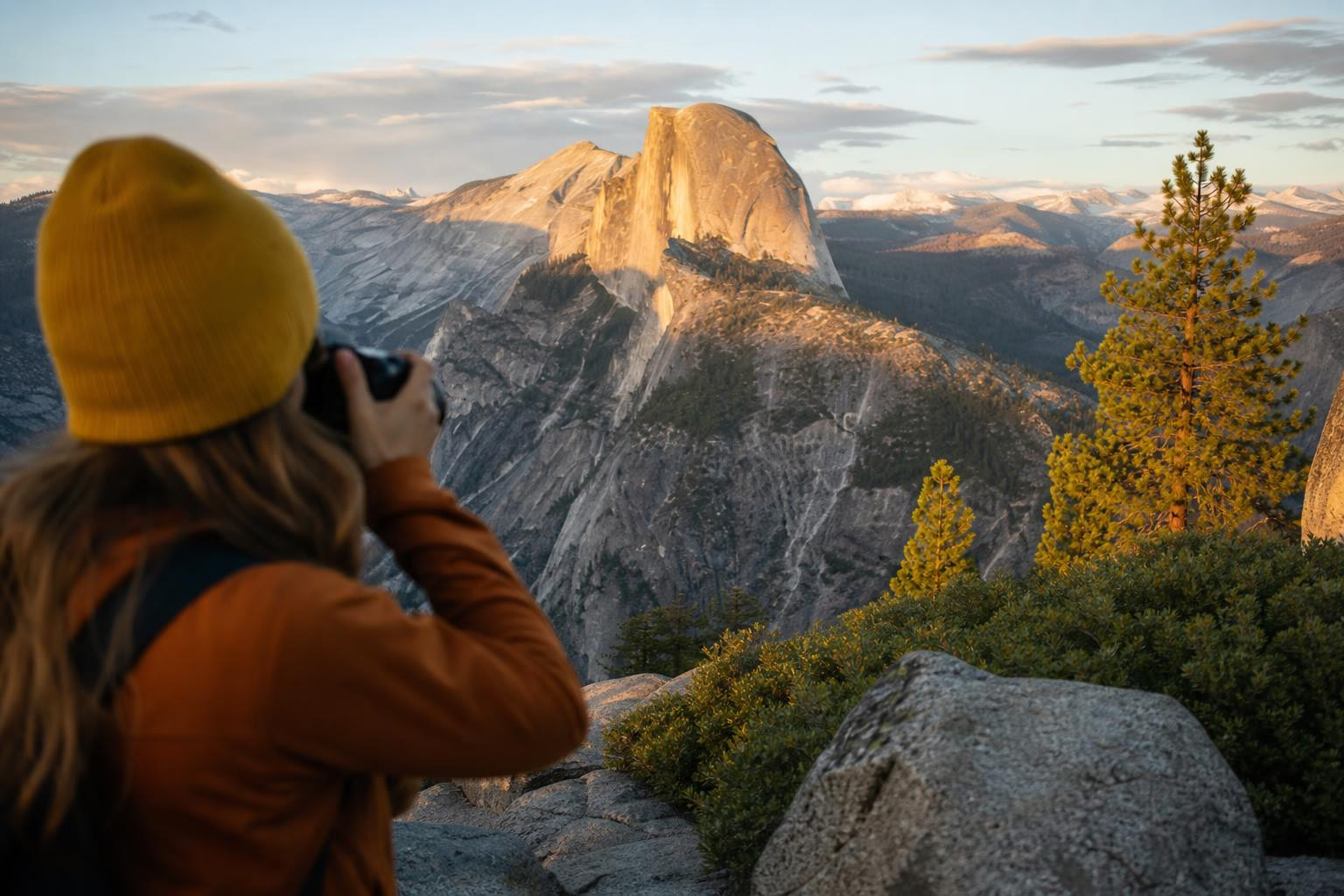
| Yosemite | California | Waterfalls, granite cliffs, giant sequoias, conservation history | Glaciers, watersheds, descriptive writing |
| Great Smoky Mountains | Tennessee, North Carolina | Most visited U.S. national park in 2025 (11.5 million visits) | Biodiversity, Appalachian geography, data analysis |
| Zion | Utah | Iconic canyon landscapes, one of the most visited parks | Desert ecosystems, erosion, visitor management |
| Rocky Mountain | Colorado | Alpine ecosystems, timed-entry reservation discussions | Elevation, ecosystems, data and planning |
| Acadia | Maine | Key Atlantic Coast park, one of the top 10 most visited | Coastal geography, habitats, tourism economics |
| Olympic | Washington | Rainforest, coast, and mountains in one park | Ecosystem comparison, climate zones |
| Glacier | Montana | Shrinking glaciers, alpine landscapes, wildlife | Climate science, maps, environmental change |
| Serengeti | Tanzania | Annual wildebeest migration; UNESCO World Heritage site | Animal migration, food webs, world geography |
For teachers building reading comprehension activities, any of these parks works as the subject of an informational passage. Students can read about one park and answer questions about its location, features, and importance.
Famous vs. Most Visited: What Is the Difference?
Explore 26 free AI tools for teachers
Browse All Tools →People use “famous,” “most visited,” and “best” interchangeably, but these are three different things.
Famous means widely recognized. The Grand Canyon is famous because nearly everyone on earth has seen a picture of it. Most visited means the park with the highest annual visitor count, which is measured by the National Park Service each year. Best is subjective and depends entirely on what someone values, whether that is solitude, wildlife, hiking, history, or accessibility.
Here are the most visited U.S. national parks in 2025, based on NPS recreation visit data:
| Rank | National Park | 2025 Recreation Visits |
|---|---|---|
| 1 | Great Smoky Mountains | 11,527,939 |
| 2 | Zion | 4,984,525 |
| 3 | Yellowstone | 4,762,988 |
| 4 | Grand Canyon | 4,430,653 |
| 5 | Yosemite | 4,278,413 |
| 6 | Rocky Mountain | 4,171,431 |
| 7 | Acadia | 4,079,318 |
| 8 | Grand Teton | 3,800,648 |
| 9 | Olympic | 3,584,187 |
| 10 | Glacier | 3,136,557 |
Great Smoky Mountains tops the visitation list every year, partly because it sits between two major population centers, charges no entrance fee, and is accessible by car from much of the eastern United States. But when people picture “famous national parks,” they often think of Yellowstone, Grand Canyon, or Yosemite first because of their iconic imagery and global recognition.
The classroom takeaway: famous parks are not always the quietest, and the most visited parks are not automatically the “best” for every purpose. A better question for students is, “Famous for what?”
Practitioners on Reddit reinforce this distinction. In one r/NationalPark thread about overrated parks, a highly upvoted comment argued that parks like Yosemite and Zion are not overrated, just overcrowded. The scenery is as stunning as advertised. The crowds are the problem, not the park itself.
This table makes a strong classroom data exercise. Students can build a quiz from the visitation numbers, create bar graphs, or calculate differences between parks.
Why Famous National Parks Matter
Conservation
Parks protect ecosystems, wildlife, geologic features, and cultural resources that would otherwise face development pressure. The NPS Organic Act explicitly requires conservation of these resources while still allowing the public to enjoy them.
Education
The National Park Service calls national parks “America’s largest classrooms.” Parks provide lesson content for geography, earth science, biology, history, civics, and even math (through visitation data and economic impact numbers).
Local Economies
Visitor spending near national parks totaled $29 billion in 2024 and supported $18.8 billion in labor income. Famous parks anchor entire regional economies, from gateway towns to guiding services to restaurants.
Civic Stewardship
Parks raise questions students need to grapple with: Who decides what land to protect? How do you balance public access with conservation? What happens when a park gets too popular? These are real civics and ethics problems, not hypothetical ones.
Teachers working on earth day activities can use national parks as the centerpiece of a conservation unit.
Common Misconceptions About Famous National Parks
“The U.S. has 433 national parks.”
Not quite. The National Park System has 433 areas, but only 63 carry the “National Park” designation. The rest include national monuments, battlefields, seashores, historic sites, recreation areas, and scenic trails. Reddit discussions on r/AskAnAmerican show this confusion is widespread. Many people have visited an NPS site without realizing it because they assumed “national park” only meant places like Yellowstone.
“The most famous park is the most visited.”
Great Smoky Mountains consistently leads in visitor counts, but Yellowstone and Grand Canyon are often more recognizable globally because of their geology and conservation history. Fame and foot traffic overlap but are not the same thing.
“National parks are only about wilderness and scenery.”
More than half the National Park System preserves places tied to human history: archaeological sites, battlefields, historic buildings, and cultural landscapes. The NPS designation guide explains how different categories protect different types of resources.
“Crowded means overrated.”
This is one of the most common complaints about famous national parks, and it misses the point. A crowded park is still a remarkable place. The Grand Canyon does not become less deep because the parking lot is full. Multiple Reddit users in park discussion threads separate crowding (a logistics issue) from park quality (which remains high). Better timing, less popular trails, and shoulder-season visits can solve crowding without writing off the park.
Classroom Activities About Famous National Parks
These activities work for grades 3 through 8 and connect to geography, science, social studies, and data literacy standards.
Activity 1: Famous National Park Fact File
Students pick one park and answer a set of research questions: Where is it? When was it created? Why was it protected? What natural or cultural resources does it preserve? How many people visit each year? What makes it famous? This format mirrors the NPS “What is a National Park?” lesson, designed for grades 3 through 5.
Activity 2: Create a National Park
Students design a fictional park. They map trails, identify scenic or historic resources, write visitor rules, create a brochure, and discuss what happens when too many people visit. The NPS offers a “Create a National Park” lesson that uses a similar simulation with entrance fees, maps, and resource-protection discussions.
Activity 3: Visitation Data Challenge
Give students the 2025 NPS top 10 visitation table. Ask them to order parks by visits, build a bar graph, calculate the difference between the most and least visited, and figure out what percentage of total NPS visits came from Great Smoky Mountains alone (hint: roughly 3.6%). For teachers building quick assessments, this is a natural fit for grade-appropriate comprehension worksheets.
Activity 4: Park Designation Sort
Create cards labeled national park, national monument, national seashore, national historic site, and national recreation area. Give students example sites and ask them to sort by designation and explain what each category protects. This builds vocabulary and classification skills.
Activity 5: Virtual Ranger Visit
When field trips are not possible, NPS distance-learning programs fill the gap. Yosemite offers free live sessions with a ranger (30-minute lesson plus 15-minute Q&A), and Yellowstone runs 20 to 40 minute programs covering geology, ecology, cultural history, and careers. These can anchor a virtual field trip day without leaving the classroom.
Activity 6: Junior Ranger Badge Design
Students create their own ranger badge, pledge, or activity booklet for a real or imaginary park. Reddit users with kids report that the official Junior Ranger program is one of the most memorable parts of a park visit. Children earn workbooks and badges by completing activities and talking to rangers. Bringing that format into the classroom, even without a trip, builds engagement.
National Parks Vocabulary Words
These terms are useful for vocabulary mats, word walls, or review games.
- National park — a protected area set aside by the government to conserve natural or cultural resources
- Conservation — the careful protection and management of natural resources
- Ecosystem — a community of living things and their environment working together
- Habitat — the natural home of a plant or animal
- Geyser — a hot spring that erupts periodically, shooting water and steam into the air
- Canyon — a deep, narrow valley with steep sides, often carved by a river
- Ranger — a person who works to protect and manage a park
- Stewardship — the responsible care and management of something entrusted to you
- Public lands — lands owned by the government and open to the public
- Wildlife — animals living in their natural habitat
For a quick vocabulary review, teachers can turn these terms into a bingo game that students play as a warm-up or exit activity.
A Note on Global Famous National Parks
While most searches for “famous national parks” focus on the United States, parks worldwide carry the same kind of recognition. Serengeti National Park in Tanzania is globally famous for the annual migration of over a million wildebeests, plus gazelles and zebras, followed by predators. UNESCO describes it as one of the world’s most impressive natural spectacles. Canada’s Banff and Jasper, part of the Canadian Rocky Mountain Parks UNESCO site, are equally iconic.
A useful classroom extension: have students compare Yellowstone and Serengeti. Both are UNESCO World Heritage sites. Both are famous for wildlife. But they protect very different ecosystems on different continents. What makes each one famous, and to whom?
Frequently Asked Questions
What are famous national parks?
Famous national parks are protected areas that many people recognize because of their landscapes, wildlife, history, geologic features, visitor numbers, or role in conservation. Well-known examples include Yellowstone, Grand Canyon, Yosemite, Great Smoky Mountains, and Serengeti.
What is the most visited U.S. national park?
In 2025, Great Smoky Mountains National Park was the most visited, with 11,527,939 recreation visits according to NPS data.
Is Yellowstone the first national park?
Yes. Yellowstone was established on March 1, 1872, and the National Park Service describes it as the world’s first national park.
How many national parks are in the United States?
There are 63 U.S. sites with “National Park” in their official name. The broader National Park System includes 433 areas with many designations, including monuments, historic sites, battlefields, seashores, and recreation areas.
What is the difference between a national park and a national monument?
A national park generally contains a variety of resources and covers a large land or water area. A national monument usually preserves at least one nationally significant resource and is often smaller or less diverse in attractions.
Why are national parks useful for students?
National parks help students study geography, ecosystems, geology, history, conservation, data analysis, and civic responsibility. The NPS provides lesson plans, distance learning programs, field trip resources, and classroom materials designed for educators.
Can students visit national parks for free?
U.S. fourth graders can use the Every Kid Outdoors program for free access to over 2,000 federal lands and waters, including national parks. Teachers should check official NPS rules before planning group visits.
Famous national parks are more than scenic backdrops for vacation photos. They are living classrooms where students can study erosion, migration, conservation ethics, economic impact, and the responsibilities that come with shared public resources. Whether the lesson involves a virtual ranger visit, a data table, or a fictional park brochure, these places give teachers material that students actually want to learn about.
Ready to turn this topic into a classroom activity? Try TeachTools for free and create worksheets, quizzes, or lesson plans about national parks in minutes.