ESL Vocabulary Games Printable: 11 Free Picks (2026)
TL;DR
Printable vocabulary games beat traditional word lists for ESL learners because they create multiple exposures and emotional connections to new words. This article covers 11 research-backed, printable ESL vocabulary games organized by proficiency level (CEFR A1 through C1), with free sources for each and practical tips for differentiation. If you need games matched to your specific word list rather than generic topics, AI generators can produce custom printable vocabulary activities in under a minute.
Why Printable Games Beat Word Lists for ESL Vocabulary
The “read the list, memorize the definitions, take the quiz” cycle fails most English language learners. It fails because it treats vocabulary acquisition as a single-exposure event when research consistently shows it requires multiple encounters across different contexts.
John Hattie’s Visible Learning research puts direct vocabulary instruction at an effect size of 0.63, well above the 0.40 threshold for meaningful impact. Games that force students to manipulate words in context push retention even higher. A study published through ERIC found that the use of games in foreign language learning benefits memory of vocabulary specifically, with measurable improvements in memorization rates. And the Journal of Adolescent & Adult Literacy found that direct instruction in vocabulary influences comprehension more than any other single factor.
Robert Marzano’s widely adopted 6-step vocabulary process offers a useful framework: the teacher provides a student-friendly definition, students restate it in their own words, they create a nonlinguistic representation, they engage in knowledge-deepening activities, they discuss with peers, and they play games for retrieval practice. Printable ESL vocabulary games serve steps four through six. They’re not a replacement for direct instruction. They’re the reinforcement layer that makes instruction stick.
The key principle is straightforward: multiple exposures in different formats equal retention. A student who encounters “reluctant” in a crossword clue, then spots it in a word search, then has to describe it without using the word “unwilling” in Taboo has three distinct neural pathways to that word instead of one.
For teachers looking to scaffold vocabulary instruction across mixed-ability ESL classrooms, differentiated content strategies make a significant difference in outcomes.
At-a-Glance Comparison Table
| Game | Best CEFR Level | Prep Time | Group Size | Skills Practiced | Free Source |
|---|---|---|---|---|---|
| Vocabulary Bingo | A1–B2 | 5–10 min | Whole class | Recognition, listening, spelling | Sadlier, iSLCollective |
| Word Search | A1–B2 | 2–5 min | Individual/pairs | Spelling, pattern recognition | EnglishWsheets, Tools for Educators |
| Crossword Puzzle | A2–C1 | 5–10 min | Individual | Spelling, definitions, decoding | ESL-Galaxy, Puzzlemaker |
| Board Game | A1–C1 | 10–15 min | Small groups (3–5) | Speaking, definitions, sentences | ESL Games World, MES-English |
| Taboo / Hot Seat | B1–C1 | Print only | Teams of 4+ | Circumlocution, synonyms | TES Marketplace |
| Memory Match | A1–B1 | 5 min (cut cards) | Pairs/small groups | Word-image association | EnglishWsheets, TPT |
| Dominoes | A2–B2 | Print + cut | Pairs/small groups | Collocations, phrasal verbs | TES Marketplace |
| Word Scramble | A1–B1 | 2 min | Individual | Spelling recall | ESLKidsWorld |
| I Have, Who Has? | A1–B1 | Print only | Whole class | Listening, definitions | ISL Collective |
| Question Cube | A2–C1 | 10 min (assemble) | Whole class | Synonyms, antonyms, context | Sadlier (free PDF) |
| Discussion Cards | B1–C1 | Print only | Pairs/small groups | Contextual use, fluency | TPT, Teach-This |
Now, the games themselves.
1. Vocabulary Bingo
Best for: Whole-class review sessions with high energy and low prep.
What it is: Students receive Bingo cards populated with vocabulary words or pictures. The teacher calls out definitions, context sentences, or clues. Students mark the matching word on their card. First to complete a row, column, or diagonal wins.
How to play:
- Print one unique Bingo card per student (or pair).
- The teacher reads a definition or shows an image.
- Students find and mark the corresponding vocabulary word.
- First student to complete a line calls “Bingo!” and reads back their words to verify.
Why it works for ESL: A study published in the International Journal of Academic Research and Business and Social Sciences found that implementing Bingo games in ESL classrooms significantly improved young learners’ vocabulary acquisition. The game creates a listening-to-recognition loop that passive study can’t replicate.
Proficiency levels: A1–B2. For young learners, make Bingo cards with pictures they must identify. For older or more advanced students, use vocabulary words with definition-based clues.
Practitioner tip: Experienced ESL teachers recommend requiring students to write definitions in their own words on the back of each card before playing. This processing step separates research-backed vocabulary strategies from passive word exposure. No writing, no playing.
Where to find free printables: Sadlier offers downloadable Bingo templates, and iSLCollective has community-uploaded sets.
Make your own: If your class is studying specific Chapter 7 vocabulary and no pre-made Bingo set matches, TeachTools has a Bingo card generator that creates printable cards by topic and grade level. Enter your words, hit generate, print.
2. Word Search Puzzles
Best for: Low-pressure independent practice and spelling reinforcement.
What it is: A grid of letters with hidden vocabulary words. Students scan the grid to find and circle target words.
How to play:
- Distribute the printed word search.
- Students locate and circle each vocabulary word in the grid.
- Optional extension: after finding a word, students write a sentence using it.
Why it works for ESL: Word search puzzles develop pattern recognition, spelling accuracy, and vocabulary retention. Visually scanning for letter sequences helps cement new terminology because students must hold the correct spelling in working memory while searching. A systematic review noted that orthographic-focused strategies like spelling rehearsal and crossword puzzles reflect a practical approach to reinforcing spelling and word decoding, both crucial skills for English learners.
Proficiency levels: A1–B2. For beginners, limit the grid to horizontal and vertical directions with short words. For Grade 6+ and higher-level ESL learners, enable all eight directions and include longer academic vocabulary words of eight or more letters.
Differentiation tip: The strongest approach uses image hints as clues so students see a picture of each vocabulary item and must recall the word’s spelling to find it in the puzzle.
Where to find free printables: EnglishWsheets.com and Tools for Educators both offer customizable word search generators with built-in image libraries.
3. Crossword Puzzles
Best for: Simultaneous spelling and definition practice for individual learners.
What it is: An interlocking word grid where students fill in vocabulary words based on clues (definitions, example sentences, or pictures).
How to play:
- Hand out the printed crossword with its clue list.
- Students read each clue and write the corresponding vocabulary word in the grid.
- Intersecting letters provide built-in hints.
Why it works for ESL: Crosswords reinforce both spelling and meaning at the same time. Research confirms they support word decoding skills that are essential for English learners. The constraint of fitting letters into a grid forces precision that open-ended exercises don’t demand.
Proficiency levels: A2–C1. For lower levels, provide a word bank and first-letter hints. For advanced learners, remove all scaffolding and require synonyms as clues rather than definitions.
Where to find free printables: ESL-Galaxy and Discovery Education’s Puzzlemaker both allow free crossword generation. For a deeper look at designing crosswords that actually reinforce retention, this guide on vocabulary crossword design covers the research.
4. Board Games (Snakes & Ladders, Vocab Land)
Best for: Small group practice with speaking and definition skills built in.
What it is: Printable game boards where students roll dice and advance by correctly answering vocabulary questions. Popular formats include themed boards (pirate adventures, crocodile-themed paths) and vocabulary-adapted versions of classic games.
How to play:
- Print the board and a set of vocabulary question cards.
- Students take turns rolling dice and drawing a card.
- To keep their position, they must correctly define the word, use it in a sentence, or answer a vocabulary question.
- First player to reach the end wins.
Why teachers love them: Sadlier’s “Vocab Land,” for example, is a version of Candy Land where students must write in and then use vocabulary words to move along in game play. The social element, arguing over whether someone’s definition is close enough, generates the kind of negotiation of meaning that second language acquisition theory prizes.
Proficiency levels: A1–C1. Board games scale by simply changing the vocabulary on the question cards. Use picture cards for beginners and context-sentence cards for advanced learners.
Where to find free printables: ESL Games World, MES-English, and ESL-Galaxy all offer themed boards. Sadlier provides several free downloadable vocabulary game PDFs.
5. Taboo / Hot Seat Cards
Best for: Building circumlocution skills at intermediate and advanced levels.
What it is: Printed cards showing a target vocabulary word at the top and three to five “forbidden” words below it. The describing student must get teammates to guess the target word without using any of the forbidden words.
How to play:
- Divide the class into teams.
- One student draws a card and describes the target word to their team.
- They cannot say any of the forbidden words listed on the card.
- Teams earn a point for each correct guess within a time limit.
Why it works for ESL: Taboo forces circumlocution, which is one of the most important communication strategies for language learners. When a student can’t say “cold” or “frozen” to describe “frigid,” they reach for synonyms, examples, and paraphrasing. These are exactly the skills that transfer to real conversations where learners encounter vocabulary gaps.
Proficiency levels: B1–C1 for full play. A2 learners can participate if you simplify the rules, perhaps allowing gestures or reducing the number of forbidden words to two.
Where to find free printables: TES Marketplace offers bundles with 150 printable Taboo cards organized by CEFR level (A1 through C1+).
6. Memory Match / Flashcard Games
Best for: Word-image and word-definition pairing in pairs or small groups.
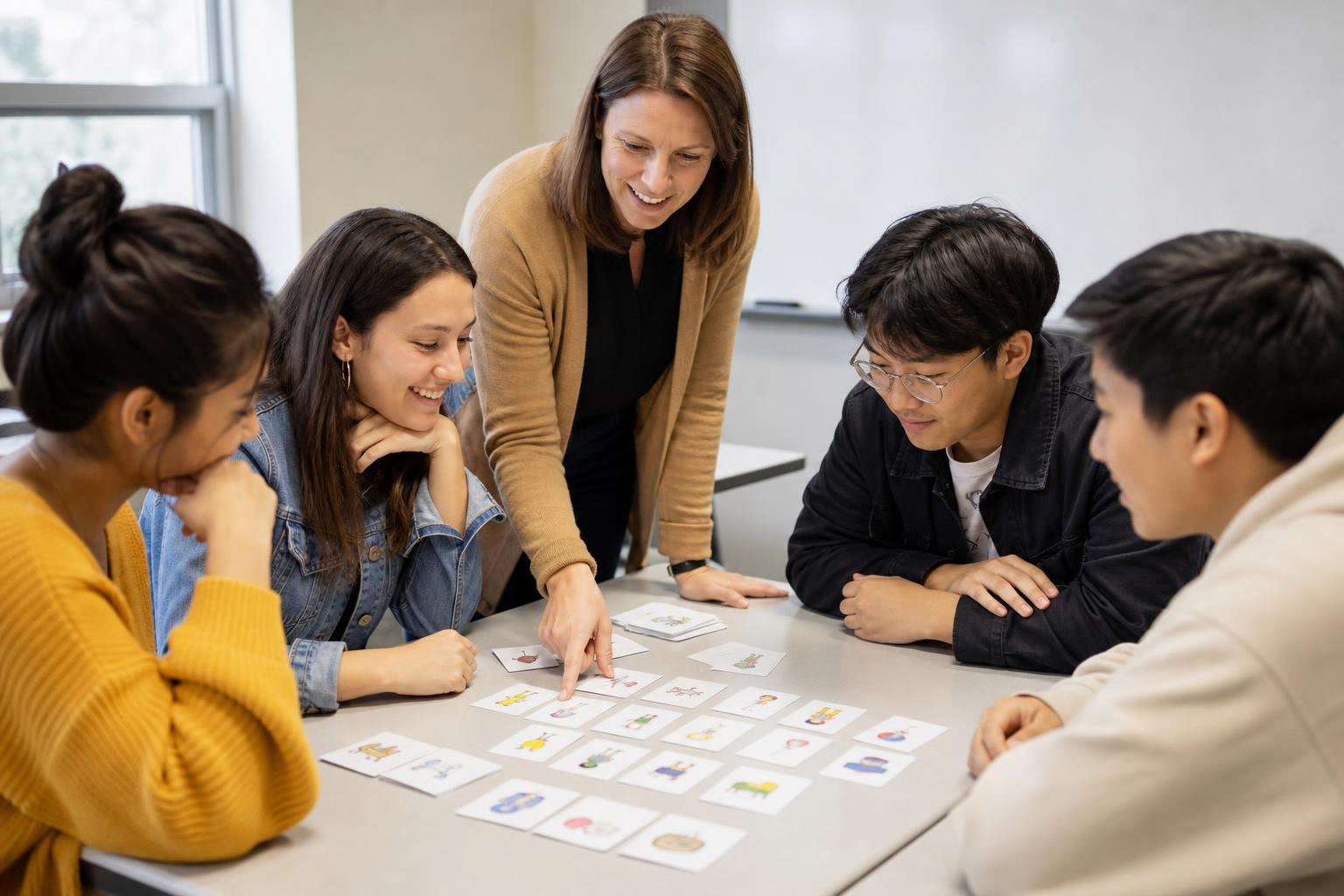
What it is: Printed cards used in multiple game formats. The core game is Memory Match: cards are placed face-down in a grid, and students flip two at a time trying to find matching pairs (word + definition, word + picture, or word + synonym).
Game variants using the same printed flashcards:
- Memory Match: Flip two cards, find the pair, keep them.
- Charades: Draw a card, act out the word.
- Pictionary: Draw a card, sketch the concept.
- Spiders and Candy: Students call out words and reveal hidden markers under flashcards to find candy or spiders (popular with younger learners).
Why it works for ESL: Research on flashcard use in language classrooms shows that when teachers integrate flashcards into active games rather than passive review, students are more likely to have fun and memorize new words more easily. The physical handling of cards also adds a kinesthetic dimension that screen-based study lacks.
Proficiency levels: A1–B1 for Memory Match. Charades and Pictionary work well up through B2.
Where to find free printables: EnglishWsheets.com offers topic-based flashcard sets. Teachers Pay Teachers has free sets filtered by ESL level.
For broader ideas on making vocabulary activities engaging for younger learners, fun vocabulary activities for Grade 3 offers several tested approaches.
7. Dominoes
Best for: Practicing collocations, phrasal verbs, and adjective pairs at intermediate levels.
What it is: Printed domino tiles with a word on one half and a matching definition or picture on the other. Students build a chain by matching the definition side of one tile to the word side of the next.
How to play:
- Cut out the domino tiles.
- Each student or pair receives a set.
- Players take turns placing a tile that correctly matches a word to its definition or image.
- The chain continues until all tiles are placed.
Why it works for ESL: The linear chain format means every connection requires a micro-decision about meaning. Unlike worksheets where students can guess and move on, dominoes require sequential accuracy because a wrong match breaks the chain.
Proficiency levels: A2–B2. Particularly effective for phrasal verbs (where students match “give” to “up” or “look” to “forward to”) and adjective-noun collocations.
Where to find free printables: TES Marketplace offers printable phrasal verb dominoes and adjective dominoes for intermediate learners.
8. Word Scramble / Unscramble
Best for: Quick warm-ups, early-finisher activities, or homework.
What it is: Students receive jumbled letters (e.g., T-A-R-E-W becomes WATER) and must rearrange them to form vocabulary words.
How to play:
- Distribute the printed scramble sheet.
- Students unscramble each set of letters to form a vocabulary word.
- Optional: add a definition or picture hint beside each scramble for lower levels.
Why it works for ESL: Word scrambles test spelling recall under a puzzle constraint without the social pressure of group games. They’re low-stakes and can be completed independently, making them ideal for mixed-pace classrooms.
Proficiency levels: A1–B1. Adding a time element (“unscramble all 10 words in 5 minutes”) increases challenge without changing the content.
Where to find free printables: EnglishWsheets.com and ESLKidsWorld both offer topic-organized scramble sheets.
9. “I Have, Who Has?” Cards
Best for: Whole-class chain review that keeps every student listening.
What it is: Each student holds a card that reads something like: “I have enormous. Who has the word that means ‘to make something smaller’?” The student holding “reduce” then reads their card, and the chain continues around the room.
How to play:
- Print one card per student.
- A designated student starts by reading their card.
- The student whose card answers the question reads next.
- Continue until the chain loops back to the first student.
Why it works for ESL: Practitioners describe this as a simple but highly engaging game for ESL students. Every student must listen actively because their turn could come at any moment. The oral component also gives pronunciation practice.
Proficiency levels: A1–B1. Excellent for reviewing a completed unit’s vocabulary.
Where to find free printables: ISL Collective and Sea of Knowledge both offer free “I Have, Who Has?” sets.
10. Vocabulary Question Cube
Best for: Generating varied practice with a single vocabulary word.
What it is: A printable cube template with a different prompt on each face: define it, use it in a sentence, give a synonym, give an antonym, draw it, act it out.
How to play:
- Print and assemble the cube (or use a soft foam die with printed labels taped on).
- One student selects a vocabulary word and tosses the cube.
- They perform the action shown on the face that lands up.
- Rotate to the next student with a new word.
Why it works for ESL: The randomness keeps students from preparing a single response. They must be ready to engage with a word in six different ways, which builds the kind of deep processing that Marzano’s framework calls “knowledge-deepening activities.”
Proficiency levels: A2–C1, adjusted by choosing vocabulary at the appropriate difficulty.
Where to find free printables: Sadlier offers free downloadable cube templates with vocabulary-specific prompts.
11. Conversation / Discussion Cards
Best for: Contextualizing vocabulary in authentic spoken communication.
What it is: Cards with vocabulary-rich discussion prompts organized by topic. Students draw a card and respond to the prompt, using target vocabulary in their answers.
How to play:
- Place cards face-down in a pile.
- Students work in pairs or small groups.
- One student draws a card and reads the prompt aloud.
- All group members respond, incorporating the target vocabulary word naturally.
Why it works for ESL: Discussion cards bridge the gap between “knowing a word” and “using a word.” Teachers Pay Teachers features resources like “Roll & Speak Dice Conversation Activity,” described as no-prep and perfect for ESL and EFL classrooms. The conversational context gives students a reason to use vocabulary rather than just define it.
Proficiency levels: B1–C1. Lower-level students benefit from sentence starters printed directly on the card (“I think ___ means… because…”).
Where to find free printables: TPT and Teach-This both offer topic-organized discussion card sets.
How to Make Custom Printable ESL Vocabulary Games with AI
Explore 26 free AI tools for teachers
Browse All Tools →Every free printable resource mentioned above shares one limitation: the word list was chosen by someone else. A “food vocabulary” word search from 2018 doesn’t include the 12 words from Chapter 4 of whatever textbook your class is reading this week. Practitioners on ESL forums consistently flag this mismatch as the biggest frustration with pre-made printables.
AI generators solve this by letting teachers input their own vocabulary list and receive a print-ready game in seconds. The workflow looks like this:
- Enter your vocabulary words (or just a topic and grade level).
- Select a game type (Bingo, crossword, word search).
- Choose the difficulty level so definitions and sentence complexity match your students’ proficiency.
- Generate and print the PDF.
What makes this approach powerful for ESL specifically is that generators adjusting definitions, sentence complexity, and example sentences to match proficiency levels can serve the mixed-ability classrooms that ESL teachers navigate daily. For beginners, you get simpler sentence frames and clearer definitions. For intermediate learners, the same word list produces more complex clues.
One practical outcome: you can build a full week of word study from a single list. A matching worksheet introduces definitions on Monday. A cloze worksheet practices words in context on Wednesday. A word search or crossword puzzle provides low-pressure review on Friday. Same 15 words, three different cognitive tasks, all print-ready.
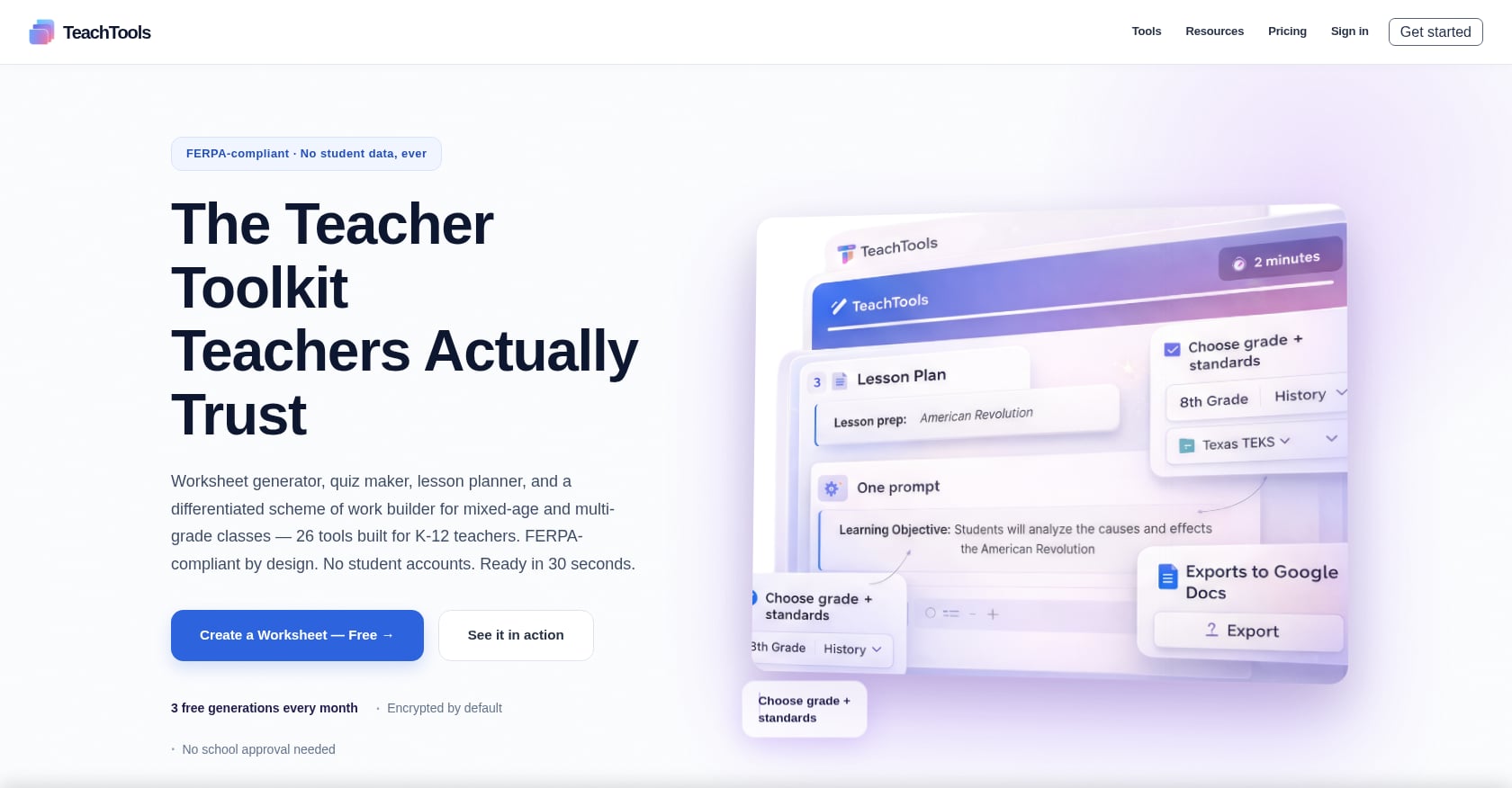
Try the Bingo generator free to see how this works. TeachTools offers 5 free generations per month across all its tools, with exports to PDF and Google Docs. No credit card required for the free tier.
For K–12 teachers concerned about using AI tools with student-adjacent materials, TeachTools doesn’t require student PII, uses AES-256 encryption at rest, and is designed to support FERPA compliance. You can also read this guide on using AI in the classroom without violating FERPA.
Tips for Using Printable Vocabulary Games Effectively
Printing a game isn’t a strategy. How you use it determines whether students actually retain the words. Here’s what the research and experienced practitioners recommend.
Pre-teach before play. Games reinforce vocabulary. They don’t introduce it. Follow Marzano’s first steps: provide a student-friendly definition, let students restate it, and have them create a drawing or visual before ever touching a game. The Science of Reading approach recommends being explicit, making vocabulary meaningful with rich contexts, and supporting learners with visuals, realia, and sentence frames.
Require writing first. The “no writing, no playing” rule is popular among experienced ESL teachers for good reason. Before a Bingo game, have students write each word’s definition in their own words. Before a crossword, have them use three target words in original sentences. This processing step converts passive recognition into active knowledge.
Rotate game types across a unit. Students remember vocabulary better when they learn it through activities instead of just reading and repeating. Games create emotional connections to words, and those feelings help lock meanings into long-term memory. A sample weekly rotation might look like this:
- Monday: Memory Match to introduce word-definition pairs
- Tuesday: Crossword puzzle for spelling and definition reinforcement
- Wednesday: Vocabulary Bingo for whole-class review
- Thursday: Taboo cards for circumlocution and synonym practice
- Friday: Discussion cards for contextual, spoken use
Five days, same 15 words, five different game formats. That’s spaced repetition built into your lesson plan without any extra planning.
Differentiate within the same game. ESL classes almost always have mixed proficiency levels. Rather than creating separate games, adjust the scaffolding. Give A1 students a word bank with their crossword while B2 students work without one. Add picture clues to Bingo cards for beginners and use definition-only clues for advanced learners. The game stays the same; the support level changes. For a comprehensive look at how to adapt activities for different levels, differentiation planning guides can help.
Frequently Asked Questions
What are the best printable ESL vocabulary games for beginners (A1)?
Vocabulary Bingo with picture cards, Memory Match with word-image pairs, word scrambles with short words, and “I Have, Who Has?” chains work best for A1 learners. These games require recognition rather than production, which is appropriate for early-stage vocabulary acquisition. Adding a word bank to crosswords or word searches also makes them accessible at this level.
How many vocabulary words should I include in a printable ESL game?
For a single game session, 10 to 20 words is the sweet spot. Fewer than 10 makes the game too short to be engaging. More than 20 overwhelms working memory, especially for English language learners processing words in a second language. If your unit has 30 words, split them across two game sessions or two different game types.
Can I use printable vocabulary games with adult ESL learners?
Absolutely. Adults respond well to Taboo, crossword puzzles, discussion cards, and board games. The key is framing. Avoid game names that sound childish and focus on the communicative challenge. Calling Taboo “Word Challenge” or Bingo “Vocabulary Review” makes the same activity feel appropriate for adult learners. Adult ESL classes at community colleges regularly use these formats.
How do I differentiate printable vocabulary games for mixed-level ESL classes?
Use the same game structure but adjust the scaffolding. Provide word banks for lower-level students while removing them for advanced learners. Use picture clues for beginners and definition-only clues for intermediate students. In Taboo, reduce the number of forbidden words for A2 players and increase them for B2 players. The game itself doesn’t change, only the level of support.
Are printable ESL vocabulary games backed by research?
Yes. Multiple studies support game-based vocabulary instruction. Hattie’s meta-analysis gives direct vocabulary instruction an effect size of 0.63. Research published through ERIC shows games improve vocabulary memorization in foreign language learning. A study in the International Journal of Academic Research and Business and Social Sciences found Bingo specifically produced significant vocabulary gains in young ESL learners.
How often should I use printable vocabulary games in my ESL class?
Two to three times per week, using different game types with the same vocabulary list, provides the spaced repetition that research shows drives long-term retention. Avoid using the same game format every day because novelty is part of what makes games effective. A weekly rotation (Bingo one day, crossword the next, Taboo later in the week) keeps engagement high.
Where can I find free ESL vocabulary games printable resources?
EnglishWsheets.com, ESL-Galaxy.com, ISL Collective, Teachers Pay Teachers (filtered by “free”), Sadlier, and Tools for Educators all offer free printable ESL vocabulary games. For custom games matched to your specific word list, TeachTools’ suite of tools lets you generate Bingo cards, crosswords, and worksheets with 5 free generations per month.
Do AI-generated printable games work as well as hand-made ones?
The learning outcome depends on the vocabulary, the game mechanics, and how the teacher uses them, not on whether a human or an AI arranged the words in a grid. AI generators have the advantage of speed and customization: you can produce a crossword puzzle matched to this week’s exact word list in under a minute. The pedagogical quality comes from the teacher’s pre-teaching, scaffolding, and follow-up, not from who typed the words into the grid.