15 Easter Traditions 2026: Global Activities for Classrooms
TL;DR
Easter traditions span religious observances, cultural customs, civic events, and family rituals across dozens of countries. This guide explains 15 traditions, from Holy Week services and egg decorating to Norwegian crime fiction and Bermuda kite flying, with their actual origins and a classroom activity for each. Public-school teachers can teach about Easter traditions academically without promoting religion, following U.S. Department of Education guidance.
Why Easter Traditions Reach Far Beyond Egg Hunts
Easter is a major Christian holy day. It is also a season wrapped in folk customs, family meals, civic events, candy, and community rituals that reach well beyond any single church. Among Americans celebrating Easter in 2026, the National Retail Federation reported that 56% planned to cook a holiday meal, 52% planned to visit friends and family, 43% planned to attend church, and 36% planned an egg hunt. Total Easter spending was expected to hit a record $24.9 billion.
That mix of sacred, secular, and seasonal is exactly what makes Easter traditions worth teaching. Not as a classroom party. Not as a religious observance. As a window into history, geography, art, food, folklore, and how communities around the world mark the arrival of spring.
Every tradition below includes its origins, what it actually means, and a classroom activity that connects to real learning goals.
Want to turn any tradition into a printable activity? Generate a worksheet in minutes by entering a topic, grade level, and subject.
Can Teachers Teach Easter Traditions in Public School?
Yes. The U.S. Department of Education is clear on this: public schools may teach about religious holidays, including their religious aspects, but may not observe holidays as religious events or promote religious observance.
The practical rule is teach about, don’t celebrate.
- Say: “Many Christians attend Easter services to celebrate the resurrection of Jesus.”
- Don’t say: “We celebrate Jesus rising today.”
- Say: “Some families decorate eggs as a symbol of new life.”
- Don’t assume: “Everyone decorates Easter eggs at home.”
Edutopia recommends starting every holiday lesson with the question “What is our educational purpose?” If the answer is cultural literacy, history, art, geography, or comparison, the lesson fits a public-school classroom.
Practitioners on Reddit report real disagreement about how far to go. In one teacher forum discussion, some educators treat egg hunts as harmless seasonal fun, while others say Easter activities can make non-Christian students feel left out or “othered.” Several teachers describe shifting from celebration-style activities to broader lessons about traditions from around the world.
A useful framework: test every activity against three questions.
- Curriculum. Does the activity connect to a real learning standard?
- Context. Is the tradition explained accurately and respectfully?
- Choice. Can students participate without violating family beliefs or being singled out?
If a family needs to opt out, have an alternative ready. A “spring traditions” or “family customs” version of the same assignment works in most cases. For more strategies, read about creating inclusive classrooms with practical approaches that apply to holiday lessons.
Need to notify families about a traditions lesson? Draft a family email explaining that the class is studying cultural customs, not holding a religious celebration.
Easter Traditions at a Glance
| Tradition | Region | Type | Best Classroom Use | Sensitivity Note |
|---|---|---|---|---|
| Holy Week and Easter services | Christian communities worldwide | Religious | Religious literacy, vocabulary | Teach about, don’t lead devotion |
| Egg decorating | Many countries | Cultural/seasonal | Art, symmetry, natural dye science | Consider allergies and cost |
| Egg hunts and baskets | U.S., Europe (German roots) | Cultural/seasonal | Direction writing, map skills | Some families opt out |
| Easter Bunny / Osterhase | German/Pennsylvania Dutch | Folklore | Source reliability, folklore vs. fact | Avoid unsupported pagan claims |
| White House Easter Egg Roll | United States | Civic | U.S. history, civics, primary sources | Civic tradition, not religious |
| Hot cross buns and Easter foods | U.K., U.S., many regions | Foodway/family | Food history, recipe math | Check allergy policies |
| Ukrainian pysanky | Ukraine/diaspora | Cultural/art | Art, geometry, symbolism | Don’t reduce to generic craft |
| Cascarones | Mexico/Mexican American/Texas | Cultural/family | Regional culture, compare traditions | Mess and safety concerns |
| Śmigus-Dyngus | Poland/diaspora | Folk/Easter Monday | Geography, compare customs | Teach it, don’t reenact it |
| Swedish Easter witches | Sweden | Folk/family | Compare with Halloween, card writing | Avoid costume stereotypes |
| Norwegian påskekrim | Norway | Literary/pop culture | Mystery writing, inference | Use age-appropriate content |
| Bermuda kite flying | Bermuda | Community/seasonal | STEM kite design, geometry | Needs outdoor space |
| Easter Bilby | Australia | Conservation/cultural | Ecology, persuasive writing | Not universal across Australia |
| Guatemala’s alfombras | Guatemala | Religious/art/community | Ephemeral art, patterns | Provide sacred context |
| Family meals and spending | U.S./global | Family/commercial | Data literacy, graphing | Don’t ask what families spend |
1. Holy Week and Easter Sunday Services
Best for: Social studies, religious literacy, vocabulary (grades 3 and up)
Easter’s religious core is the Christian celebration of Jesus’ resurrection. Many Christian communities observe Holy Week, which includes Palm Sunday, Maundy Thursday, Good Friday, the Easter Vigil, and Easter Sunday worship. The Vatican describes Easter as the “Feast of feasts” and the “Solemnity of solemnities.” The date is traditionally set as the Sunday after the first full moon after the vernal equinox, though Western and Eastern churches sometimes land on different dates because of calendar differences.
Not all Christians observe Easter the same way. Orthodox churches may use a different calendar. Some Protestant traditions emphasize sunrise services. Catholic and Anglican churches hold Easter Vigil liturgies on Saturday night.
Classroom activity: vocabulary classification
Give students a list of terms: Lent, Holy Week, Palm Sunday, Good Friday, Easter Sunday, Resurrection, Pascha, Vigil. Students define each and classify it as an event, practice, symbol, or time period.
Watch for:
- This is explicitly religious content. Keep it academic and neutral.
- Don’t ask students to pray, recite beliefs, or identify their own religion publicly.
- In public schools, present the information the same way you’d present any world religion unit.
2. Decorating Easter Eggs
Best for: Elementary art, science, patterning, cultural comparison (grades K and up)
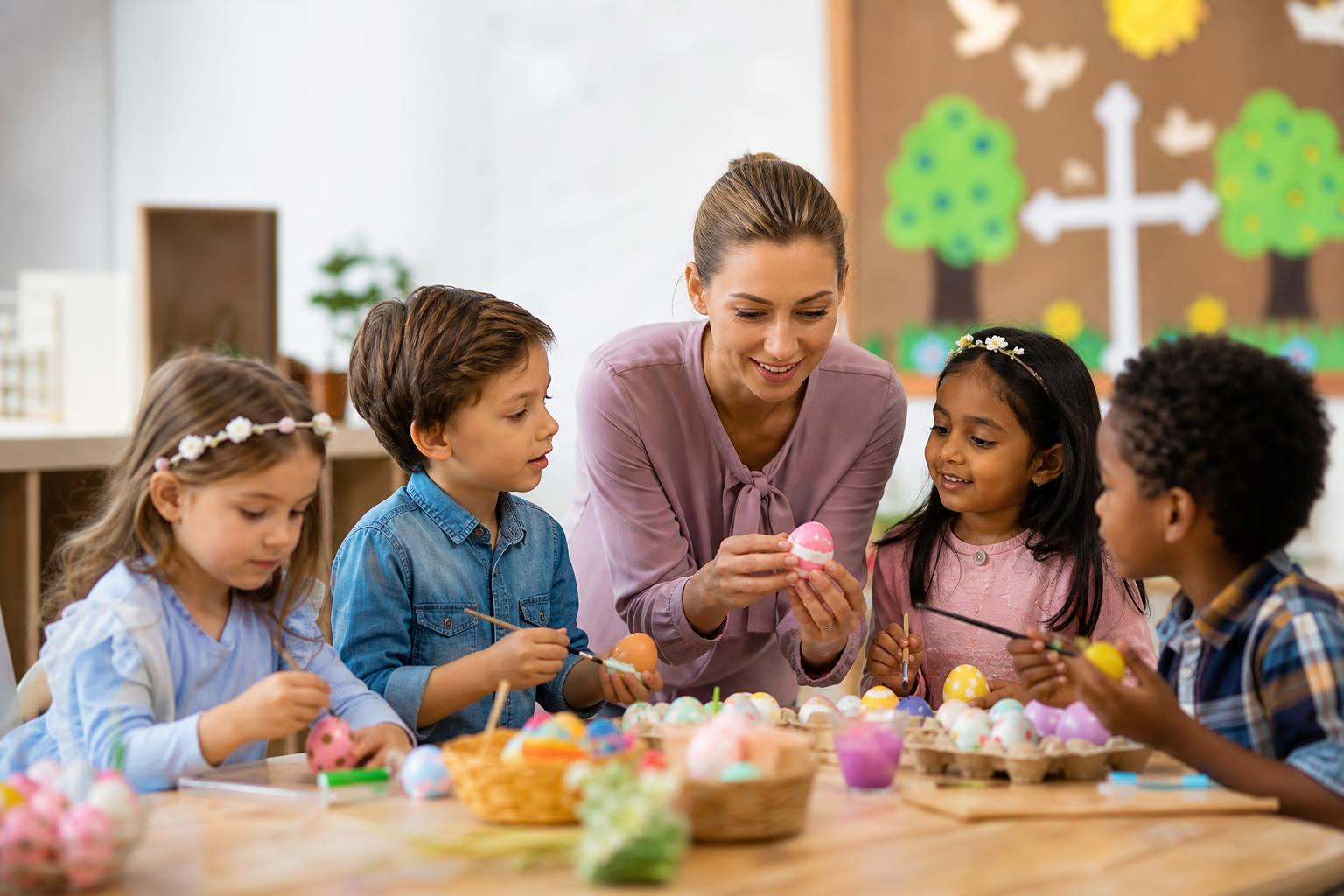
Decorating eggs is one of the most recognizable Easter traditions worldwide. Eggs are widely associated with new life and spring, and in Christian interpretation, with resurrection. But egg decorating long predates modern Easter customs. The Library of Congress describes it as an ancient art and notes that Ukrainian Easter egg traditions preserve cultural symbolism once common across Eurasia.
Today, families dye eggs with food coloring, vinegar baths, or natural ingredients like turmeric, beet juice, onion skins, and blueberries. In the classroom, natural dye experiments offer a surprisingly good STEM connection: students can observe how pH, temperature, and soaking time affect color.
Classroom activity: natural dye investigation (or paper version)
If your school allows, prepare teacher-led dye samples and let students chart color changes over time. If not, use paper egg templates where students create a pattern egg, a symbol egg, or a geography egg based on a specific country’s tradition.
Watch for:
- Real eggs create allergy, cost, refrigeration, and food waste issues.
- Some families avoid Easter activities entirely. Paper eggs or “spring symbol design” prompts are safer.
- Teachers on Reddit debate whether egg activities feel secular or exclusionary; several recommend reframing them as standards-based or traditions-comparison activities.
3. Easter Egg Hunts and Baskets
Best for: Direction writing, map skills, vocabulary review, classroom movement (grades K to 5)
Egg hunts and Easter baskets are staple family traditions in the U.S. and parts of Europe. The custom of children finding hidden eggs connects to the Easter Bunny/Osterhase tradition, in which a hare was said to leave eggs in nests or baskets that children prepared.
The modern egg hunt is more about fun than folklore. But it can also become a real writing and math lesson.
Classroom activity: “Where’s My Egg?” direction hunt
Students hide a paper or cardboard egg somewhere in the classroom, write step-by-step directions to its location, and then have a partner follow the directions. This turns a seasonal custom into a procedural-writing lesson. Variations include vocabulary clue hunts, math fact hunts, and “traditions around the world” station rotations.
Watch for:
- Avoid candy unless school policy allows it.
- Offer non-Easter language if needed: “spring clue hunt” or “symbol hunt.”
- One teacher forum thread specifically pushed back on egg hunt pressure, noting that celebrations shouldn’t require teachers to spend their own money. Keep it low-cost.
4. The Easter Bunny and Osterhase
Best for: Folklore, source reliability, immigration history, myth vs. evidence (grades 3 and up)
The Easter Bunny is a folklore figure, not a biblical one. The strongest historical evidence points to German and Pennsylvania Dutch traditions around the Easter Hare, called Oschter Haws or Oster Haas. The Library of Congress notes that the early Pennsylvania Dutch tradition featured a hare (not a rabbit) that left eggs for children in nests they had prepared.
Many online articles claim the Easter Bunny descends directly from a pagan goddess. That claim is weaker than it looks. Contributors on r/AskHistorians repeatedly caution that Bede’s brief reference to Eostre does not include eggs, rabbits, baskets, or any of the modern symbols people try to trace back to it. The Easter Bunny evidence points to early modern German folklore, not a simple ancient survival.
Classroom activity: “Fact, folklore, or unsupported claim?”
Give students four statements and ask them to classify each:
- “The Easter Bunny is in the Bible.” (Unsupported)
- “The Easter Bunny connects to German folklore.” (Supported)
- “Every Easter symbol comes from one pagan goddess.” (Unsupported)
- “Pennsylvania Dutch families had Easter Hare traditions.” (Supported)
This is a strong source-reliability exercise for grades 5 and up.
Watch for:
- Don’t present speculative pagan-origin claims as settled fact.
- This tradition works well as a media literacy lesson because so much misinformation circulates online.
5. The White House Easter Egg Roll
Best for: U.S. history, civics, primary source analysis, PE (grades 2 and up)
The White House Easter Egg Roll is one of the oldest annual events at the White House. The National Park Service traces it to 1878, when Congress restricted egg rolling on Capitol grounds and President Rutherford B. Hayes allowed children to use the White House lawn instead.
It started as an informal community gathering and evolved into a large civic tradition with celebrity guests, reading nooks, and themed activities.
Classroom activity: civic tradition timeline
Students create a mini-timeline: 1870s Capitol egg rolling, 1876 Capitol grounds restriction, 1878 Hayes opens White House grounds, modern-day Easter Egg Roll. Then they answer: “How can a children’s game become a national civic tradition?”
Watch for:
- This is U.S.-specific. Balance it with global traditions.
- It works well as a civics sidebar rather than the centerpiece of an Easter lesson.
6. Hot Cross Buns and Easter Foods
Best for: Foodways, family traditions, recipe math, fractions, cultural geography (all grades)
Easter food traditions vary enormously by country, region, religion, and family. In the U.S., eggs, ham or lamb, and hot cross buns have been recurring Easter favorites for generations. English Heritage explains that one theory links hot cross buns to medieval monks stamping bread with a cross to mark the religious occasion.
Reddit food discussions show wide variation even within a single country. Some families eat lamb, ham, deviled eggs, or regional Easter breads. Others don’t have a formal Easter meal at all.
Classroom activity: Easter foodways map
Students read short cards about five Easter foods (hot cross buns, lamb, Easter bread, fish cakes, butter lambs). They map each food’s region and classify it as religious, regional, family-based, or commercial.
Watch for:
- Avoid eating in class unless school policy permits it.
- Include allergy-safe and non-food alternatives.
- Let students discuss “a family meal or gathering tradition” rather than assuming everyone has Easter dinner.
7. Ukrainian Pysanky
Best for: Art, geometry, cultural heritage, symbolism, diaspora studies (grades 3 and up)
Pysanky are Ukrainian Easter eggs decorated using a wax-resist method. UNESCO lists pysanka traditions as intangible cultural heritage, noting that the practice is deeply rooted in Ukrainian identity and meaningful to Ukrainians regardless of religion. The process involves applying symbols with wax, dipping the egg into dye, and repeating the process for layered colors and designs.
This is not the same thing as dyeing eggs with a kit from the grocery store. Pysanky carry specific symbols (trees of life, suns, animals, geometric motifs) with cultural meanings passed through generations.
Classroom activity: paper pysanky design
Students do not need real wax-resist materials. Instead, they study three pysanky motifs, design a paper egg using at least three symbols, and write a key explaining each symbol’s meaning.
Watch for:
- Don’t reduce pysanky to “pretty Easter eggs.” Explain that this is a living cultural tradition with specialized tools and techniques.
- If possible, use Ukrainian museum or UNESCO sources rather than generic craft blogs.
- Reddit discussions among people seeking pysanky supplies mention beeswax, kistka tools, and dyes, showing that a classroom paper version should not pretend to fully replicate the real process.
8. Cascarones
Best for: Regional culture, Mexican American traditions, fine motor skills, compare and contrast (grades K and up)
Cascarones are hollowed eggshells filled with confetti, common in Mexican and Mexican American celebrations including Easter. They are especially familiar in Texas and the Southwest.
The tradition is simple: save eggshells, fill them with confetti, seal with tissue paper, and crack them over someone’s head during celebrations for good luck. In practice, it is messy and fun.
Classroom activity: compare two egg traditions
Students compare cascarones, Ukrainian pysanky, U.S. dyed eggs, and (optionally) Greek red eggs. Comparison categories: materials, purpose, region, timing, and how the egg is handled after decorating.
Watch for:
- Real cascarones can be messy, and some kids crack them too hard. Paper confetti envelopes or a photo-based comparison are safer for classroom settings.
- Texas Reddit threads show cascarones remain a familiar local Easter custom but surface practical concerns about preparation and cleanup.
- This pairs well with a geography lesson about Mexican American cultural traditions in the U.S. Southwest.
9. Śmigus-Dyngus (Wet Monday)
Best for: Geography, world cultures, discussion of consent and changing traditions (grades 3 and up)
In Poland and Polish diaspora communities, Easter Monday brings Śmigus-Dyngus, also called Lany Poniedziałek or Wet Monday. People pour water on each other to close the Easter holiday with laughter and joy.
Users in r/Poland describe the tradition as well known but note that modern practice varies. Some families and communities participate enthusiastically. Others consider it outdated.
Classroom activity: tradition adaptation discussion
Students answer four questions: What is the tradition? What might make it fun in its original context? Why would it be inappropriate to reenact in a classroom? How could we represent it respectfully instead?
Watch for:
- Do not reenact water throwing in class.
- This is a good opportunity to discuss consent and how traditions evolve over time.
- Avoid presenting it as something “all Polish people do the same way.”
10. Swedish Easter Witches
Best for: Folklore, compare and contrast, letter writing, cultural geography (grades K and up)
In Sweden, children dress as påskkärring (Easter witches), wearing colorful old clothes, and go door to door exchanging homemade drawings or Easter letters for sweets. Visit Sweden describes the practice as beginning in western Sweden in the early 19th century before spreading nationwide.
Modern Swedish Easter is largely secularized, blending Christian, folkloric, and older seasonal customs. The Easter witch tradition is one of the most distinctive.
Classroom activity: compare two door-to-door traditions
Students compare Swedish Easter witches with Halloween trick-or-treating, caroling, or Lunar New Year greetings. Prompt: “How do children participate in community traditions across cultures?”
Watch for:
- Avoid “witch costume day” in public school unless your school culture supports it.
- Focus on the card exchange and folklore comparison, not costumes.
- This pairs well with a unit on festive activities that span multiple holidays and cultures.
11. Norwegian Påskekrim
Best for: Middle school ELA, inference, mystery writing, media literacy, genre study (grades 5 and up)
In Norway, Easter is strongly associated with påskekrim, or Easter crime fiction. Visit Norway describes reading crime stories during Easter as normal, often paired with cabin holidays, skiing, chocolate, and oranges. The Norsk Folkemuseum traces the tradition’s origin story to 1923, when a crime novel publisher ran an ad that looked like a real front-page train robbery headline. It worked so well that crime fiction and Easter became permanently linked in Norwegian culture.
Reddit users in r/Norway recognize påskekrim as a modern tradition with a marketing origin, not an ancient custom. That makes it useful for media literacy and advertising discussions too.
Classroom activity: write a classroom-safe mystery blurb
Students write a mysterious headline, three clues, one red herring, and a solution paragraph. Keep it nonviolent for younger students: missing library books, vanished pencils, mystery footprints, or secret codes.
Watch for:
- Avoid violent crime content for elementary students. Use “mystery” rather than “murder.”
- This is an unexpectedly high-interest tradition that gets strong engagement from older students.
12. Bermuda Kite Flying
Best for: STEM, engineering design, wind and weather, geometry, art (grades 2 and up)
In Bermuda, Good Friday means making and flying kites. Families gather at beaches, parks, and community clubs to launch colorful handmade kites. One local tradition holds that the kite’s upward flight symbolizes Christ’s ascension.
A Bermuda Reddit event thread about Good Friday mentions kites alongside fish cakes, hot cross buns, and family time, showing the tradition is part of a wider community holiday weekend.
Classroom activity: mini kite engineering challenge
Students design paper kites and test shape, tail length, symmetry, weight, and stability. If outdoor flying is not possible, students build a prototype and explain their design choices.
Watch for:
- Outdoor flying needs space and weather.
- Include cultural context. Don’t just make kites without explaining Bermuda’s Easter connection.
- This works well as a cross-curricular STEM and social studies activity.
13. Australia’s Easter Bilby
Best for: Ecology, invasive species, conservation, persuasive writing (grades 3 and up)
In Australia, the Easter Bilby is a conservation-minded alternative to the Easter Bunny. The Australian Museum says bilbies appearing in Easter celebrations and chocolate stores can raise awareness for the threatened species. Australia’s environment minister has described the Greater Bilby as at risk from habitat loss, feral cats, foxes, and fire.
The reasoning makes ecological sense. Rabbits are an invasive species in Australia, responsible for massive agricultural and environmental damage. Promoting a native endangered animal instead of a destructive imported one is a conservation statement.
Australian Reddit discussions show awareness of Easter Bilbies but note the tradition is not universal across Australia. One r/Bluey discussion mentions that chocolate bilbies raised awareness and funds for bilby conservation, while another user says not all parts of the country follow the custom.
Classroom activity: persuasive paragraph
Students read a short passage about rabbits as invasive species in Australia and bilby conservation. Then they write a persuasive paragraph: keep the bunny, promote the bilby, use both, or create a local endangered-species spring symbol.
Watch for:
- Don’t claim all Australians celebrate with the Easter Bilby.
- Present it as a conservation movement and cultural alternative.
14. Guatemala’s Alfombras
Best for: Art, ephemeral art, community traditions, patterns, Latin America geography (grades 3 and up)
During Semana Santa in Guatemala, communities create colorful alfombras (carpets) from dyed sawdust, flowers, fruit, and other materials along procession routes. The Smithsonian describes families and neighbors spending hours making elaborate carpets on streets in front of their homes. UNESCO recognizes Guatemala’s Semana Santa as intangible cultural heritage involving processions, vigils, flower carpets, and altars.
The alfombras are temporary by design. Processions walk over them, and they’re swept away. That impermanence is part of the tradition’s meaning: the labor and beauty are an offering, not a decoration meant to last.
Classroom activity: ephemeral art design
Students create a temporary collaborative “carpet” on paper or with cut paper shapes. They explain pattern choices, color symbolism, and how temporary art can still be meaningful.
Watch for:
- Don’t treat sacred processional art as generic decoration.
- Avoid copying explicitly religious imagery without context.
- Use geometric or nature-inspired designs in public-school settings.
15. Family Meals, Candy, and Easter Spending
Best for: Data literacy, bar graphs, percentages, consumer culture, economics (grades 4 and up)
Many Easter traditions today are family and consumer traditions as much as religious or folk customs. The National Retail Federation’s 2026 data breaks this down clearly: $7.5 billion on food, $3.9 billion on gifts, $3.7 billion on clothing, $3.5 billion on candy, and $2.2 billion on flowers.
This is a goldmine for data literacy.
Classroom activity: graph Easter traditions data
Students use the NRF percentages (56% cooking a meal, 52% visiting family, 43% attending church, 36% egg hunts) to create a bar graph, rank the activities, write two observations, and discuss which traditions are religious, family-based, commercial, or seasonal.
Watch for:
- Avoid asking students what their families spend.
- Don’t make candy the center of the lesson.
- Use public data, not personal family comparison.
- One LinkedIn practitioner in early childhood education describes the best holiday lessons as family-aware and student-centered, avoiding assumptions about how anyone celebrates.
How to Adapt Easter Traditions by Grade Level
Explore 26 free AI tools for teachers
Browse All Tools →The 15 traditions above work across grade bands, but the activities should match student readiness.
K to 2
Picture cards, symbol sorting, pattern eggs, read-aloud discussions, and optional “my family has a tradition” drawings. Focus on visual and hands-on activities. The Swedish Easter witches card exchange and Bermuda kite building work especially well here.
Grades 3 to 5
Compare two traditions using a graphic organizer. Map Easter customs around the world. Run a vocabulary clue hunt. Use natural dye observation charts. This is the sweet spot for the comparison table and foodways map.
Grades 6 to 8
Folklore vs. evidence (Easter Bunny origins). Primary and secondary source comparison. Mystery writing inspired by påskekrim. Civic history of the White House Egg Roll. Conservation arguments around the Easter Bilby. These activities connect directly to ELA, social studies, and science standards.
Grades 9 to 12
Religion and public schools discussion. Consumer spending data analysis. Comparative religion or culture essays. Folklore source reliability. UNESCO cultural heritage case studies. Students at this level can handle the nuance of why claims about Easter’s “pagan origins” are more complicated than viral posts suggest.
For more ideas on elementary-level planning, check out lesson plan ideas that include seasonal and cross-curricular approaches.
Ready to build a complete lesson? Create a lesson plan by entering a topic and grade level, and get a full plan with objectives, activities, and assessments.
Frequently Asked Questions
What are the most common Easter traditions?
The most common Easter traditions in the U.S. include attending church services, cooking a holiday meal, visiting friends and family, decorating eggs, Easter egg hunts, and filling Easter baskets. The National Retail Federation’s 2026 data shows cooking a meal (56%) and visiting family (52%) as the top two planned activities among those celebrating.
Why do people decorate eggs at Easter?
Eggs are widely associated with new life and spring. In Christian interpretation, they also symbolize resurrection. Egg decorating has deep roots across many cultures. The Library of Congress notes that traditions like Ukrainian pysanky preserve cultural symbolism that was once common across Eurasia. Modern egg dyeing with vinegar and food coloring is a much simplified version of a very old art form.
Is the Easter Bunny a religious figure?
No. The Easter Bunny is a folklore figure, not a biblical one. The best-supported historical trail connects it to German and Pennsylvania Dutch Easter Hare (Osterhase) traditions. Historians caution against claiming the Easter Bunny descends directly from an ancient pagan goddess, as that evidence is thinner than many online articles suggest.
Can public-school teachers do Easter activities?
They can teach about Easter traditions academically and cover secular aspects, but they should not observe Easter as a religious event or promote devotional practice. The safest approach is to frame lessons around cultural literacy, history, geography, art, and comparison. Offer alternatives for students who don’t celebrate. For guidance on using AI to build compliant classroom materials, see how to use AI without violating FERPA.
What are some unusual Easter traditions around the world?
Norwegian Easter crime fiction (påskekrim), Swedish Easter witches (påskkärring), Bermuda Good Friday kite flying, Australia’s Easter Bilby, Polish Wet Monday (Śmigus-Dyngus), Mexican American cascarones, and Guatemalan sawdust carpets (alfombras) are all real Easter traditions that most U.S. students have never heard of. Each one opens a different classroom door into geography, art, ecology, folklore, or literature.
How can I teach Easter traditions without excluding non-Christian students?
Start with the 3C test: curriculum connection, cultural context, and student choice. Never assume every student celebrates Easter. Offer “spring traditions” or “family customs” alternatives for any assignment. Focus on comparison and cultural literacy rather than participation in any single tradition. Teachers on Reddit consistently recommend making holiday units academic rather than celebratory.
What Easter classroom activities don’t require food or money?
Paper egg design, vocabulary clue hunts, compare-and-contrast graphic organizers, folklore fact-checking, mystery writing (inspired by Norwegian påskekrim), tradition mapping, and persuasive paragraphs about the Easter Bilby all cost nothing and avoid food entirely. Teachers in online forums specifically push back on the expectation to personally fund classroom holiday activities, and these alternatives respect that boundary.
Making Easter Traditions Work in Your Classroom
Easter traditions are richer than one egg hunt or one coloring page. They can open short lessons on religion, folklore, food, art, civic life, conservation, geography, and family culture. The key is to teach them with context, choice, and a clear learning purpose. Pick two or three traditions from this list, compare them, and give students a way to show what they learned through a map, writing piece, art analysis, or discussion.
If you want to save prep time, explore TeachTools to turn any of these traditions into a printable worksheet, quiz, or full lesson plan for your grade level.